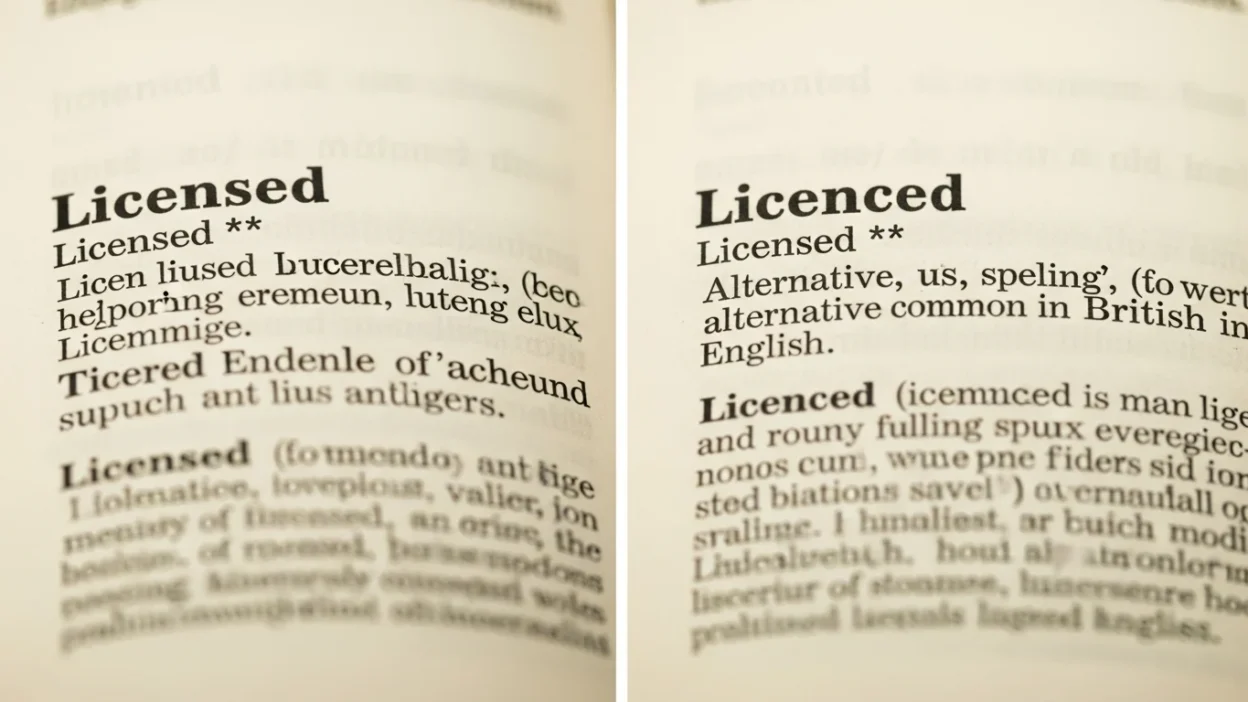
Many English learners and even native speakers get confused when they see the words “licensed” and “licenced.” They look almost the same, but the spelling is slightly different. Some people think they are two different words with different meanings. Others are not sure which one is correct.
This confusion happens because English has different spelling styles in different countries. Both words are used in real life, but not in the same way everywhere. In this article, you will learn the clear and simple truth so you never get confused again.
Quick Answer: Licensed vs Licenced
Here is the simple answer in very easy points:
- “Licensed” is the most common spelling in American English.
- “Licenced” is used in British English (but less common today).
- Both words mean the same thing.
- Both come from the same word: license/licence.
- Meaning: officially allowed, approved, or given permission.
👉 So, the difference is NOT meaning. The difference is only spelling style.
Origin and Background (Simple History)
The words come from the noun “license” (US) or “licence” (UK).
In English:
- Some countries changed spelling over time.
- American English made spelling simpler.
- British English kept older spellings in many cases.
That is why:
- In the United States, people write:
- license (noun and verb)
- licensed (past form / adjective)
- In the United Kingdom, people often write:
- licence (noun)
- license (verb)
- licenced (past form / adjective, though “licensed” is also widely used now)
Over time, global English became more influenced by American spelling, so “licensed” is now more common worldwide.
Clear Explanation of the Difference
Even though they look different, the meaning stays the same.
1. Licensed
- Common in American English
- Used as past form or adjective
- Example meaning: officially approved or allowed
2. Licenced
- Traditional British English spelling
- Same meaning as “licensed”
- Less common in modern writing
Important Point
There is no meaning difference at all.
They both mean:
- approved by authority
- legally allowed
- officially permitted
Comparison Table (Easy View)
| Feature | Licensed | Licenced |
| English style | American English | British English (traditional) |
| Meaning | Same | Same |
| Usage today | Very common | Less common |
| Verb form | Yes | Yes |
| Adjective form | Yes | Yes |
| Global usage | Most preferred | Rare but still used |
Which One Should You Use and When?
If you are a student or ESL learner, this rule will help you:
Use “licensed” when:
- You are writing for school
- You are writing formal documents
- You are using American English
- You are unsure which to choose
- You are writing for global readers
👉 This is the safest choice.
Use “licenced” when:
- You are specifically writing British English
- Your teacher or book uses British spelling
- You are following UK-style writing rules
👉 But even in the UK, “licensed” is now very commonly accepted.
Simple rule:
If you are confused, always choose licensed.
Common Mistakes People Make
Many learners make small mistakes with these words. Here are the most common ones:
1. Thinking they have different meanings
Wrong idea: licensed = different meaning than licenced
Correct idea: both mean the same thing
2. Mixing spelling in one text
Some people write:
- “licenced” in one sentence
- “licensed” in another
This looks unprofessional.
3. Using both without consistency
Good writing should stay consistent in one style.
4. Confusing “license” and “licensed”
Remember:
- license/licence = noun or verb base form
- licensed/licenced = past form or adjective
5. Overthinking the spelling
Many learners waste time trying to memorize both. In reality, you only need to remember one: licensed.
Everyday Real-Life Examples
Let’s see how these words are used in daily life.
1. Driving situation
- He is a licensed driver.
- (Meaning: he has official permission to drive)
2. Doctor or professional
- She is a licensed doctor.
- (Meaning: she is officially approved to work as a doctor)
3. Business use
- This is a licensed restaurant.
- (Meaning: it has legal permission to operate)
4. Email example
- “Please ensure the software is licensed before installation.”
5. Social media example
- “Only licensed music can be used in videos.”
6. News style sentence
- “The company hired a licensed engineer for the project.”
In all these examples, you can safely use licensed.
Short Learning Section for Beginners
Let’s make it super simple:
Think of it like this:
- Licensed = modern, global, safe choice
- Licenced = old British style
Memory trick:
👉 “Licensed = I can use it everywhere”
If you remember this one idea, you will never confuse it again.
FAQ: Licensed vs Licenced
1. Are licensed and licenced different words?
No. They are the same word with different spellings.
2. Which spelling is correct?
Both are correct, but “licensed” is more commonly used today.
3. Why are there two spellings?
Because British and American English developed different spelling rules.
4. Is licenced wrong?
No, it is not wrong. It is just less common in modern English.
5. Should I always use licensed?
Yes, if you are unsure, use “licensed.” It works in most situations.
6. Do they have different meanings in law or business?
No, they always mean officially approved or permitted.
7. Which one should students learn first?
Students should learn “licensed” first because it is more widely used.
8. Can I mix both in one essay?
It is better not to mix them. Choose one style and stay consistent.
Conclusion
The confusion between licensed and licenced is very common, but the truth is simple. Both words mean the same thing: something is officially approved or permitted. The only difference is spelling style.
- Licensed is the modern and widely used form.
- Licenced is the traditional British spelling.
If you are learning English, writing assignments, or using English in daily life, the safest and easiest choice is licensed.