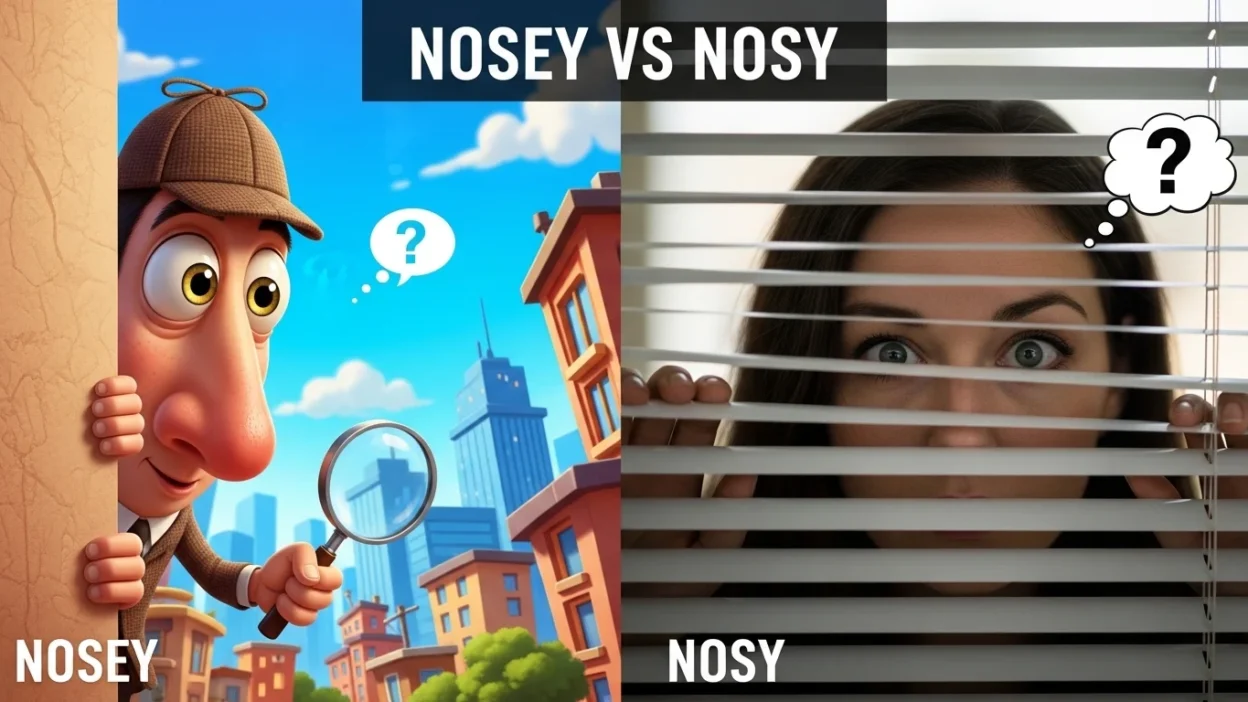
Many English learners and even native speakers get confused between “nosey” and “nosy.” They look almost the same, and they sound the same when spoken. Because of this, people often wonder:
- Which spelling is correct?
- Do they have different meanings?
- Is one wrong?
The truth is simple: both words mean the same thing. The confusion only comes from spelling differences. In this article, you will learn everything in very easy English so you never mix them up again.
Quick Answer (Simple Points)
Here is the fastest way to understand:
- Nosy = the most common and standard spelling
- Nosey = an older or less common spelling
- Both words mean: a person who is too interested in other people’s private life
- There is no difference in meaning
- “Nosy” is preferred in modern English writing
👉 So, if you are unsure, always use nosy.
Origin and Background (Very Simple History)
The word comes from the noun “nose.”
Long ago, people used the idea of “putting your nose into other people’s business.” This means someone is trying to know private things that are not their concern.
From this idea:
- “nose” → “nosy” (adjective form)
- “nosey” appeared later as an alternative spelling
Over time, English speakers started using “nosy” more often, especially in books, newspapers, and modern writing.
So today:
- Nosy = modern standard form
- Nosey = older/less common form
But both are still understood everywhere.
Clear Explanation of the Difference
Even though the meaning is the same, the difference is about usage and spelling style.
1. Nosy
- Most accepted spelling today
- Used in schools, exams, and formal writing
- Found in dictionaries as the main form
- More common in American and modern British English
2. Nosey
- Older spelling
- Still used in casual writing or informal speech
- Sometimes used in British English conversations
- Not wrong, but less preferred in formal writing
👉 Simple rule:
If you are writing an essay, email, or exam, use nosy.
Comparison Table (Easy View)
| Feature | Nosy | Nosey |
| Meaning | Same | Same |
| Correctness | Standard modern spelling | Acceptable but less common |
| Usage | Formal + informal | Mostly informal |
| Popularity | Very common | Less common |
| Writing style | Preferred today | Old-style spelling |
| Exam use | Recommended | Not recommended |
Which One to Use and When
Choosing between them is very easy if you follow this simple guide:
Use “nosy” when:
- Writing school essays
- Writing emails
- Doing exams
- Writing articles or formal text
- Talking about modern English
You may see “nosey” when:
- Reading old books or stories
- Seeing casual social media posts
- Hearing informal speech in some regions
👉 Best advice:
Always choose nosy to stay safe and correct in most situations.
Common Mistakes People Make
Many learners make simple mistakes with these words:
1. Thinking they have different meanings
Both words mean exactly the same thing, but people think they are different. This is not true.
2. Using “nosey” in exams
Some students write “nosey” in exams and lose marks. Teachers usually prefer “nosy.”
3. Overthinking the spelling
People waste time trying to find a hidden difference. There is none.
4. Mixing pronunciation
Both are pronounced the same way:
👉 /ˈnəʊ.zi/
So pronunciation does not help you tell them apart.
Everyday Real-Life Examples
Let’s see how the word is used in daily life.
1. Talking about a person
- “My neighbor is very nosy. She always asks about my family.”
2. At school
- “Don’t be nosy during the test. Focus on your paper.”
3. Social media comment
- “Why are you so nosey about their relationship?”
4. Friendly conversation
- “I don’t want to be nosy, but what happened yesterday?”
5. News or writing
- “Journalists should not be nosy about private lives.”
👉 Notice: In real life, both spellings appear, but nosy is more common in writing.
Short Learning Section for Students and Beginners
Let’s make it super easy to remember.
Think of it like this:
- Nosy = New and Normal
- Nosey = Old and Optional
Memory trick:
👉 “Nosy is now standard.”
Quick practice:
Fill in the blank:
- Don’t be so ______ about my phone.
- She is a very ______ neighbor.
- I don’t want to sound ______, but what happened?
Answers:
- nosy
- nosy
- nosy
FAQs (Frequently Asked Questions)
1. Is “nosey” wrong?
No, it is not wrong. It is just less common today.
2. Which spelling is correct in exams?
“Nosy” is the safest and most accepted spelling.
3. Do both words mean the same thing?
Yes, both mean someone who is too interested in other people’s private life.
4. Why are there two spellings?
Because English changed over time. “Nosey” is older, and “nosy” became the modern standard.
5. Which one should I use in writing?
Use “nosy” in most writing situations.
6. Are they pronounced differently?
No, both are pronounced the same: noh-zee
7. Can I use “nosey” in conversation?
Yes, but “nosy” is still more common and widely understood.
8. Is “nosy” American or British English?
It is used in both. It is the standard spelling in modern English everywhere.
Conclusion
The difference between “nosy” and “nosey” is very simple. Both words mean the same thing, and both describe someone who is too interested in other people’s private matters.
The only real difference is spelling style:
- Nosy = modern, standard, and widely accepted
- Nosey = older, less common, but still understandable
If you remember just one thing, remember this:
👉 Always use nosy in writing, exams, and daily communication.
Now you can confidently use the word without confusion and understand it clearly whenever you see it in books, social media, or conversations.