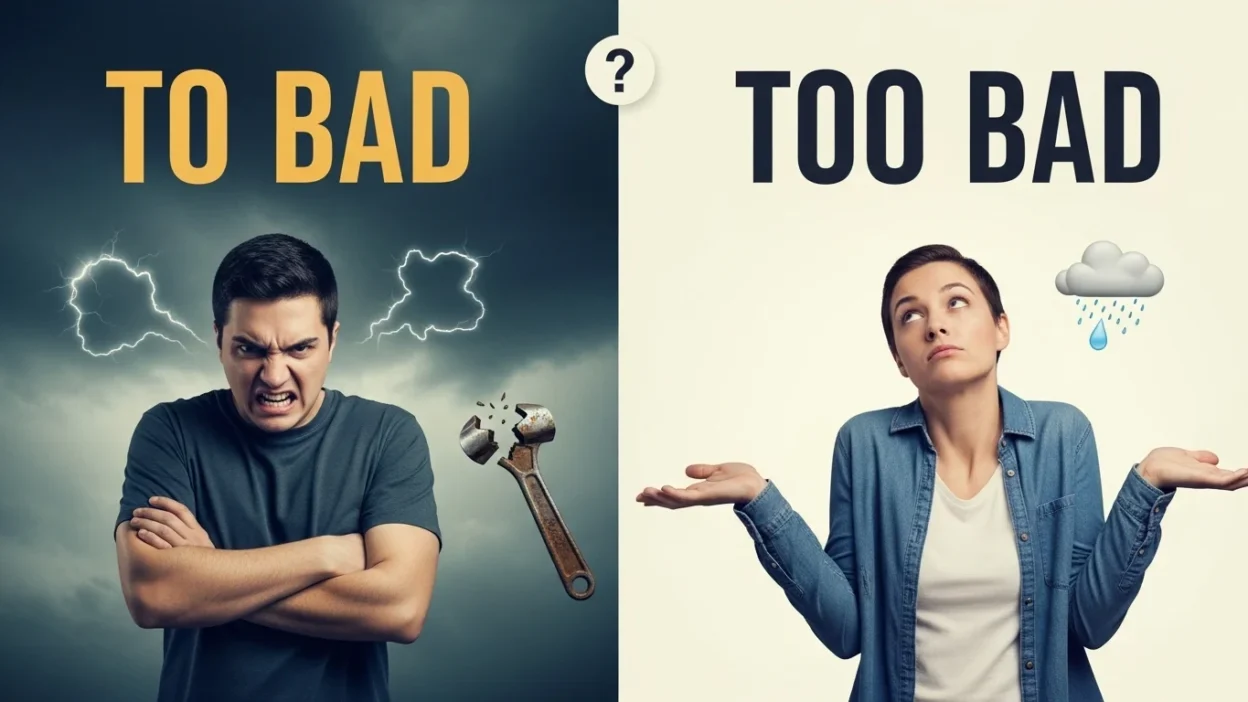
Many learners feel confused when they see “to bad” and “too bad.” They look almost the same, but they do not mean the same thing at all. This small difference can change the meaning of a sentence.
The good news is that once you understand one simple rule, the confusion will disappear. This guide will explain everything in very easy English so you can understand it quickly and use it correctly in your daily life.
Quick Answer
Here is the short and simple answer:
- “Too bad” = correct
- Means something is sad, unfortunate, or disappointing
- Example: It’s too bad you missed the party.
- “To bad” = incorrect (in most cases)
- It is not a proper phrase
- Usually a mistake people make
Simple Background Explanation
Let’s break the words:
- “To”
- A small word used for direction or purpose
- Example: I am going to school.
- “Too”
- Means “very” or “more than needed”
- Example: It is too hot today.
- “Bad”
- Means something is not good
- Example: This is a bad idea.
Now when we combine them:
- “Too bad” = very unfortunate / sad situation
- “To bad” = does not make sense in normal English
Clear Explanation of the Difference
1. What does “Too Bad” mean?
“Too bad” is a common English expression. It is used when something is disappointing, unlucky, or sad.
Examples:
- It’s too bad the shop is closed.
- That’s too bad you lost your phone.
- Too bad we can’t go today.
It often shows sympathy or mild sadness.
2. What about “To Bad”?
“To bad” is usually wrong. It happens when someone mixes up “to” and “too.”
Wrong examples:
- ❌ It’s to bad you are late.
- ❌ That’s to bad.
Correct versions:
- ✔ It’s too bad you are late.
- ✔ That’s too bad.
Comparison Table
| Feature | Too Bad | To Bad |
| Correct usage | Yes | No (usually incorrect) |
| Meaning | Something sad or unfortunate | No clear meaning |
| Common use | Daily conversation | Mistake in writing |
| Example | It’s too bad you missed it | ❌ It’s to bad you missed it |
Which One to Use and When
Use “Too Bad” when:
- Something did not go well
- You feel sorry for someone
- A situation is disappointing
Examples:
- It’s too bad the movie was boring.
- Too bad we didn’t meet earlier.
- That’s too bad for him.
Do NOT use “To Bad”
There is almost no situation where “to bad” is correct as a phrase.
Instead, always check:
- If you mean “very” → use too
- If you mean direction or purpose → use to
Common Mistakes People Make
Here are mistakes learners often make:
1. Mixing “to” and “too”
- ❌ It’s to bad
- ✔ It’s too bad
2. Forgetting the meaning of “too”
Many people forget that “too” means “very” or “extra.”
- ✔ too hot
- ✔ too cold
- ✔ too bad
3. Typing errors
Sometimes people type fast and write “to” instead of “too.”
Tip: Always double-check your writing.
4. Thinking both are correct
Some learners think both forms are okay.
But remember:
👉 Only “too bad” is correct.
Everyday Real-Life Examples
1. In Emails
- It’s too bad I cannot attend the meeting.
- That’s too bad, I was really interested.
2. In Text Messages
- Too bad you’re not coming!
- Aw, too bad!
3. On Social Media
- Too bad the event got canceled.
- That’s too bad for the team.
4. In Daily Conversations
- Too bad we missed the bus.
- It’s too bad you’re sick.
5. In News Style
- It’s too bad the project failed.
- Too bad the weather ruined the game.
Simple Learning Section for Students
Here is an easy way to remember:
Trick 1: “Too” = “Very”
If the sentence means “very bad,” use too bad.
- Too bad = very unfortunate
Trick 2: Replace “too” with “very”
Try this:
- It’s too bad → It’s very bad ✔
- It’s to bad → It’s very bad ❌ (doesn’t fit)
Practice Sentences
Fill in the blank:
- It’s ___ bad you missed class.
- That’s ___ bad we can’t go.
- It’s ___ bad the shop is closed.
Answers:
- too
- too
- too
FAQ Section
1. Is “to bad” ever correct?
No, not as a phrase. It is almost always a mistake.
2. What does “too bad” mean?
It means something is sad, unlucky, or disappointing.
3. Can I use “too bad” in formal writing?
Yes, but it sounds more casual. In formal writing, you may say:
- It is unfortunate.
4. Is “too bad” rude?
Not usually. It depends on tone. It can sound kind or slightly careless.
5. Why do people confuse “to” and “too”?
Because they sound the same. But they have different meanings.
6. How can I remember the difference?
Remember:
- “Too” has an extra “o” → means “extra” or “very”
7. Is “too bad” always negative?
Yes, it is used for negative or disappointing situations.
8. Can I use “too bad” in speaking?
Yes, it is very common in everyday speech.
Conclusion
Understanding the difference between “to bad” and “too bad” is actually very simple.
- “Too bad” is correct and means something is sad or disappointing.
- “To bad” is incorrect and should be avoided.
Once you remember that “too” means “very,” you will never make this mistake again. Keep practicing with simple sentences, and soon it will feel natural to use the correct form every time.