Many students and English learners feel confused about “farther” and “further.” These two words look very similar, sound almost the same, and are often used in place of each other.
Even native English speakers sometimes mix them up!
But don’t worry. In this simple guide, you will learn the difference clearly. By the end, you will know exactly when to use each word with confidence.
Quick Answer (Easy to Remember)
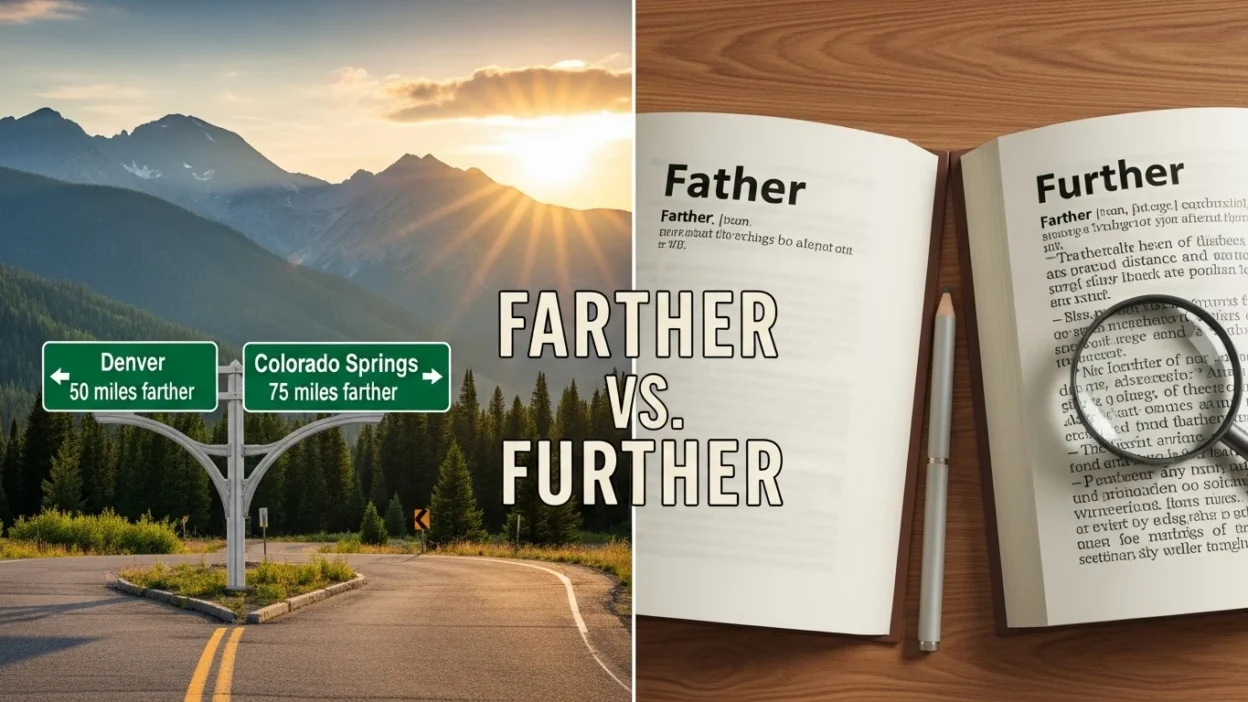
- Farther → Used for physical distance (real, measurable space)
- Further → Used for non-physical ideas (time, ideas, level, degree)
👉 Simple trick:
- If you can measure it (meters, miles) → use farther
- If you cannot measure it → use further
Simple Background (Where Do These Words Come From?)
Both farther and further come from the word “far.”
- “Far” means a long distance.
- Over time, English developed two forms:
- Farther → stayed closer to physical distance
- Further → grew to include ideas and abstract meanings
Today, both words are sometimes used in similar ways, but there is still a helpful difference.
Clear Explanation of the Difference
Let’s make it very simple.
1. Farther = Physical Distance
Use farther when talking about real space—something you can see or measure.
Examples:
- The school is farther than the park.
- She walked farther than her friend.
- The shop is farther down the road.
👉 You can measure these distances (meters, kilometers, etc.)
2. Further = Abstract or Figurative Meaning
Use further when talking about things that are not physical.
Examples:
- We need to discuss this further.
- He wants to study further.
- For further information, contact us.
👉 These are ideas, not real distances.
Comparison Table (Quick View)
| Feature | Farther | Further |
| Main use | Physical distance | Ideas, time, level, degree |
| Can you measure? | Yes | No |
| Example | The car is farther away | Let’s talk further |
| Type | Concrete (real space) | Abstract (not physical) |
| Easy trick | Distance you can see | Anything else |
Which One Should You Use and When?
Here’s a simple guide:
Use Farther when:
- Talking about distance in space
- Comparing how far things are
- Describing movement in a physical area
✔ Examples:
- He ran farther than I did.
- The river is farther from here.
- Can you move farther away?
Use Further when:
- Talking about ideas or discussions
- Giving more information
- Describing progress or development
✔ Examples:
- We need further explanation.
- She continued her studies further.
- I have no further questions.
👉 Helpful tip:
If you are unsure, “further” is safer because it works in more situations.
Common Mistakes People Make
Let’s look at mistakes and fix them.
❌ Wrong:
- The house is further down the street.
✔ Better: - The house is farther down the street.
❌ Wrong:
- We need to talk farther about this issue.
✔ Correct: - We need to talk further about this issue.
❌ Mixing both:
- He walked further than me to the park.
✔ Better: - He walked farther than me to the park.
👉 Why mistakes happen:
- The words sound similar
- Many people use them interchangeably
- Some modern English accepts both, but learning the difference helps you sound more accurate
Everyday Real-Life Examples
Here are examples you might see in daily life.
1. Emails
- Please contact us for further details.
- We cannot go any further without your reply.
2. News
- The investigation will continue further.
- The storm moved farther north.
3. Social Media
- Let’s not take this argument any further.
- I ran farther today than yesterday!
4. Daily Conversations
- Can you stand a bit farther away?
- I will explain this further later.
5. School or Study
- She wants to study further after college.
- The library is farther than the classroom.
Short Learning Section for Students and Beginners
Here’s an easy way to practice:
Step 1: Ask yourself a question
👉 “Is this about real distance?”
- YES → Use farther
- NO → Use further
Step 2: Try simple sentences
Fill in the blank:
- The shop is ______ than my house.
- Let’s discuss this ______ tomorrow.
- He ran ______ than his brother.
- I need ______ help with this topic.
✔ Answers:
- farther
- further
- farther
- further
Step 3: Make your own examples
Try writing:
- 2 sentences with farther
- 2 sentences with further
This helps you remember faster.
Frequently Asked Questions (FAQ)
1. Can I use “further” instead of “farther”?
Yes, sometimes. Many people use further for distance too, but farther is more correct for physical distance.
2. Is “farther” old-fashioned?
No. It is still correct and commonly used, especially in careful writing.
3. Which word is more common?
Further is more common because it has more meanings.
4. How can I remember the difference easily?
Think:
- Farther = Far = Distance
- Further = Future ideas (not real distance)
5. Do native speakers always follow this rule?
Not always. Many people mix them, but knowing the rule helps you speak and write better.
6. Can both be correct in some sentences?
Yes, in informal English, both may sound okay. But for learning, it’s best to follow the rule.
7. Is it important to learn the difference?
Yes, especially for students and exams. It helps you write clearly and correctly.
8. What is the easiest way to avoid mistakes?
Use this simple trick:
👉 If you can measure it → farther
👉 If not → further
Conclusion
Understanding farther vs further does not have to be difficult.
Just remember:
- Farther = physical distance you can measure
- Further = ideas, time, or anything not physical
Even though people sometimes mix them, using the correct word makes your English clearer and more natural.
Keep practicing with simple sentences, and soon this difference will feel easy and natural to you.