Many English learners see the words crummy and crumby and think they mean the same thing. They look almost identical, and both come from the word “crumb.” Because of this, it is easy to mix them up in writing and speaking.
But here’s the truth: these two words are not always used in the same way. One is much more common in daily English, while the other has a more specific meaning.
Quick Answer
- Crummy
- Means: bad, poor, low quality
- Used in everyday speech
- Very common
- Crumby
- Means: full of crumbs (small pieces of food)
- Sometimes also used like “crummy,” but less common
- More literal meaning
👉 In most cases, “crummy” is the better and safer choice.
Simple Origin or Background
Both words come from the word “crumb,” which means small pieces of bread or food.
- Crumby started as a word to describe something covered in crumbs.
- Over time, people began using similar words like crummy to describe something unpleasant or bad.
Language changes slowly, and that is why both forms exist today. However, “crummy” became more popular, especially when talking about something bad.
Clear Explanation of the Difference
Let’s break it down in the easiest way possible.
What does “crummy” mean?
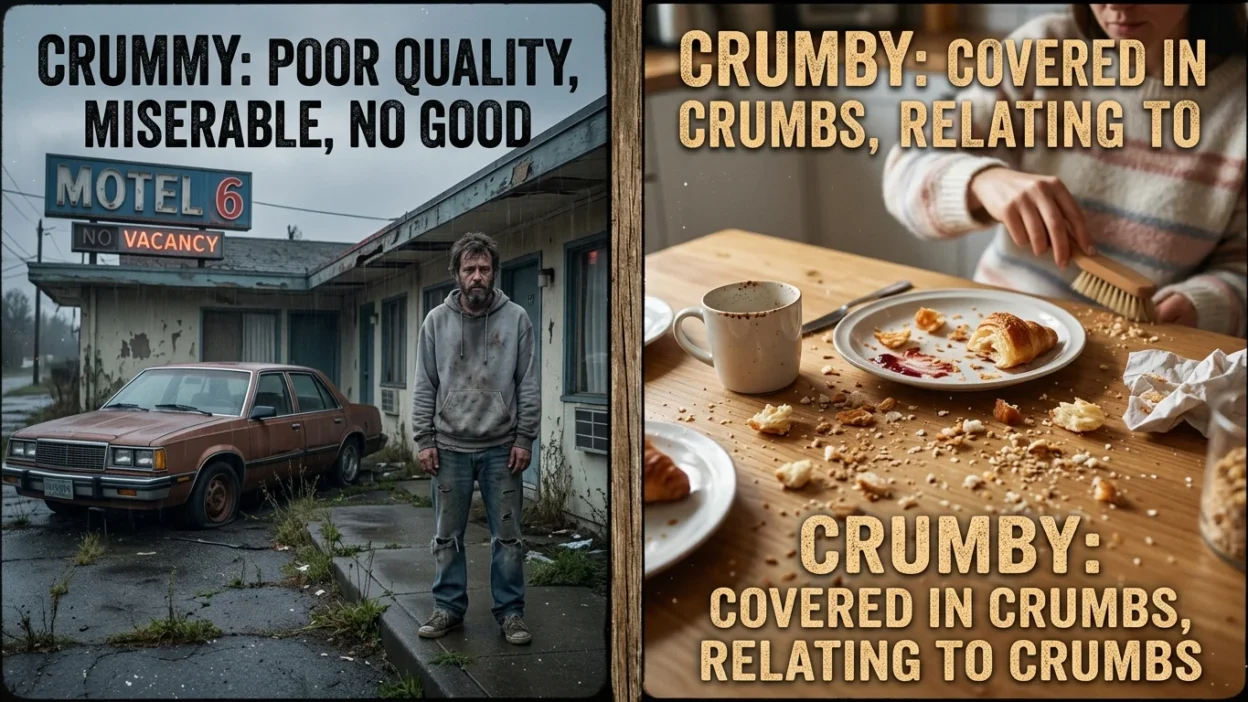
Crummy is mostly used to describe something that is:
- Bad
- Cheap
- Not good enough
- Disappointing
Examples:
- “This is a crummy phone.”
- “I had a crummy day.”
👉 Think of crummy = bad quality or unpleasant.
What does “crumby” mean?
Crumby has a more direct meaning:
- Covered in crumbs
- Full of small food pieces
Examples:
- “The table is crumby.”
- “Your shirt looks crumby after eating.”
👉 Think of crumby = covered in crumbs (literal meaning).
Sometimes people also use crumby to mean “bad,” but this is less common.
Comparison Table
| Feature | Crummy | Crumby |
| Main meaning | Bad, poor quality | Covered with crumbs |
| Usage type | Informal, everyday speech | Literal description |
| Popularity | Very common | Less common |
| Tone | Negative feeling | Neutral (can be negative too) |
| Example | “That was a crummy movie.” | “The floor is crumby.” |
Which One to Use and When
Here is a simple guide you can follow:
Use “crummy” when:
- You want to say something is bad
- You are talking about quality or feelings
- You are speaking casually
Examples:
- “This food tastes crummy.”
- “I feel crummy today.”
Use “crumby” when:
- You are talking about actual crumbs
- You want to describe a surface or object
Examples:
- “The couch is crumby after snacks.”
- “Clean the crumby table.”
👉 If you are not sure, use “crummy”. It works in most situations.
Common Mistakes People Make
Here are some mistakes learners often make:
1. Using “crumby” for everything
❌ “This is a crumby day.”
✔️ Better: “This is a crummy day.”
👉 “Crumby” is not usually used for feelings.
2. Mixing both words randomly
❌ “The movie was crumby and I felt crumby.”
✔️ Better: “The movie was crummy and I felt crummy.”
3. Forgetting the literal meaning of “crumby”
❌ “The table is crummy with bread.”
✔️ Better: “The table is crumby.”
4. Overthinking the spelling
Many learners worry too much about which spelling to use.
👉 Simple rule:
- Bad quality = crummy
- Full of crumbs = crumby
Everyday Real-Life Examples
Let’s look at how people use these words in daily life.
In emails
- “Sorry for the crummy service yesterday.”
- “The desk is a bit crumby, please clean it.”
In social media posts
- “I had a crummy day at work 😞”
- “My keyboard is crumby after eating snacks 😂”
In news or reports (informal tone)
- “Customers complained about the crummy product quality.”
- “The floor was left crumby after the event.”
In daily conversations
- “This weather is so crummy.”
- “Brush off the crumby crumbs from your shirt.”
Short Learning Section for Students and Beginners
Here is a quick learning tip you can remember:
Easy Memory Trick
- Crummy = yucky (bad feeling)
- Crumby = crumbs (food pieces)
👉 Both start with “crumb,” but:
- One is about feeling
- One is about food bits
Practice Sentences
Try to fill in the blanks:
- “This is a ______ day.” → crummy
- “The table is ______ after lunch.” → crumby
- “I bought a ______ product.” → crummy
- “Your shirt looks ______.” → crumby
FAQ (Frequently Asked Questions)
1. Are “crummy” and “crumby” the same?
No, they are not exactly the same.
“Crummy” means bad, while “crumby” means full of crumbs.
2. Which word is more common?
Crummy is much more common in everyday English.
3. Can “crumby” mean bad too?
Sometimes yes, but it is not very common. Most people prefer “crummy.”
4. Is “crummy” formal or informal?
It is informal, so it is best used in casual situations.
5. Can I use “crummy” in writing?
Yes, but mostly in casual writing like messages, emails, or stories.
6. How do I remember the difference?
- Crummy = bad feeling
- Crumby = crumbs on something
7. Is one spelling wrong?
No, both are correct, but they are used in different ways.
8. Which one should beginners use?
Beginners should mostly use crummy, because it is easier and more common.
Conclusion
The difference between crummy and crumby is simple once you understand it.
- Crummy is used to describe something bad, unpleasant, or low quality.
- Crumby is used to describe something covered with crumbs.
Even though they look similar, their meanings are not the same. In daily English, people use crummy much more often.
If you remember one thing, remember this:
👉 Use “crummy” for bad things, and “crumby” for crumbs.
With this simple rule, you will not be confused again.