Many learners mix up past and passed because they sound exactly the same. When two words sound alike but have different meanings, it can be tricky to choose the right one. Even native speakers sometimes make this mistake in writing.
The good news is that the difference is actually simple once you understand how each word works. This guide will help you learn it clearly, step by step, in very easy English.
Quick Answer
Here is the simple difference:
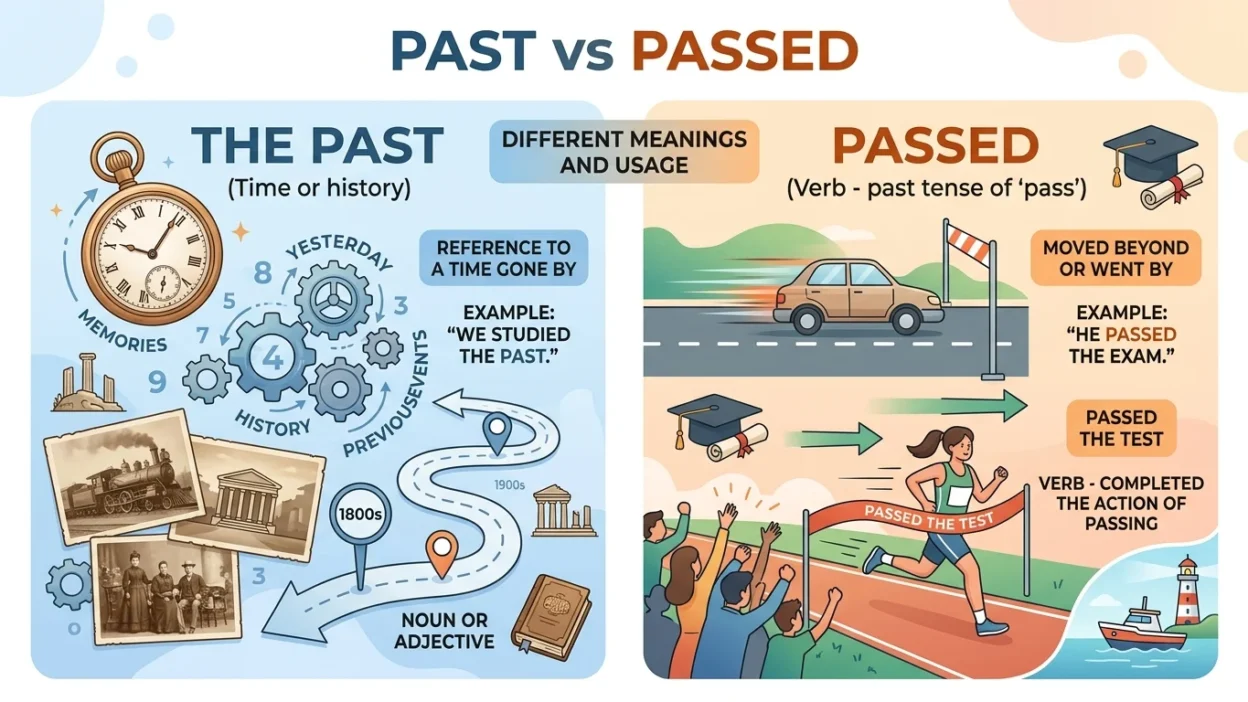
- Past = related to time (before now) or position (after something)
- Passed = the past form of the verb “pass” (an action)
Quick tips:
- Use past when talking about time: in the past
- Use passed when talking about an action: he passed the test
Simple Background Explanation
Both words come from the same base idea: pass, which means “to move” or “to go by.”
- Pass is a verb (an action word)
- Passed is the past tense of that verb (something already done)
- Past became a separate word used as a noun, adjective, or preposition
Over time, English kept both words, but they developed different uses.
Clear Explanation of the Difference
What Does “Past” Mean?
Past is not a verb. It is used to talk about:
- Time before now
- Example: That happened in the past.
- Movement beyond a point
- Example: He walked past the shop.
- Something finished
- Example: It is past midnight.
👉 Important: Past is not an action.
What Does “Passed” Mean?
Passed is a verb. It shows that something already happened.
It is the past form of pass.
Examples:
- She passed the exam.
- The car passed us on the road.
- Time passed quickly.
👉 Important: Passed is always an action.
Comparison Table
| Feature | Past | Passed |
| Type | Noun / adjective / preposition | Verb (past tense) |
| Meaning | Time before now or beyond | Action of passing |
| Action? | ❌ No | ✅ Yes |
| Example | In the past | He passed the ball |
| Easy clue | Think “time” | Think “did something” |
Which One to Use and When
Use “Past” When:
- You talk about time before now
- In the past, people wrote letters.
- You talk about position
- He walked past me.
- You describe something already finished
- It is past bedtime.
Use “Passed” When:
- You describe an action that already happened
- She passed the exam.
- You talk about movement
- The car passed us.
- You talk about time going by
- Hours passed quickly.
Common Mistakes People Make
Here are mistakes many learners make:
❌ I passed my childhood in a small town.
✅ I spent my childhood in a small town. (better sentence)
❌ He past the ball to me.
✅ He passed the ball to me.
❌ Time past very fast.
✅ Time passed very fast.
❌ We drove passed the park.
✅ We drove past the park.
Simple Trick to Remember
Try this:
- If you can replace the word with “went” or “did something”, use passed
- If not, use past
Example:
- He ___ the shop. → He went the shop ❌ → Use past
- He ___ the test. → He did the test ✔ → Use passed
Everyday Real-Life Examples
In Emails
- I passed the interview yesterday.
- In the past, I worked in a small company.
In News
- The law was passed last year.
- In the past, this area was very quiet.
On Social Media
- I just passed my driving test! 🎉
- I miss the past sometimes.
In Daily Conversation
- We walked past the school.
- He passed me the book.
Short Learning Section for Students and Beginners
Here is a quick way to practice:
Step 1: Ask Yourself
- Is this about time or place? → Use past
- Is this an action? → Use passed
Step 2: Try Simple Sentences
Fill in the blanks:
- She ______ the exam.
- We walked ______ the park.
- In the ______, life was slower.
- Time ______ very quickly.
Answers:
- passed
- past
- past
- passed
Step 3: Practice Daily
Try writing 2–3 sentences every day using both words. This helps you remember faster.
FAQ Section
1. Why do “past” and “passed” sound the same?
They are pronounced the same in English, but they have different meanings and uses.
2. Is “passed” always a verb?
Yes. “Passed” is always an action word.
3. Can “past” be a verb?
No. “Past” is never a verb.
4. Which one is correct: “walked past” or “walked passed”?
Correct: walked past
Because it shows direction, not action.
5. Which one is correct: “passed the exam” or “past the exam”?
Correct: passed the exam
Because it is an action.
6. How can I remember the difference easily?
Remember:
- Passed = action
- Past = time or place
7. Is “time passed” correct?
Yes, it is correct. It means time moved or went by.
8. Can both words be in one sentence?
Yes!
Example:
In the past, he passed every test.
Conclusion
Understanding past vs passed is easier than it seems. The key idea is simple:
- Past is about time or position
- Passed is about an action
If you remember this one rule, you will avoid most mistakes.
Keep practicing with small sentences, and soon it will feel natural. Learning small differences like this can make your English much clearer and more confident.