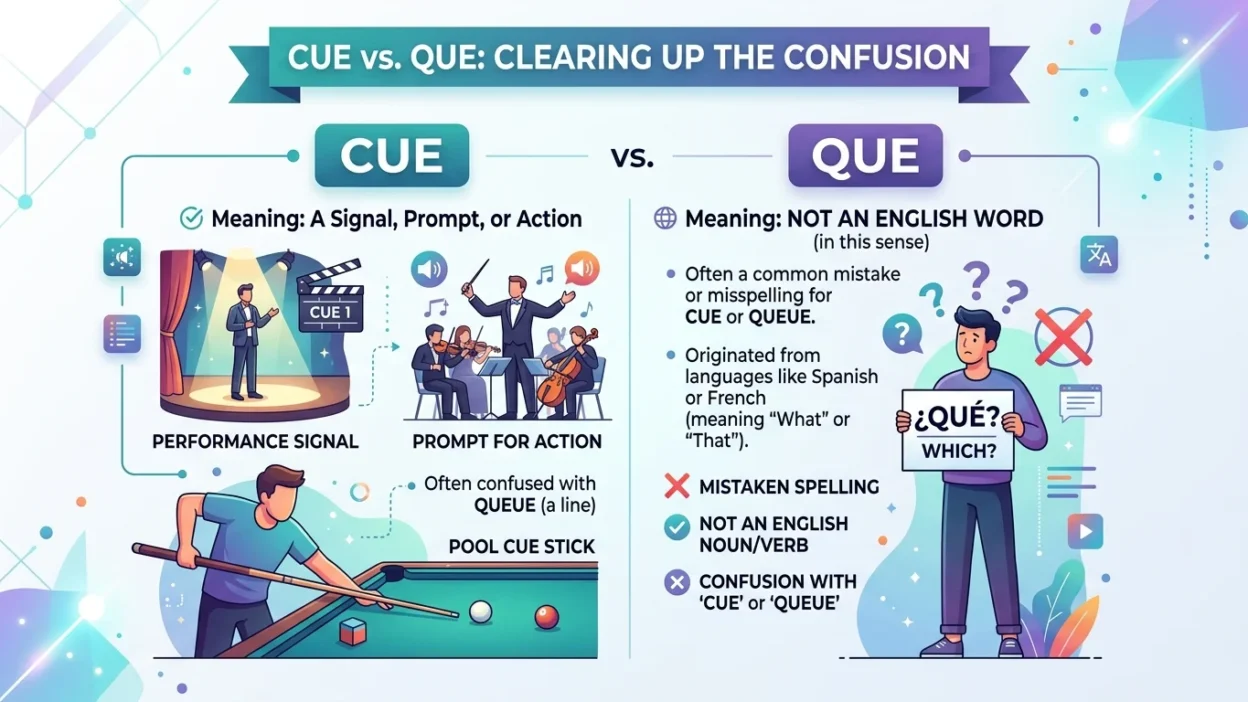
Many people get confused between cue and que because the two words look very similar. They are also short words, which makes spelling mistakes easy. You may see them in text messages, social media posts, emails, or even school writing.
The good news is that the difference is actually simple once you understand what each word means. One word is commonly used in English, while the other usually belongs to another language or is used in special situations.
This guide explains everything in very easy English so students, ESL learners, and beginners can understand it quickly and clearly.
Quick Answer: Cue vs Que
Here is the simple difference:
- Cue is an English word.
- Cue means a signal, reminder, or something that tells you to act.
- Que is usually not an English word.
- Que often comes from Spanish, where it means “what” or “that.”
- In normal English writing, cue is usually the correct choice.
Easy Memory Tip
- Cue = signal or hint
- Que = foreign-language word or spelling mistake
Simple Background of the Words
Understanding where these words come from can make them easier to remember.
Where “Cue” Comes From
The word cue has been used in English for a long time. It became popular in theater and acting.
In plays, actors waited for a cue before speaking or moving. A cue could be:
- a word
- a sound
- a movement
- a signal
Today, the word is used in many everyday situations.
For example:
- a teacher gives a cue
- music starts on cue
- a traffic light gives a cue to stop or go
Where “Que” Comes From
The word que mostly comes from Spanish and some other languages.
In Spanish, que can mean:
- what
- that
- which
Example in Spanish:
- “¿Que pasa?” means “What’s happening?”
Sometimes English speakers accidentally write que when they really mean cue or queue.
The Main Difference Between Cue and Que
The biggest difference is simple:
| Word | Main Use | Language |
| Cue | Signal or reminder | English |
| Que | Foreign-language word | Mostly Spanish |
What Does “Cue” Mean?
“Cue” usually means:
- a signal
- a hint
- something that tells you to begin
Examples
- The music was my cue to dance.
- She waited for her cue before speaking.
- His smile was a cue that everything was okay.
- The green light is your cue to drive.
In all these examples, cue means a signal or sign.
What Does “Que” Mean?
“Que” is usually used in Spanish or other languages, not regular English.
Examples
- Que bueno!
- No se que hacer.
- Que pasa?
If you are writing in English only, you probably do not need “que.”
Cue vs Que Comparison Table
Here is an easy table to help you remember the difference quickly.
| Feature | Cue | Que |
| Is it common in English? | Yes | Usually no |
| Meaning | Signal, hint, reminder | Foreign-language word |
| Used in theater/music? | Yes | No |
| Used in everyday English? | Yes | Rarely |
| Correct English sentence | “That was my cue.” | Usually incorrect |
| Common mistake? | Sometimes misspelled as “que” | Often typed by mistake |
Which One Should You Use and When?
Use “Cue” When Talking About Signals or Hints
Choose cue when something tells a person to act, speak, move, or react.
Use “Cue” In Situations Like:
- acting
- music
- conversations
- sports
- teaching
- daily life
Examples
- The bell was our cue to leave class.
- He gave me a cue to start talking.
- The coach’s whistle was the cue to begin.
- Her face gave a cue that she was upset.
Use “Que” Only in Foreign-Language Writing
Use que only if:
- you are writing Spanish
- you are quoting another language
- it is part of a name or title
Examples
- Que sera, sera.
- ¿Que hora es?
- The song includes Spanish words like “que.”
If your sentence is fully English, “cue” is usually the correct spelling.
Common Mistakes People Make
Many learners mix these words because they sound similar in some accents or because of fast typing online.
Here are the most common mistakes.
Mistake 1: Writing “que” Instead of “cue”
❌ Wrong:
- That was my que to speak.
✅ Correct:
- That was my cue to speak.
Reason: The sentence needs the English word meaning “signal.”
Mistake 2: Thinking “que” Is an English Word
Some people believe “que” is a normal English spelling. In most cases, it is not.
❌ Wrong:
- The teacher gave us a que.
✅ Correct:
- The teacher gave us a cue.
Mistake 3: Mixing Up Cue and Queue
Another common confusion is between cue and queue.
- Cue = signal
- Queue = line of people waiting
Example
- We stood in a queue at the store.
- The music cue started the show.
Everyday Real-Life Examples
Real examples make the difference easier to understand.
In Emails
Correct
- Please wait for my cue before sending the file.
Incorrect
- Please wait for my que before sending the file.
On Social Media
Correct
- That laugh was my cue to leave.
Incorrect
- That laugh was my que to leave.
In School
Correct
- The teacher gave a cue for the students to begin writing.
Incorrect
- The teacher gave a que for the students to begin writing.
In News or TV
Correct
- The anchor waited for the cue from the producer.
Incorrect
- The anchor waited for the que from the producer.
In Daily Conversation
Correct
- I took his silence as a cue to stop talking.
Incorrect
- I took his silence as a que to stop talking.
Easy Learning Section for Students and Beginners
If you are still unsure, this simple learning trick can help.
Remember This Sentence
“A cue gives you a clue.”
Both words rhyme, so they are easier to remember together.
A cue is like a clue or signal that helps you know what to do next.
Small Practice Activity
Choose the correct word.
- The music was my ___ to dance.
- The actor missed his ___.
- ___ pasa?
- She gave me a ___ to start.
Answers
- cue
- cue
- Que
- cue
One-Minute Rule
Before using the word, ask yourself:
“Am I talking about a signal or hint?”
- If YES → use cue
- If NO and it is Spanish → use que
This simple question solves the confusion most of the time.
FAQ About Cue vs Que
1. Is “que” an English word?
Usually no. It mostly comes from Spanish and other languages.
2. What does “cue” mean in simple words?
It means a signal, hint, or reminder to do something.
3. Why do people confuse cue and que?
They look similar and are often typed quickly online.
4. Which spelling is correct in English writing?
Most of the time, cue is correct.
5. Can “que” ever be correct?
Yes, when writing Spanish or quoting another language.
6. Is “cue” used in movies and theater?
Yes. Actors often wait for a cue before speaking or moving.
7. What is the difference between cue and queue?
- Cue = signal
- Queue = waiting line
8. How can I remember the correct spelling?
Think:
“Cue gives a clue.”
That helps many learners remember the meaning.
Final Thoughts on Cue vs Que
The difference between cue and que is much easier than many people think.
Use cue when talking about:
- signals
- hints
- reminders
- starting actions
Use que mainly in Spanish or other non-English writing.
For most English sentences, cue is the correct word.
Once you remember that a cue is a signal or clue, the confusion usually disappears. Keep practicing with simple examples, and soon the correct spelling will feel natural every time you write.