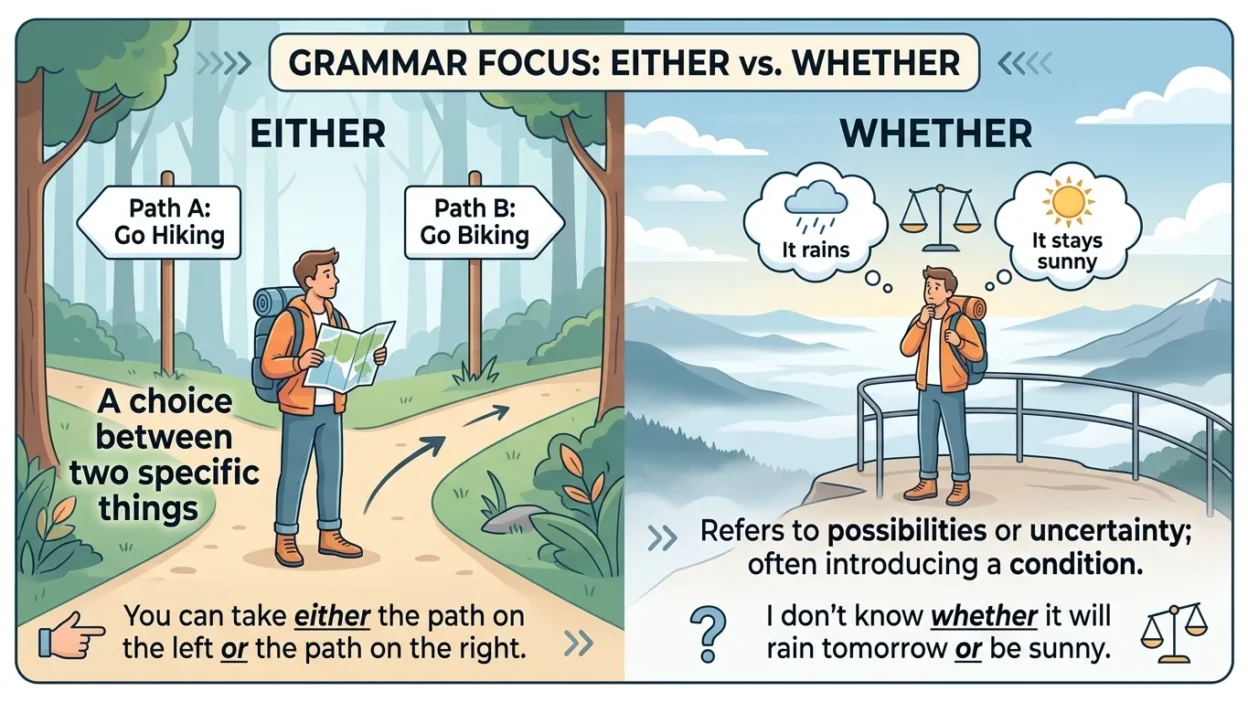
Many English learners get confused by either and whether because both words can appear in sentences about choices or possibilities. Sometimes they even seem similar at first glance. But the truth is that they do very different jobs in English grammar.
The good news is that the difference is actually simple once you see how each word works in real sentences.
This guide explains everything in very easy English so students, ESL learners, and beginners can understand the difference clearly and use both words correctly in daily life.
Quick Answer
Here is the easiest way to remember the difference:
- Whether is used when talking about a choice, doubt, or possibility.
- Either is used when talking about one of two choices.
Simple Examples
- I do not know whether he will come.
- You can choose either tea or coffee.
Easy Memory Tip
- Whether = if or not
- Either = one of two options
Simple Background of the Words
Understanding a little background can make the words easier to remember.
Where “Whether” Comes From
“Whether” is an old English word connected to ideas of doubt and choice. It has been used for hundreds of years when people are unsure about something.
Example:
- I wonder whether it will rain.
The speaker is uncertain.
Where “Either” Comes From
“Either” developed from old words meaning “one of two.” It is connected to choosing between two things.
Example:
- Either road will take us home.
This means both choices are possible, and one can be selected.
The Main Difference Between Either and Whether
This is the most important part of the lesson.
What “Whether” Means
“Whether” introduces uncertainty, doubt, or two possibilities.
It often means:
- if
- if or not
- which choice is true
Examples
- I do not know whether she is busy.
- We are deciding whether to travel tomorrow.
- He asked whether I liked the movie.
In all these sentences, there is uncertainty.
What “Either” Means
“Either” talks about two choices.
It usually means:
- one or the other
- both are acceptable
- one of two options
Examples
- You can sit on either chair.
- Either answer is correct.
- We can go either today or tomorrow.
Here, the speaker is choosing between two things.
Easy Comparison Table
| Feature | Whether | Either |
| Main meaning | uncertainty or doubt | one of two choices |
| Often means | if or not | one or the other |
| Used for | questions and possibilities | choices between two things |
| Grammar role | conjunction | determiner, pronoun, or adverb |
| Example | I wonder whether he called. | Either option works. |
| Talks about | uncertainty | selection |
Which One to Use and When
Use “Whether” When You Are Unsure
Choose “whether” when there is doubt, uncertainty, or two possible situations.
Common Patterns
1. Whether + clause
- I do not know whether he is home.
- She asked whether we were ready.
2. Whether or not
- We will go whether or not it rains.
- He is coming whether or not you agree.
3. Whether + infinitive
- I cannot decide whether to study or sleep.
- They discussed whether to move abroad.
Use “Either” When Choosing Between Two Things
Use “either” when talking about two choices.
Common Patterns
1. Either + noun
- Either road is fine.
- Either answer can work.
2. Either…or
- You can either call me or text me.
- Either John or Sara will help you.
3. Either as a response
- “I do not like spicy food.”
- “I do not either.”
In informal English, many people say “me either,” though “I do not either” is more formal.
Common Mistakes People Make
Mistake 1: Using “Either” Instead of “Whether”
❌ I do not know either he is coming.
✅ I do not know whether he is coming.
Why?
Because the sentence shows uncertainty, not a choice between two objects.
Mistake 2: Using “Whether” for Direct Choices
❌ Whether shirt looks better on me.
✅ Either shirt looks good on me.
Why?
Because you are choosing between two shirts.
Mistake 3: Forgetting “Or” After “Either”
❌ Either you study you fail.
✅ Either you study or you fail.
“Either” often works together with “or.”
Mistake 4: Confusing “Whether” and “If”
Sometimes “if” can replace “whether,” but not always.
Correct
- I do not know whether he called.
- I do not know if he called.
But Sometimes Only “Whether” Works
✅ We talked about whether to move.
❌ We talked about if to move.
Everyday Real-Life Examples
Learning real-life examples helps the difference become natural.
In Emails
Whether
- Please let me know whether you can attend the meeting.
- We are checking whether the payment arrived.
Either
- You can send the document in either PDF or Word format.
- Either day works for me.
In News Sentences
Whether
- Scientists are studying whether the new method is safe.
- People are wondering whether prices will rise again.
Either
- Either side could win the election.
- The storm may move in either direction.
On Social Media
Whether
- I cannot decide whether to post this photo.
- People are debating whether the video is real.
Either
- Either outfit looks amazing!
- We can meet either before lunch or after dinner.
In Daily Conversation
Whether
- Are you sure whether the shop is open?
- I am thinking about whether to change jobs.
Either
- You can take either bus.
- Either movie sounds fun.
Short Learning Section for Students and Beginners
Simple Trick to Remember
Ask yourself this question:
Is the sentence about uncertainty?
Use whether.
Example:
- I do not know whether he is serious.
Is the sentence about choosing one of two things?
Use either.
Example:
- Either sandwich is okay.
Mini Practice
Choose the correct word.
1.
I cannot decide ___ to stay home.
Answer: whether
2.
You may choose ___ pen.
Answer: either
3.
She asked ___ I finished my homework.
Answer: whether
4.
We can go ___ by train or by bus.
Answer: either
FAQ About Either vs Whether
1. Can “whether” and “either” mean the same thing?
No. They are different words with different jobs. “Whether” shows uncertainty. “Either” shows choice between two things.
2. Can I replace “whether” with “if”?
Sometimes yes, but not always.
Correct:
- I wonder whether he is coming.
- I wonder if he is coming.
But after prepositions or before infinitives, “whether” is usually better.
3. Is “either” always used with “or”?
Not always.
Examples:
- Either option works.
- Either child can help.
But “either…or” is very common.
4. What is the easiest way to remember “whether”?
Think:
- whether = if or not
Example:
- I do not know whether she agrees.
5. What is the easiest way to remember “either”?
Think:
- either = one of two choices
Example:
- Either road is fine.
6. Can “either” be used in negative sentences?
Yes.
Example:
- I do not like coffee either.
This means “also not.”
7. Is “whether or not” correct?
Yes. It is very common and completely correct.
Example:
- We are leaving whether or not he comes.
8. Which word is more formal?
“Whether” is usually a little more formal than “if.”
“Either” is common in both formal and informal English.
Simple Practice Sentences
Try reading these aloud.
- I am not sure whether they arrived.
- Either answer could be correct.
- She wondered whether to call him.
- You can choose either restaurant.
- We do not know whether school is closed.
- Either path will take us there.
Reading examples many times helps you remember naturally.
Conclusion
The difference between either and whether becomes much easier when you focus on their main ideas.
- Whether is about uncertainty, doubt, or “if or not.”
- Either is about choosing between two options.
A simple memory trick is:
- Whether = uncertainty
- Either = choice
Once you practice with real-life examples, the confusion quickly disappears. Over time, choosing the correct word will start to feel natural in speaking, writing, emails, schoolwork, and everyday conversation.