Many learners feel confused about “breath” and “breathe” because they look almost the same. The only difference is one small letter “e” at the end—but that small change also changes the meaning and how we use the word in a sentence.
If you’ve ever stopped while writing and wondered, “Is it breath or breathe?”—you’re not alone. This guide will make everything clear in very simple English so you can understand it quickly and use both words correctly with confidence.
Quick Answer
Here is the easiest way to remember the difference:
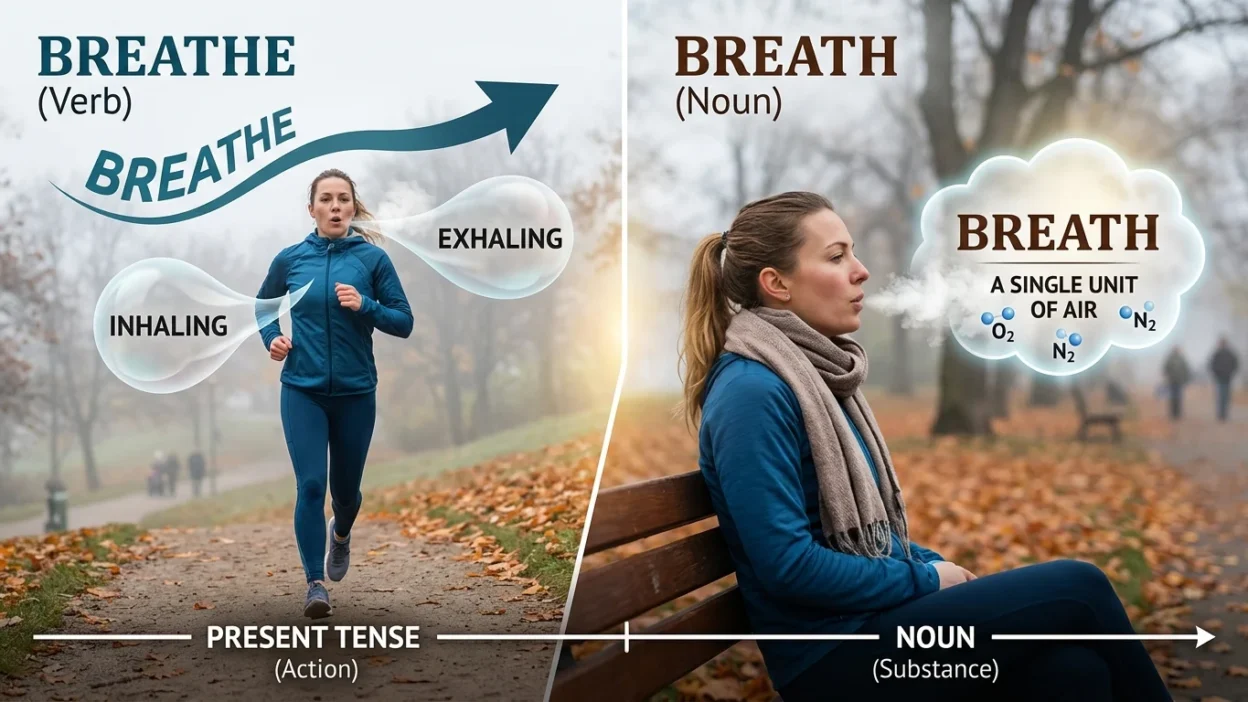
- Breath = a thing (noun) → the air you take in or out
- Breathe = an action (verb) → the act of taking air in and out
Quick tip:
- If you can replace the word with “air”, use breath
- If you can replace it with “inhale/exhale”, use breathe
Simple Background (Origin)
Both words come from the same old root word related to air and life. Over time, English created two forms:
- Breath became a noun (a thing)
- Breathe became a verb (an action)
This pattern is common in English. For example:
- Advice (noun) → Advise (verb)
- Device (noun) → Devise (verb)
The extra “e” often shows an action.
Clear Explanation of the Difference
1. What is “Breath”?
Breath is a noun. It means the air that goes in and out of your lungs.
👉 Think of it as something you can count or notice.
Examples:
- I took a deep breath.
- His breath smells bad.
- She held her breath underwater.
2. What is “Breathe”?
Breathe is a verb. It means the action of taking air in and out.
👉 Think of it as something you do.
Examples:
- Try to breathe slowly.
- He cannot breathe well.
- I need fresh air to breathe.
Key Difference in One Line:
- Breath = air (noun)
- Breathe = action (verb)
Comparison Table
| Feature | Breath | Breathe |
| Type | Noun (thing) | Verb (action) |
| Meaning | Air in lungs | To take air in and out |
| Usage | “Take a breath” | “Try to breathe” |
| Ends with “e”? | No | Yes |
| Sound | Short sound (breth) | Long sound (bree-th) |
Which One to Use and When
Use this simple guide:
Use “Breath” when:
- You talk about air itself
- You count or describe it
- You say phrases like:
- Take a breath
- Hold your breath
- Out of breath
Examples:
- I lost my breath after running.
- Take a deep breath before speaking.
Use “Breathe” when:
- You talk about the action
- Someone is doing something
- You can add words like “can,” “will,” or “should”
Examples:
- You should breathe slowly.
- I cannot breathe in this room.
Common Mistakes People Make
Here are mistakes learners often make:
❌ Incorrect:
- Take a deep breathe
- I cannot breath properly
✅ Correct:
- Take a deep breath
- I cannot breathe properly
Why do these mistakes happen?
- Words look almost the same
- Pronunciation is similar
- People forget noun vs verb rules
Everyday Real-Life Examples
1. In Daily Conversation:
- “Wait, let me catch my breath.”
- “Please breathe slowly and relax.”
2. In Emails:
- “Take a moment to catch your breath before the meeting.”
- “Remember to breathe and stay calm during your presentation.”
3. On Social Media:
- “This view took my breath away!”
- “Just breathe… everything will be okay.”
4. In News or Health Advice:
- “Patients had trouble catching their breath.”
- “Doctors say it’s important to breathe clean air.”
5. In Daily Life:
- After running: “I need a minute to catch my breath.”
- During stress: “Just breathe and relax.”
Short Learning Section for Students and Beginners
Here is a simple way to remember forever:
Memory Trick:
👉 Breath = No “E” = Empty air (thing)
👉 Breathe = Has “E” = Effort (action)
Practice Sentences
Fill in the blanks:
- Take a deep ______.
- Try to ______ slowly.
- I lost my ______ after running.
- It’s hard to ______ in smoke.
Answers:
- breath
- breathe
- breath
- breathe
FAQ Section
1. What is the main difference between breath and breathe?
Breath is a noun (air), and breathe is a verb (action).
2. How do I remember which one to use?
Remember:
- Breath = thing
- Breathe = action
3. Is “breath” used with verbs?
Yes, but as an object:
- Take a breath
- Hold your breath
4. Is “breathe” always an action word?
Yes, it always shows an action.
5. Why do they sound similar?
Because they come from the same root word, but English changed them slightly.
6. Can I use them in the same sentence?
Yes!
- Take a deep breath and breathe slowly.
7. Which one is more common?
Both are common, but they are used in different ways.
8. Is pronunciation important?
Yes:
- Breath → short sound
- Breathe → longer sound
Conclusion
The difference between breath and breathe is simple once you understand it:
- Breath is the air you take (a thing)
- Breathe is the act of taking air (an action)
That small letter “e” changes everything.
If you remember one rule, remember this:
👉 If it’s something, use “breath.” If it’s an action, use “breathe.”