Many people feel confused when they see who’s and whose. They look almost the same, and they sound exactly the same when spoken. Because of this, even good English learners sometimes mix them up in writing.
The good news is that the difference is actually very simple. Once you understand one small idea, you will never confuse them again.
Quick Answer
Here is the easiest way to remember:
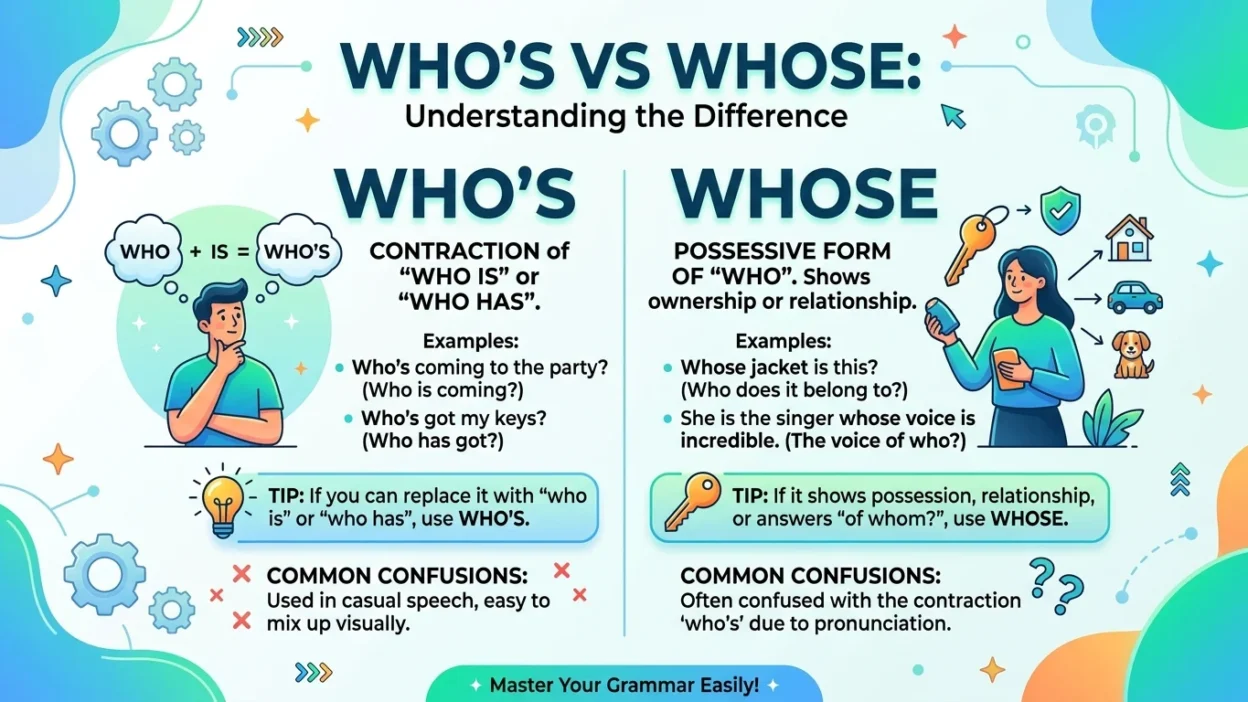
- Who’s = who is / who has
- Whose = shows ownership (something belongs to someone)
Example:
- Who’s at the door? (= Who is at the door?)
- Whose bag is this? (= Who does this bag belong to?)
Simple Origin or Background
Both words come from the base word “who”, which is used to ask about a person.
- Who’s is a short form (called a contraction). It combines:
- who + is → who’s
- who + has → who’s
- Whose is a possessive form. It shows that something belongs to someone.
Think of it like this:
- “Who” asks about a person
- “Whose” asks about something owned by that person
Clear Explanation of the Difference
Let’s break it down in the simplest way.
1. What does “who’s” mean?
Who’s is always short for:
- who is
- or who has
If you can replace “who’s” with “who is” or “who has,” then it is correct.
Examples:
- Who’s coming to the party? (Who is coming?)
- Who’s finished the work? (Who has finished?)
2. What does “whose” mean?
Whose shows ownership. It asks about something that belongs to someone.
Examples:
- Whose phone is ringing?
- Whose idea was this?
You cannot replace “whose” with “who is.” If you try, the sentence will sound wrong.
Comparison Table
| Word | Meaning | Use | Example |
| Who’s | Who is / Who has | Short form (contraction) | Who’s calling me? |
| Whose | Belonging to someone | Possession (ownership) | Whose book is this? |
Which One to Use and When
Here is a simple trick to decide quickly:
Step 1: Try expanding the word
- Replace it with “who is” or “who has”
If it still makes sense → use who’s
Example:
- Who’s ready? → Who is ready? ✔
Step 2: Check for ownership
If the sentence talks about something belonging to someone → use whose
Example:
- Whose shoes are these? (They belong to someone) ✔
Easy Memory Tip
- Who’s = who is
- Whose = ownership (like “his,” “her,” “their”)
Common Mistakes People Make
Even native speakers sometimes make these mistakes. Here are the most common ones:
Mistake 1: Using “who’s” for ownership
❌ Who’s bag is this?
✔ Whose bag is this?
Mistake 2: Forgetting that “who’s” is a short form
❌ Whose coming today?
✔ Who’s coming today?
Mistake 3: Mixing them because they sound the same
They are homophones (same sound, different meaning), so people confuse them in writing.
Mistake 4: Not checking the meaning
People often write quickly and don’t stop to check if the sentence needs “who is” or ownership.
Everyday Real-Life Examples
In Emails
- Who’s responsible for this report?
- Whose name should I write on the form?
In Social Media
- Who’s watching this show right now?
- Whose comment made you laugh?
In News or Conversations
- Who’s leading the meeting today?
- Whose decision changed everything?
In Daily Life
- Who’s at the door?
- Whose keys are on the table?
Short Learning Section for Students and Beginners
If you are learning English, follow this simple method:
Practice Step-by-Step
- Read the sentence slowly
- Ask:
- Can I say “who is”?
- Can I say “who has”?
- If yes → use who’s
- If no → think about ownership → use whose
Mini Practice
Fill in the blanks:
- ___ coming with us?
- ___ notebook is this?
- ___ finished the homework?
- ___ idea was better?
Answers:
- Who’s
- Whose
- Who’s
- Whose
FAQ Section
1. Are “who’s” and “whose” pronounced the same?
Yes, they sound the same. That’s why people often confuse them.
2. Can “who’s” mean “who has”?
Yes.
Example: Who’s finished the task? (Who has finished)
3. Is “whose” only used in questions?
No. It can also be used in statements.
Example: I know the person whose car was stolen.
4. Can I replace “whose” with “who is”?
No. It will not make sense. “Whose” is about ownership, not identity.
5. What is the easiest way to remember the difference?
Just remember:
- Who’s = who is
- Whose = ownership
6. Is it okay to use “who’s” in formal writing?
Yes, but in very formal writing, people often write the full form “who is.”
7. Why do people make mistakes with these words?
Because they sound the same and look similar in spelling.
8. Is “whose” used for things or only people?
It can be used for both.
Example: Whose house is that? / Whose color is brighter?
Conclusion
The difference between who’s and whose is simple once you understand the idea behind each word.
- Who’s is just a short form of who is or who has
- Whose shows that something belongs to someone
Whenever you feel confused, just pause and test the sentence:
- If “who is” fits → use who’s
- If it shows ownership → use whose
With a little practice, you will start using both words correctly without even thinking.