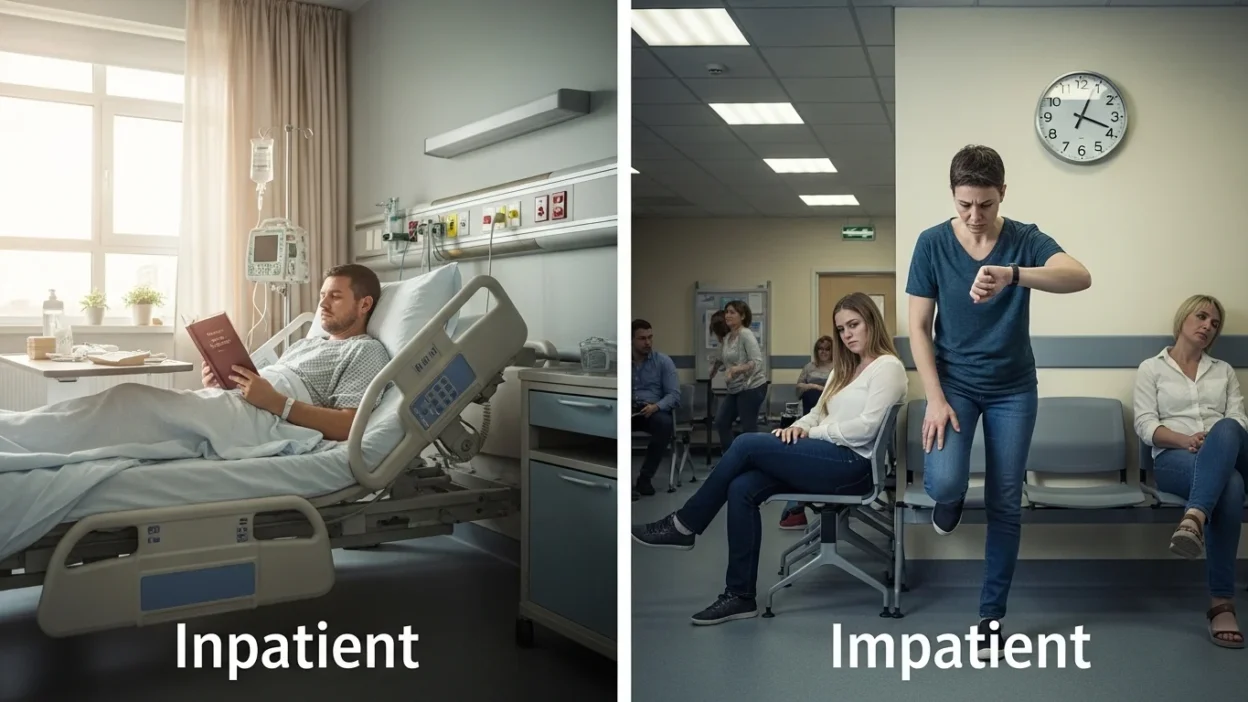
Many learners feel confused when they see the words inpatient and impatient. At first glance, they look almost the same. The only difference is a small space and one extra “i.” But their meanings are completely different.
This confusion is very common, especially for students and people learning English as a second language. The good news is that once you understand their meanings and usage, it becomes very easy to remember them forever.
Quick Answer
- Inpatient
- A noun (person)
- Means a patient who stays in a hospital for treatment
- Impatient
- An adjective (describing word)
- Means feeling annoyed because something is taking too long
Simple Origin or Background
Understanding the parts of the words can help:
- Inpatient
- “In” = inside
- “Patient” = a person receiving medical care
- So, an inpatient is someone staying inside a hospital
- Impatient
- “Im-” = not
- “Patient” = calm and able to wait
- So, impatient means not patient (not able to wait calmly)
This simple breakdown can make things much clearer.
Clear Explanation of the Difference
What does “Inpatient” mean?
An inpatient is a person who stays in a hospital for treatment. They usually need special care, surgery, or close monitoring.
Example:
- She became an inpatient after her surgery.
What does “Impatient” mean?
Impatient describes a feeling. It means you are annoyed, restless, or unable to wait calmly.
Example:
- He became impatient while waiting for the bus.
Key Idea
- Inpatient = person in hospital
- Impatient = feeling of not wanting to wait
Comparison Table
| Feature | Inpatient | Impatient |
| Type | Noun (person) | Adjective (feeling) |
| Meaning | A hospital patient staying inside | Not willing to wait |
| Usage Area | Medical/hospital context | Daily emotions and behavior |
| Example | The inpatient needs rest | She is impatient today |
| Easy Memory Tip | “In” = inside hospital | “Im” = not patient |
Which One to Use and When
Use “Inpatient” when:
- Talking about hospitals
- Referring to a patient staying overnight or longer
- Discussing medical treatment
Examples:
- The doctor checked the inpatient in the ward.
- He is an inpatient after his accident.
Use “Impatient” when:
- Talking about feelings
- Someone cannot wait calmly
- Someone feels annoyed or restless
Examples:
- She is impatient with slow service.
- Children often get impatient during long trips.
Common Mistakes People Make
Here are some mistakes learners often make:
1. Mixing spelling
❌ He is an impatient in the hospital.
✔ He is an inpatient in the hospital.
2. Using wrong meaning
❌ The doctor treated many impatient today.
✔ The doctor treated many inpatients today.
3. Forgetting word type
- Inpatient is a noun (person)
- Impatient is an adjective (feeling)
4. Saying them the same way
They sound similar, but the meanings are very different. Always check the context.
Everyday Real-Life Examples
In Emails
- The hospital currently has 20 inpatients.
- Sorry for the delay. I know you may feel impatient.
In News
- The hospital is full of inpatients after the accident.
- People became impatient due to long delays at the airport.
On Social Media
- “I’ve been an inpatient for 3 days. Feeling better now!”
- “Waiting for my order… getting impatient 😩”
Daily Conversation
- My uncle is an inpatient after surgery.
- Don’t be impatient. It will take some time.
Short Learning Section for Students and Beginners
Here is a simple way to remember:
Trick 1: Look at the beginning
- In = inside → hospital → inpatient
- Im = not → not patient → impatient
Trick 2: Ask a question
- Is it about a person in hospital? → inpatient
- Is it about a feeling? → impatient
Practice Sentences
Fill in the blanks:
- The ______ is recovering after surgery.
- She became ______ while waiting.
Answers:
- inpatient
- impatient
FAQ Section
1. Are “inpatient” and “impatient” the same?
No. They have completely different meanings.
2. Is “inpatient” a feeling?
No. It is a person staying in a hospital.
3. Is “impatient” used in hospitals?
Not usually. It describes emotions, not medical roles.
4. Can a person be both inpatient and impatient?
Yes! A person in a hospital (inpatient) can feel impatient.
5. Which word is more common in daily use?
“Impatient” is more common in everyday conversation.
6. How can I remember the difference easily?
Remember:
- In = inside → hospital
- Im = not → not patient
7. Is “in-patient” with a hyphen correct?
Sometimes, but “inpatient” (one word) is more common now.
8. What is the opposite of impatient?
The opposite is “patient,” meaning calm and able to wait.
Conclusion
Even though inpatient and impatient look very similar, their meanings are very different. One is about a person in a hospital, and the other is about a feeling of not wanting to wait.
By remembering a simple trick—“in = inside” and “im = not”—you can easily choose the correct word every time. With a little practice, this confusion will disappear, and you will feel more confident using both words in real life.