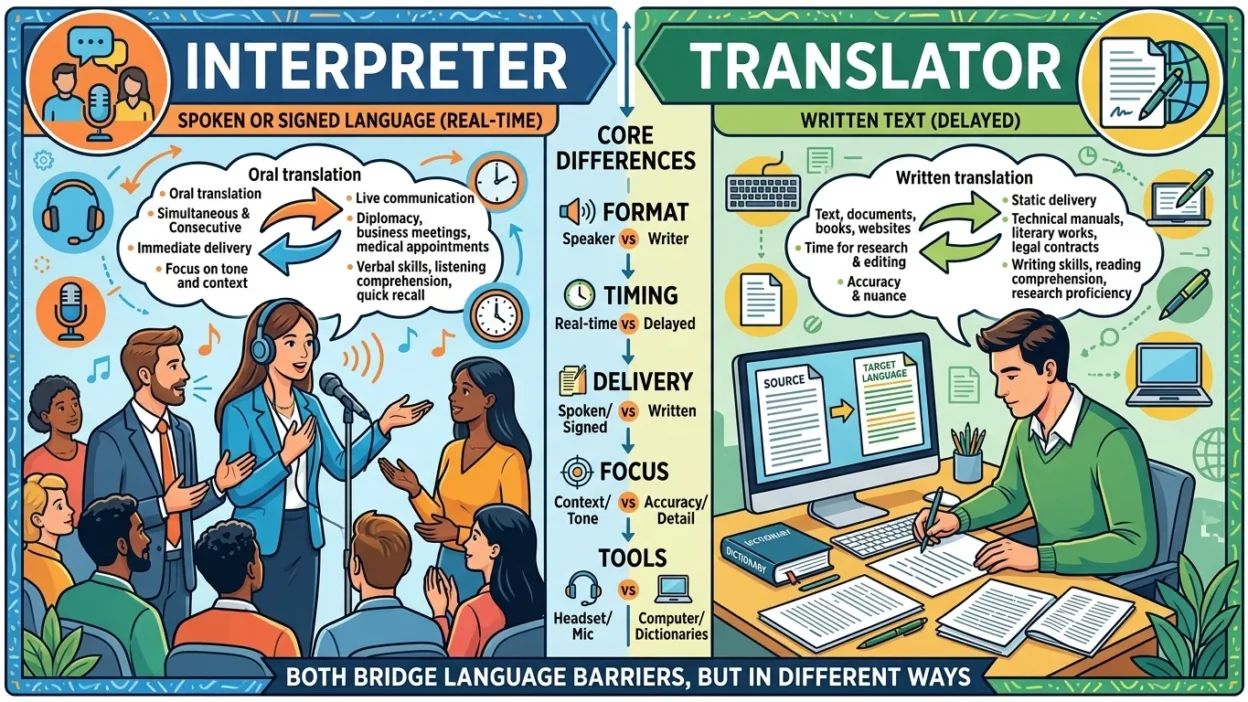
Many people think interpreter and translator mean the same thing. Both jobs help people understand another language, so the confusion is very common.
But there is one important difference:
- One usually works with spoken words
- The other usually works with written words
Students, English learners, and even native speakers often mix these words up in daily conversation. This guide explains everything in very simple English so you can understand the difference clearly and use both words correctly.
Quick Answer
Here is the short and simple answer:
- Interpreter = changes spoken language into another language
- Translator = changes written text into another language
Easy Example
- A person helping two people talk in different languages during a meeting is an interpreter
- A person changing a book from Spanish into English is a translator
Quick Memory Trick
- Interpreter = speech
- Translator = text
Simple Background of the Words
The two words come from different language roots.
Interpreter
The word “interpreter” comes from an old word meaning:
- “to explain”
- “to make things clear between people”
This makes sense because interpreters help people communicate in real-time conversations.
Translator
The word “translator” comes from a word meaning:
- “to carry across”
A translator carries meaning from one written language into another written language.
Both jobs are about communication, but they work in different ways.
The Main Difference Explained Clearly
The biggest difference is how the language is given.
Interpreters Work With Spoken Language
An interpreter listens to someone speaking and quickly says the same meaning in another language.
This often happens:
- face-to-face
- online
- on phone calls
- during meetings
- in hospitals
- in courts
- at international events
The interpreter usually works live and must think very fast.
Translators Work With Written Language
A translator reads written text and rewrites it in another language.
This includes:
- books
- emails
- subtitles
- websites
- school papers
- business documents
- social media posts
A translator usually has more time to check grammar, spelling, and word choice carefully.
Interpreter vs Translator Comparison Table
| Feature | Interpreter | Translator |
| Works with | Spoken language | Written language |
| Main skill | Listening and speaking | Reading and writing |
| Speed | Very fast, live | Usually slower and careful |
| Common places | Meetings, hospitals, courts | Books, websites, documents |
| Uses voice? | Yes | Usually no |
| Uses text? | Sometimes notes only | Yes |
| Can edit later? | Usually no | Yes |
| Works in real time? | Often yes | Usually no |
| Example | Live speech translation | Translating a novel |
Which One Should You Use?
Choosing the correct word depends on the situation.
Use “Interpreter” When Talking About Speech
Use this word when someone:
- listens to speech
- speaks another language aloud
- helps conversations happen live
Examples
- “The hospital provided an interpreter.”
- “An interpreter helped during the interview.”
- “The interpreter translated the speaker’s words immediately.”
Use “Translator” When Talking About Writing
Use this word when someone:
- works with documents
- changes written text
- translates books or subtitles
Examples
- “She is a Japanese-to-English translator.”
- “The translator worked on the website.”
- “I hired a translator for my documents.”
Different Types of Interpreters
Not all interpreters work the same way.
Simultaneous Interpreter
This interpreter speaks almost at the same time as the speaker.
Often used in:
- world meetings
- live conferences
- international events
Consecutive Interpreter
The speaker pauses, then the interpreter speaks.
Often used in:
- interviews
- doctor visits
- business meetings
Sign Language Interpreter
This interpreter changes spoken language into sign language.
Often seen:
- on television
- in schools
- at public events
Different Types of Translators
Translators also work in different areas.
Literary Translator
Works on:
- novels
- poems
- stories
Technical Translator
Works on:
- manuals
- science papers
- machine instructions
Subtitle Translator
Creates subtitles for:
- movies
- TV shows
- videos
Legal Translator
Works on:
- contracts
- legal papers
- official records
Common Mistakes People Make
Many learners confuse these words in everyday English.
Here are the most common mistakes.
Mistake 1: Calling Every Language Worker a Translator
Wrong:
- “The translator helped us talk at the airport.”
Correct:
- “The interpreter helped us talk at the airport.”
Why?
Because the communication was spoken, not written.
Mistake 2: Using Interpreter for Written Documents
Wrong:
- “I need an interpreter for this book.”
Correct:
- “I need a translator for this book.”
Books are written text, so the correct word is translator.
Mistake 3: Thinking Both Jobs Are Easy
Both jobs require:
- strong language skills
- cultural understanding
- careful thinking
Good interpreters and translators must understand meaning, not just words.
Real-Life Everyday Examples
Seeing the words in daily situations makes the difference easier to remember.
Example 1: At a Hospital
A patient speaks Arabic. The doctor speaks English.
An interpreter helps them communicate during the appointment.
Example 2: Reading a Foreign Book
A Korean novel is changed into English.
A translator does this work.
Example 3: Watching Movies
Movie subtitles are written in another language.
A translator usually creates them.
Example 4: International News
A world leader gives a speech in French.
An interpreter may help reporters understand the speech live.
Example 5: Business Email
A company receives an email in Chinese.
A translator changes the written message into English.
Example 6: Social Media Video
A creator speaks Spanish during a live stream.
An interpreter may help viewers understand in real time.
Why the Difference Matters
Using the correct word helps you:
- sound more natural in English
- avoid confusion
- communicate clearly
- understand job titles better
For example:
- A company hiring a “translator” usually needs written work
- A company hiring an “interpreter” usually needs spoken communication help
These are different skills, even though both involve languages.
Simple Learning Tips for Students and Beginners
Here are easy ways to remember the difference forever.
Tip 1: Think About the Voice
Ask yourself:
- Is someone speaking live?
If yes → interpreter
Tip 2: Think About the Paper or Screen
Ask yourself:
- Is the language written?
If yes → translator
Tip 3: Use the “Talk vs Text” Rule
- Interpreter = talk
- Translator = text
This simple rule works most of the time.
Tip 4: Practice With Daily Examples
Try making your own sentences:
- “The interpreter helped during the meeting.”
- “The translator worked on the website.”
Practice helps the words stay in your memory.
FAQ: Interpreter vs Translator
1. Is an interpreter the same as a translator?
No. An interpreter works mainly with spoken language, while a translator works mainly with written language.
2. Can one person be both?
Yes. Some language experts work as both interpreters and translators.
3. Which job is harder?
Both can be difficult in different ways. Interpreters must think quickly, while translators must write very carefully.
4. Do interpreters translate word for word?
Usually no. They focus on meaning and clear communication.
5. Do translators only work with books?
No. Translators also work with websites, subtitles, emails, apps, and many other written materials.
6. What does a sign language interpreter do?
They change spoken language into sign language and sometimes sign language back into spoken language.
7. Can apps replace interpreters and translators?
Apps can help with simple tasks, but human language experts are still important for accuracy and natural meaning.
8. Which word should students remember first?
Remember this simple rule:
- interpreter = spoken language
- translator = written language
Final Thoughts
The difference between interpreter and translator is actually very simple once you focus on one idea:
- Interpreters work with speech
- Translators work with writing
Both help people understand different languages, but they do the work in different ways.
If someone is helping people talk live, use interpreter.
If someone is changing written text into another language, use translator.
Once you remember “speech vs writing,” the confusion becomes much easier to avoid.