Many people get confused between “thankful” and “thankfull.” The two words look almost the same, and the extra “l” can easily trick writers, students, and English learners.
If you have ever stopped while typing and wondered which spelling is right, you are not alone. This is a very common English spelling mistake. The good news is that the answer is simple once you understand the pattern.
This guide will clearly explain the difference between thankful and thankfull in very easy English. By the end, you will know exactly which one is correct and how to avoid mistakes in the future.
Quick Answer
Here is the simple answer:
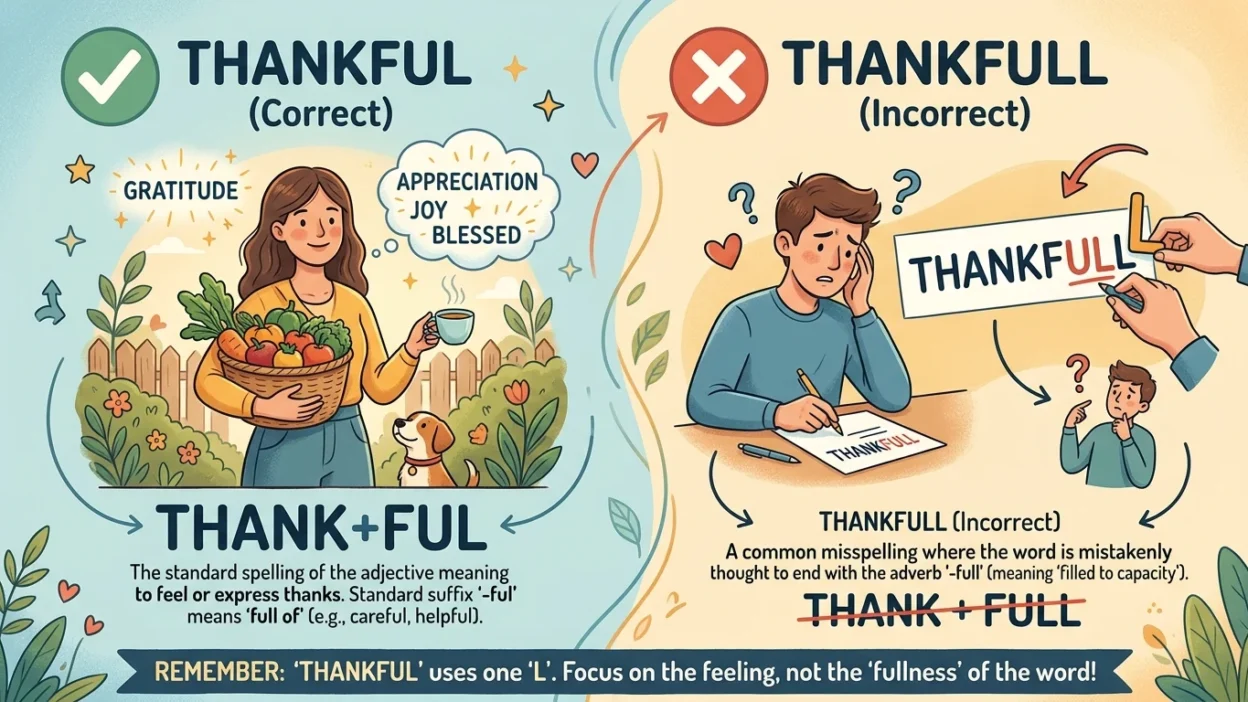
- Thankful ✅ = Correct spelling
- Thankfull ❌ = Incorrect spelling
Easy Rule
Use thankful when talking about feeling grateful or happy about something.
Examples:
- I am thankful for my family.
- She felt thankful for the help.
- We are thankful to our teacher.
Never use thankfull in standard English writing.
Simple Background of the Word
The word thankful comes from the word “thank.”
The ending “-ful” means “full of” something.
So:
- thankful = full of thanks
- careful = full of care
- helpful = full of help
In English, many words use the ending “-ful” with only one “l.”
That is why:
- thankful ✅
- useful ✅
- helpful ✅
Not:
- thankfull ❌
- usefull ❌
- helpfull ❌
The confusion happens because the word “full” by itself has two “l” letters. But when it becomes the ending “-ful,” English usually keeps only one “l.”
What Is the Difference Between Thankful and Thankfull?
The biggest difference is very simple:
| Word | Correct or Incorrect? | Meaning |
| thankful | Correct | Feeling grateful |
| thankfull | Incorrect | Not a standard English word |
“Thankfull” is only a spelling mistake. It is not accepted in normal English writing, school work, books, emails, or professional communication.
Understanding “Thankful”
Meaning of Thankful
“Thankful” means:
- feeling grateful
- appreciating something
- being happy for help, kindness, or good things
Examples
- I am thankful for your support.
- They were thankful after the safe trip.
- We feel thankful for good friends.
The word is positive and warm. People often use it during:
- family conversations
- thank-you messages
- speeches
- holidays
- school writing
- social media posts
Why People Write “Thankfull”
There are a few reasons why learners make this mistake.
1. The Word “Full” Has Two L’s
People think:
- full → thankfull
But English changes the spelling when “-ful” becomes a suffix.
2. Typing Fast
Many spelling mistakes happen during fast typing, especially on phones or social media.
3. English Spelling Rules Can Be Confusing
English has many unusual spelling patterns. Beginners often add extra letters because other words look similar.
Easy Comparison Table
Thankful vs Thankfull
| Feature | Thankful | Thankfull |
| Correct spelling | Yes | No |
| Used in dictionaries | Yes | No |
| Used in schools | Yes | No |
| Used in professional writing | Yes | No |
| Meaning | Feeling grateful | Spelling mistake |
| Common in English | Very common | Incorrect form |
Which One Should You Use?
You should always use thankful.
Use “Thankful” When:
- writing essays
- sending emails
- posting online
- writing messages
- speaking English
- doing homework
- making cards or notes
Correct Examples
- I am thankful for your kindness.
- She was thankful to get another chance.
- We are thankful for peace and safety.
Common Mistakes People Make
Mistake 1: Adding an Extra “L”
❌ I am thankfull for your help.
✅ I am thankful for your help.
Mistake 2: Thinking Both Spellings Are Acceptable
Some people believe both forms are correct. They are not.
Only thankful is accepted in standard English.
Mistake 3: Copying Incorrect Online Writing
Social media and comments sometimes contain spelling mistakes. Just because you see “thankfull” online does not mean it is correct.
Always check trusted English spelling rules.
Everyday Real-Life Examples
Here are examples of how people use thankful in daily life.
In Emails
- Thank you for your support. I am truly thankful.
- We are thankful for your quick reply.
In Text Messages
- I’m thankful you called me today.
- So thankful for your friendship!
On Social Media
- Feeling thankful for another beautiful day.
- Very thankful for everyone who supported me.
In School Writing
- The character was thankful after receiving help.
- I am thankful for my parents and teachers.
In News or Public Speaking
- The family said they were thankful for community support.
- Citizens felt thankful after the rescue effort.
Helpful Memory Trick
Here is an easy way to remember the correct spelling:
Think About These Words:
- helpful
- useful
- careful
- joyful
All of them end with “-ful” using only one “l.”
So:
- thankful ✅
Not:
- thankfull ❌
Short Learning Section for Students and Beginners
Easy Grammar Tip
“Thankful” is an adjective.
An adjective describes a feeling or condition.
Examples
- happy
- grateful
- thankful
- excited
Sentence Practice
Fill in the blank:
- I am ______ for your kindness.
- She felt ______ after the good news.
- We are ______ to our teachers.
Answer: thankful
Easy Pronunciation Help
“Thankful” sounds like:
THANK-ful
The second part is soft and short.
Mini Writing Practice
Try writing your own sentences:
- I am thankful for…
- My family is thankful because…
- Today I feel thankful about…
This helps learners remember the correct spelling naturally.
Thankful in Positive English Communication
The word “thankful” is often connected with:
- kindness
- gratitude
- appreciation
- respect
- happiness
Using this word can make your writing sound warm and polite.
Examples
- We are thankful for your patience.
- I’m thankful for this opportunity.
- She felt thankful after recovering from illness.
FAQ: Thankful vs Thankfull
1. Is “thankfull” a real word?
No. “Thankfull” is not a correct English spelling.
2. Which spelling should I use?
Always use thankful.
3. Why does “thankful” have only one “l”?
Because the suffix “-ful” usually uses one “l” in English spelling.
4. Do native English speakers make this mistake?
Yes. Even native speakers sometimes type “thankfull” by accident.
5. Is “thankfull” acceptable in informal writing?
No. It is still considered a spelling error.
6. Can spelling checkers detect this mistake?
Most spelling tools will mark “thankfull” as incorrect.
7. What part of speech is “thankful”?
It is an adjective.
8. What is another word for thankful?
Some similar words are:
- grateful
- appreciative
- pleased
Simple Practice Quiz
Choose the correct spelling:
- I am thankful / thankfull for your help.
- She felt thankful / thankfull after the gift.
- We are thankful / thankfull to our parents.
Correct Answers
- thankful
- thankful
- thankful
Final Thoughts
The difference between thankful and thankfull is actually very simple once you learn the spelling rule.
- Thankful is the correct word.
- Thankfull is a spelling mistake.
Remember that many English words use the ending “-ful” with only one “l.” That is why we write:
- thankful
- helpful
- useful
- careful
Learning small spelling rules like this can make your English writing clearer and more confident. The next time you type the word, you will know exactly which spelling to use.