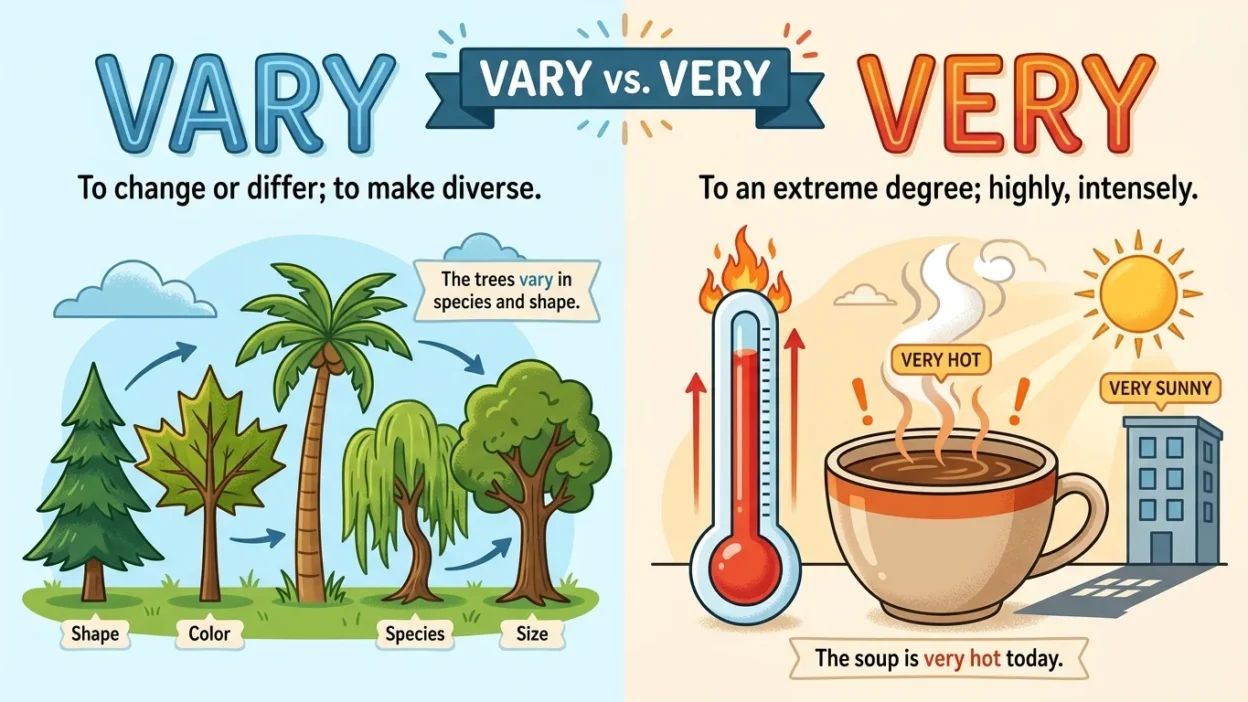
Many people confuse vary and very because the words look almost the same. They also sound similar when spoken quickly. Students, ESL learners, and even native speakers sometimes mix them up in writing.
But the good news is that the meanings are completely different.
One word talks about change or difference, while the other word adds strong feeling or emphasis. Once you understand this simple idea, the confusion becomes much easier to fix.
This guide explains everything in very simple English with clear examples, easy tables, and common mistakes to help you remember the difference forever.
Quick Answer
Here is the short and simple answer:
- Vary = to change or to be different
- Very = used to make something stronger or more intense
Easy Examples
- Prices vary from store to store.
- The movie was very funny.
Simple Memory Trick
- Vary → think about variation or change
- Very → think about making something stronger
Simple Background of the Words
Learning a little background can help you remember the meanings better.
Vary
The word vary comes from an old word meaning “to change” or “to become different.”
It is connected to words like:
- variety
- variable
- variation
All of these words are related to difference or change.
Very
The word very has been used in English for a long time to add strength or emphasis to another word.
It is often used before:
- adjectives
- adverbs
Examples:
- very cold
- very slowly
- very happy
What Is the Difference Between Vary and Very?
The main difference is simple:
| Word | Main Meaning | Word Type |
| Vary | To change or differ | Verb |
| Very | Adds emphasis or strength | Adverb |
Understanding “Vary”
Vary is an action word. It means things are not all the same.
Examples:
- Weather conditions vary across the country.
- Prices vary during holidays.
- Students vary in skill level.
In all these examples, something changes or differs.
Understanding “Very”
Very is used to make another word stronger.
Examples:
- She is very kind.
- The test was very easy.
- I am very tired today.
Here, very increases the strength of the description.
Easy Comparison Table
| Feature | Vary | Very |
| Meaning | To change or differ | Adds emphasis |
| Type of Word | Verb | Adverb |
| Used For | Differences and changes | Strong feelings or descriptions |
| Example | Results vary each year. | The results are very good. |
| Related Words | variation, various | extremely, really |
| Can It Stand Alone? | Usually yes | Usually used before another word |
Which One Should You Use and When?
Use “Vary” When Talking About Change
Use vary when things are:
- different
- changing
- not the same
Examples
- Opinions vary among teachers.
- Colors vary in different lights.
- Travel costs vary by season.
You can also use forms like:
- varies
- varied
- varying
Example:
- Her mood varies during the week.
Use “Very” to Make Something Stronger
Use very when you want extra emphasis.
Examples
- The soup is very hot.
- He runs very fast.
- That was very interesting.
You can use very with many describing words.
Examples:
- very big
- very small
- very beautiful
- very difficult
Common Mistakes People Make
Because the words look similar, many learners write the wrong one by accident.
Mistake 1: Using “Very” Instead of “Vary”
❌ Prices very between stores.
✅ Prices vary between stores.
Why?
Because prices are changing or different.
Mistake 2: Using “Vary” Instead of “Very”
❌ The movie was vary funny.
✅ The movie was very funny.
Why?
Because you are adding strength to “funny.”
Mistake 3: Spelling Problems
Some learners accidentally spell:
- vary → very
- very → vary
This often happens during fast typing.
A helpful trick:
- vary = change
- very = strong feeling
Mistake 4: Confusing Pronunciation
The pronunciation is close, but not exactly the same.
- vary sounds like “VAIR-ee”
- very sounds like “VEH-ree”
Listening practice can help improve this.
Everyday Real-Life Examples
In Emails
- Meeting times may vary next week.
- Thank you very much for your help.
In News Reports
- Temperatures vary across the region.
- The storm was very powerful.
On Social Media
- Reactions vary from person to person.
- This video is very funny.
In School
- Students vary in learning speed.
- The lesson was very simple.
In Shopping
- Prices vary by brand.
- This phone is very expensive.
In Daily Conversation
- Opinions vary about the movie.
- I am very hungry right now.
Easy Sentence Practice
Sentences with “Vary”
- Results vary each month.
- Sizes vary from small to large.
- Rules vary in different schools.
- Prices vary during sales.
- Colors vary under sunlight.
Sentences with “Very”
- She is very smart.
- The room is very clean.
- I am very excited.
- The weather is very cold.
- He speaks very clearly.
Helpful Memory Tricks
Trick for “Vary”
Think:
- variation
- various
- variable
All these words connect to change or difference.
Trick for “Very”
Think about adding power to a sentence.
Example:
- happy → very happy
- cold → very cold
The word makes the feeling stronger.
Short Learning Section for Students and Beginners
If you are learning English, here is the easiest way to remember these words.
Step 1: Ask Yourself a Question
Ask:
“Am I talking about change?”
- Yes → use vary
- No → continue
Ask:
“Am I making a word stronger?”
- Yes → use very
Step 2: Practice Small Sentences
Practice these pairs:
- Weather conditions vary.
- The weather is very cold.
- Opinions vary.
- The movie is very popular.
Reading these aloud helps your memory.
Step 3: Look for the Word After It
Usually:
- very comes before an adjective or adverb
- vary acts as the main action in the sentence
Examples:
- very fast
- very kind
But:
- prices vary
- opinions vary
Mini Quiz
Choose the correct word.
1. Prices _____ from city to city.
- vary
- very
✅ Answer: vary
2. She is _____ friendly.
- vary
- very
✅ Answer: very
3. Weather conditions _____ during winter.
- vary
- very
✅ Answer: vary
4. The exam was _____ difficult.
- vary
- very
✅ Answer: very
FAQ Section
1. Is “vary” a verb?
Yes. “Vary” is a verb because it shows action or change.
Example:
- Opinions vary widely.
2. Is “very” an adjective?
No. “Very” is usually an adverb. It strengthens another word.
Example:
- very tall
3. Can “very” be used alone?
Usually no. It normally comes before another word.
Example:
- very happy
- very slow
4. Can “vary” describe differences?
Yes. It is commonly used to show differences or change.
Example:
- Results vary by age group.
5. Why do learners confuse these words?
They look and sound similar, especially in fast speech or typing.
6. What is an easy way to remember the difference?
- vary = change
- very = stronger feeling
7. Which word is more common in daily conversation?
Both are common, but “very” appears more often in everyday speech.
8. Can I replace “very” with “really”?
Often yes.
Example:
- very good
- really good
But “vary” cannot replace “really.”
Conclusion
The difference between vary and very is actually simple once you focus on meaning.
- Vary means things change or are different.
- Very adds stronger feeling or emphasis.
Remember this easy rule:
- If something changes → use vary
- If you want stronger description → use very
With practice, reading, and simple sentence examples, you will quickly stop confusing these two words. Even small grammar differences become easy when explained clearly and step by step.