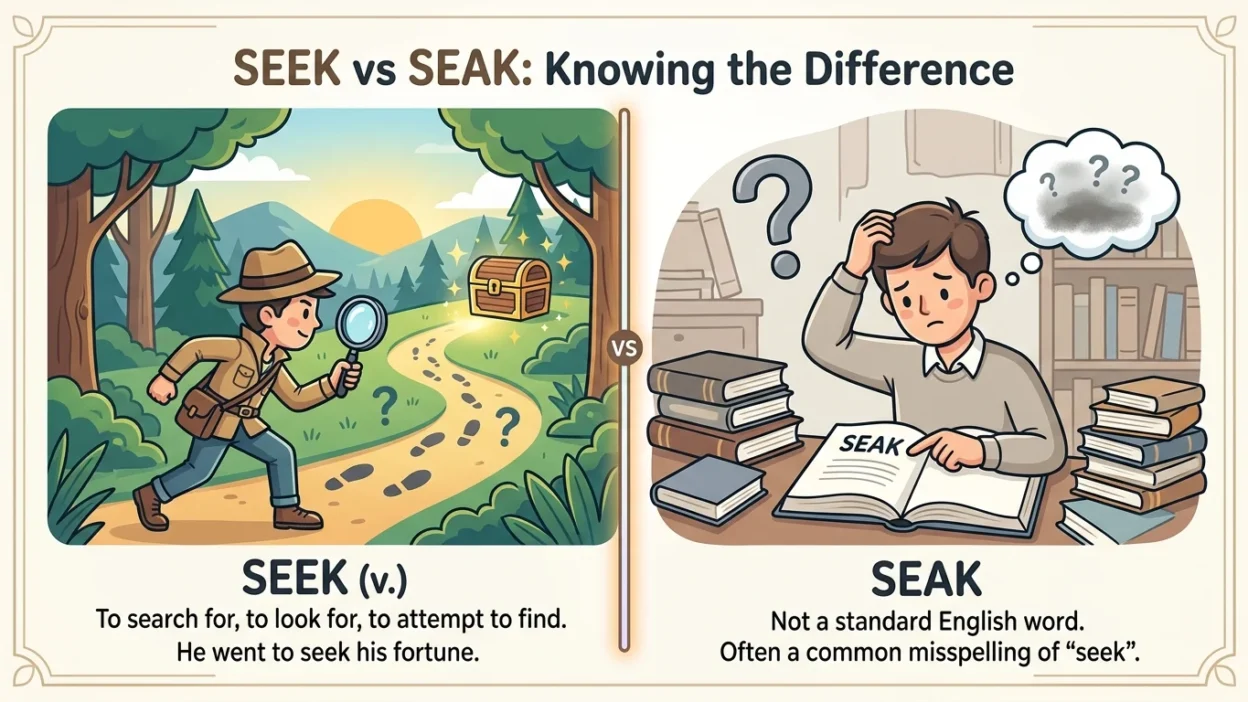
Many people get confused between “seak” and “seek” because the two words look and sound very close. This confusion is common for students, ESL learners, and even native English speakers when typing quickly.
The good news is that the difference is actually very simple.
One word is correct English, and the other is usually just a spelling mistake. Once you understand how “seek” works, you will probably never confuse these words again.
This guide explains everything in very easy English with examples, tables, and simple tips.
Quick Answer
Here is the short and simple answer:
- Seek = a real English word
- Seak = usually a spelling mistake of “seek”
- Use seek when talking about:
- looking for something
- trying to find something
- asking for help or information
Correct Examples
- I want to seek advice.
- They seek a better life.
- She went to seek help.
Incorrect Examples
- I want to seak advice.
- They seak a better job.
Simple Background of the Word “Seek”
The word seek is a very old English word. It has been used for hundreds of years.
It means:
- to look for something
- to try to get something
- to search for something carefully
People use “seek” in:
- daily conversations
- books
- news reports
- school writing
- business emails
The word “seak” does not have the same meaning in normal modern English. In most cases, it is simply a typing or spelling error.
People often write “seak” because:
- the sound is similar
- English spelling can be confusing
- “ea” and “ee” sometimes sound alike
What Does “Seek” Mean?
“Seek” means:
- to search
- to look for
- to try to find
- to ask for
Easy Examples
- We seek peace.
- She seeks new opportunities.
- They are seeking answers.
- I need to seek medical help.
The word can be used in many situations.
Common Things People Seek
- help
- information
- jobs
- advice
- truth
- peace
- answers
- support
Is “Seak” a Real Word?
In normal English writing, “seak” is not considered the correct spelling for the meaning of “look for” or “search.”
Most of the time:
- “seak” = spelling mistake
- “seek” = correct word
Spell-check tools usually change “seak” to “seek.”
So if you are writing about searching, asking, or trying to find something, always use seek.
Main Difference Between Seak and Seek
The difference is very easy:
| Word | Correct? | Meaning |
| Seek | Yes | To look for or try to find |
| Seak | No (usually) | Common spelling mistake |
Comparison Table
Here is a simple table to help you remember.
| Feature | Seek | Seak |
| Real English word | Yes | Usually no |
| Correct spelling | Yes | No |
| Used in dictionaries | Yes | Usually no |
| Meaning | Search or look for | None in normal use |
| Common in writing | Very common | Usually a typo |
| Example | Seek help | Seak help ❌ |
Which One Should You Use?
You should use seek anytime you mean:
- look for
- search for
- ask for
- try to get
Use “Seek” in These Situations
Looking for Information
- Students seek knowledge.
- Reporters seek the truth.
Asking for Help
- You should seek medical advice.
- He sought support from friends.
Trying to Get Something
- Many people seek success.
- She seeks happiness.
Forms of the Word “Seek”
Like many English verbs, “seek” changes form.
| Tense | Word |
| Present | seek |
| Past | sought |
| Continuous | seeking |
| Third person | seeks |
Examples
- I seek answers.
- Yesterday, I sought help.
- They are seeking a solution.
- She seeks attention.
Common Mistakes People Make
1. Writing “Seak” Instead of “Seek”
❌ Wrong:
- I seak advice.
✅ Correct:
- I seek advice.
This is the most common mistake.
2. Mixing Up “Seek” and “Search”
These words are similar but not always exactly the same.
- “Seek” often sounds more formal.
- “Search” is more direct.
Examples
- Police searched the building.
- The company seeks new workers.
3. Wrong Past Tense
Some learners write:
- “seeked”
But the correct past tense is:
- “sought”
Example
❌ I seeked help.
✅ I sought help.
4. Using “Seek” in Every Situation
Sometimes “look for” sounds more natural in casual speaking.
Example
Formal:
- We seek answers.
Casual:
- We are looking for answers.
Both are correct.
Everyday Real-Life Examples
Understanding words becomes easier with real examples.
In Emails
- Please seek approval before sending the file.
- We seek your feedback on this project.
In News Reports
- Leaders seek peace talks.
- Police seek information from the public.
On Social Media
- Many young people seek motivation online.
- People seek honest reviews before buying products.
In School
- Students should seek help when confused.
- Teachers encourage learners to seek knowledge.
In Daily Conversation
- I need to seek advice from my parents.
- She is seeking a new apartment.
Simple Tips to Remember the Correct Word
Here are easy memory tricks.
Tip 1: “Seek” Has Double “E”
Think of:
- sEEk = sEEarch
Both have “ee.”
Tip 2: Remember the Meaning
If you mean:
- search
- look for
- ask for
then use:
- seek
Tip 3: Read the Sentence Aloud
If “seak” looks strange while reading, it is probably wrong.
Short Learning Section for Students and Beginners
Here is a simple learning practice section.
Fill in the Blank
Choose the correct word.
- I want to ___ help.
- They ___ a better future.
- She is ___ advice online.
Answers
- seek
- seek
- seeking
Easy Sentence Practice
Correct Sentences
- We seek peace.
- He seeks attention.
- They sought help yesterday.
- I am seeking information.
Incorrect Sentences
- We seak peace.
- He seaks attention.
- They seeked help.
Why Do People Spell It as “Seak”?
English spelling is not always simple.
People confuse “seek” and “seak” because:
- “ea” and “ee” can sound similar
- typing mistakes happen
- English has many unusual spellings
Examples:
- speak
- weak
- peak
These words use “ea,” so learners sometimes think “seek” should also use “ea.”
But the correct spelling is:
- seek
Seek in Formal and Informal English
“Seek” is often used in more formal English.
Formal Style
- The company seeks experienced workers.
- We seek justice.
Informal Style
- The company is looking for workers.
- We want justice.
Both styles are correct.
Frequently Asked Questions (FAQ)
1. Is “seak” a real English word?
Usually no. In most situations, it is just a spelling mistake of “seek.”
2. Which spelling is correct: seak or seek?
The correct spelling is:
- seek
3. What does “seek” mean?
It means:
- to look for
- to search for
- to try to find
4. What is the past tense of “seek”?
The past tense is:
- sought
Example:
- She sought help.
5. Can I use “seek” in daily conversation?
Yes. It is common and correct in both speaking and writing.
6. Why do people confuse these words?
Because the spellings and sounds are similar.
7. Is “seek” formal?
It can sound more formal than “look for,” but people still use it often.
8. What is another word for “seek”?
Some similar words are:
- search for
- look for
- try to find
Final Thoughts
The difference between seak and seek is actually very simple once you learn it clearly.
- Seek is the correct English word.
- Seak is usually a spelling mistake.
Use seek when talking about:
- searching
- looking for something
- asking for help
- trying to find answers or opportunities
The more you read and practice, the easier it becomes to remember the correct spelling. Small spelling mistakes are normal while learning English, and understanding them step by step helps build confidence.
If you remember one thing from this guide, remember this:
Seek = correct
Seak = usually incorrect