Many people get confused between “onamonapia” and “onomatopoeia.”
The confusion happens because both words sound very similar when spoken out loud. Also, “onomatopoeia” is a long and difficult word to spell, so many people accidentally write it as “onamonapia” or in other incorrect ways.
If you have ever searched for “onamonapia,” you are not alone. Students, ESL learners, and even native English speakers often misspell this word.
The good news is simple:
- Onomatopoeia is the correct English word.
- Onamonapia is a misspelling.
This article explains everything in very easy English so you can understand the difference clearly and never feel confused again.
Quick Answer
Here is the short and simple answer:
- ✅ Onomatopoeia = Correct spelling
- ❌ Onamonapia = Incorrect spelling
- “Onomatopoeia” is a real English word
- “Onamonapia” is not found in standard dictionaries
- The word means a sound word like:
- buzz
- bang
- meow
- splash
Example:
- ✅ “Buzz” is an example of onomatopoeia
- ❌ “Buzz” is not an example of “onamonapia”
Simple Background and Origin
The word onomatopoeia comes from old Greek language roots.
It was created to describe words that sound like the noise they represent.
For example:
- A bee makes a “buzz” sound
- A cat makes a “meow” sound
- Rain can go “pitter-patter”
These words copy real sounds, so they are called onomatopoeia.
Over time, the word became part of English grammar and literature lessons.
Because the spelling is long and unusual, many people type it incorrectly. One common mistake is writing:
- onamonapia
- onomatapea
- onomotopoeia
- onomatapoeia
Among these, “onamonapia” is simply a spelling error.
What Does Onomatopoeia Mean?
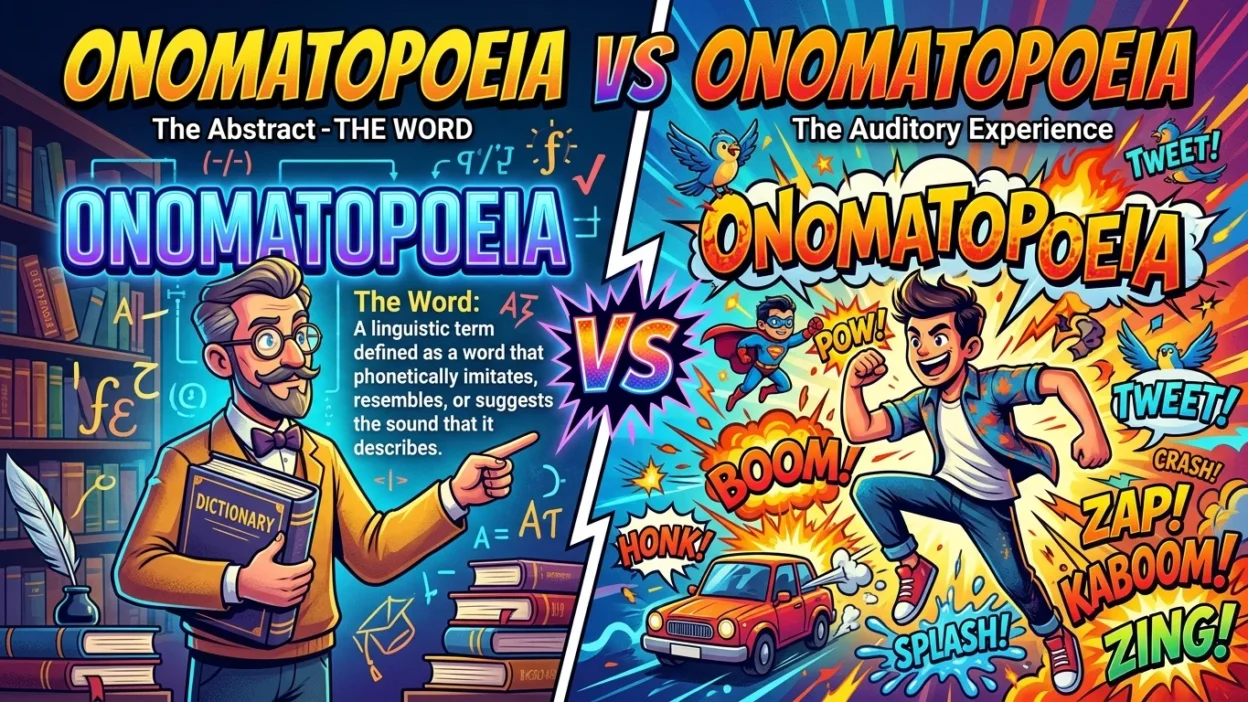
Onomatopoeia means a word that sounds like the noise it describes.
These words help readers and listeners imagine sounds more clearly.
Easy Examples
| Sound | Word |
| Dog sound | Woof |
| Clock sound | Tick-tock |
| Explosion | Boom |
| Cat sound | Meow |
| Door sound | Creak |
| Water sound | Splash |
These are all examples of onomatopoeia.
What Is “Onamonapia”?
“Onamonapia” is not a correct English word.
People usually write it by mistake because:
- the real word is hard to spell
- the pronunciation is tricky
- letters get mixed up easily
Many learners hear the word in class or online and try to spell it from memory. That often leads to incorrect spellings like “onamonapia.”
So if you see “onamonapia,” it almost always means the person wanted to write onomatopoeia.
Main Difference Between Onamonapia and Onomatopoeia
The difference is actually very simple.
Onomatopoeia
- Real English word
- Correct spelling
- Used in grammar and writing
- Found in dictionaries
- Means words that copy sounds
Onamonapia
- Incorrect spelling
- Not a real dictionary word
- Usually a typing or spelling mistake
- Should be replaced with “onomatopoeia”
Easy Comparison Table
| Feature | Onomatopoeia | Onamonapia |
| Correct spelling? | Yes | No |
| Real English word? | Yes | No |
| Found in dictionaries? | Yes | No |
| Used in school grammar lessons? | Yes | No |
| Means sound words? | Yes | No |
| Example | buzz, bang, splash | None |
Which One Should You Use?
You should always use onomatopoeia in writing, school work, emails, and daily English.
Never use “onamonapia” unless you are talking about common spelling mistakes.
Correct Usage
✅ “The comic book uses onomatopoeia like ‘boom’ and ‘pow.’”
✅ “Splash is an example of onomatopoeia.”
Incorrect Usage
❌ “The poem contains onamonapia.”
❌ “Bang is an example of onamonapia.”
Why Is “Onomatopoeia” So Hard to Spell?
This word is difficult for many reasons:
1. It Is Long
The word has many letters, so people forget parts of it.
2. The Sound Is Unusual
The pronunciation does not clearly match the spelling for many learners.
3. Similar Letter Patterns
People mix up:
- “poe”
- “pia”
- “mon”
- “mat”
4. Fast Typing Mistakes
When typing quickly, letters can easily get swapped.
Easy Trick to Remember the Correct Spelling
Try breaking the word into smaller parts:
on-o-mat-o-poe-ia
You can also remember this:
“Poe” is inside the word:
onomatoPOEia
Some students remember it by saying it slowly several times.
Common Mistakes People Make
Here are mistakes learners often make with this word.
Mistake 1: Spelling It Wrong
Incorrect:
- onamonapia
- onomatapia
- onomatopiea
Correct:
- onomatopoeia
Mistake 2: Thinking Both Words Are Correct
Some people believe “onamonapia” is another version of the word.
It is not.
Only “onomatopoeia” is correct in standard English.
Mistake 3: Using It in the Wrong Way
Remember:
- onomatopoeia is usually about sound words
Not every descriptive word is onomatopoeia.
For example:
- “loud” is descriptive
- “boom” is onomatopoeia
Mistake 4: Confusing It With Sound Effects Only
Onomatopoeia is not only for comics.
It is also used in:
- poems
- novels
- advertisements
- songs
- conversations
Everyday Real-Life Examples
Here are simple examples from daily life.
In Text Messages
✅ “Haha, the balloon went pop!”
“Pop” is onomatopoeia.
In Social Media Posts
✅ “The fireworks went boom all night.”
“Boom” copies the sound.
In Children’s Books
✅ “The duck said quack.”
“Quack” sounds like the real noise.
In News Writing
✅ “The tires screeched before the crash.”
“Screeched” helps readers imagine the sound.
In Comics
Comic books often use:
- bam
- pow
- boom
- crash
These are famous examples of onomatopoeia.
Short Learning Section for Students and Beginners
If you are learning English, here is the easiest way to understand onomatopoeia:
Ask Yourself This Question
“Does the word sound like the noise?”
If the answer is yes, it may be onomatopoeia.
Practice With Easy Words
Try reading these aloud:
- buzz
- hiss
- clap
- drip
- bang
- zoom
Notice how the words sound like real noises.
That is the key idea of onomatopoeia.
Fun Practice Activity
See if you can identify the sound words below.
Sentence 1
“The bacon sizzled in the pan.”
Sound word:
✅ sizzled
Sentence 2
“The bee went buzz near the flowers.”
Sound word:
✅ buzz
Sentence 3
“The old floor creaked loudly.”
Sound word:
✅ creaked
FAQ Section
1. Is “onamonapia” a real word?
No. It is a misspelling of “onomatopoeia.”
2. What does “onomatopoeia” mean?
It means words that sound like the noises they describe.
Examples:
- bang
- meow
- buzz
3. Why do people spell it as “onamonapia”?
Because the correct word is long and difficult to spell.
4. Is “onomatopoeia” used in schools?
Yes. It is commonly taught in English and literature classes.
5. Can onomatopoeia be used in stories?
Yes. Writers use it to make scenes feel more alive and realistic.
6. Is “boom” an example of onomatopoeia?
Yes. “Boom” sounds like a loud explosion noise.
7. How can I remember the correct spelling?
Break it into parts:
- on-o-mat-o-poe-ia
Practice saying and writing it slowly.
8. Are animal sounds examples of onomatopoeia?
Yes. Many animal sounds are examples, including:
- woof
- meow
- moo
- quack
Conclusion
The difference between onamonapia and onomatopoeia is very simple once you understand it clearly.
- Onomatopoeia is the correct English word.
- Onamonapia is only a spelling mistake.
Onomatopoeia describes words that sound like real noises, such as:
- buzz
- splash
- boom
- meow
Even though the spelling looks difficult at first, it becomes easier with practice. Many learners make mistakes with this word, so you are definitely not alone.
The most important thing to remember is this:
If the word copies a sound, it is probably an example of onomatopoeia.