Many people get confused between everyone and every one because the two expressions look almost the same. They sound the same when spoken, but they do not always mean the same thing.
This small space between the words changes the meaning. That is why students, ESL learners, and even native English speakers sometimes use the wrong one.
The good news is that the difference is actually very simple once you see how each one works in a sentence. In this guide, you will learn the meaning, grammar, examples, and common mistakes in very easy English.
Quick Answer
Here is the simple difference:
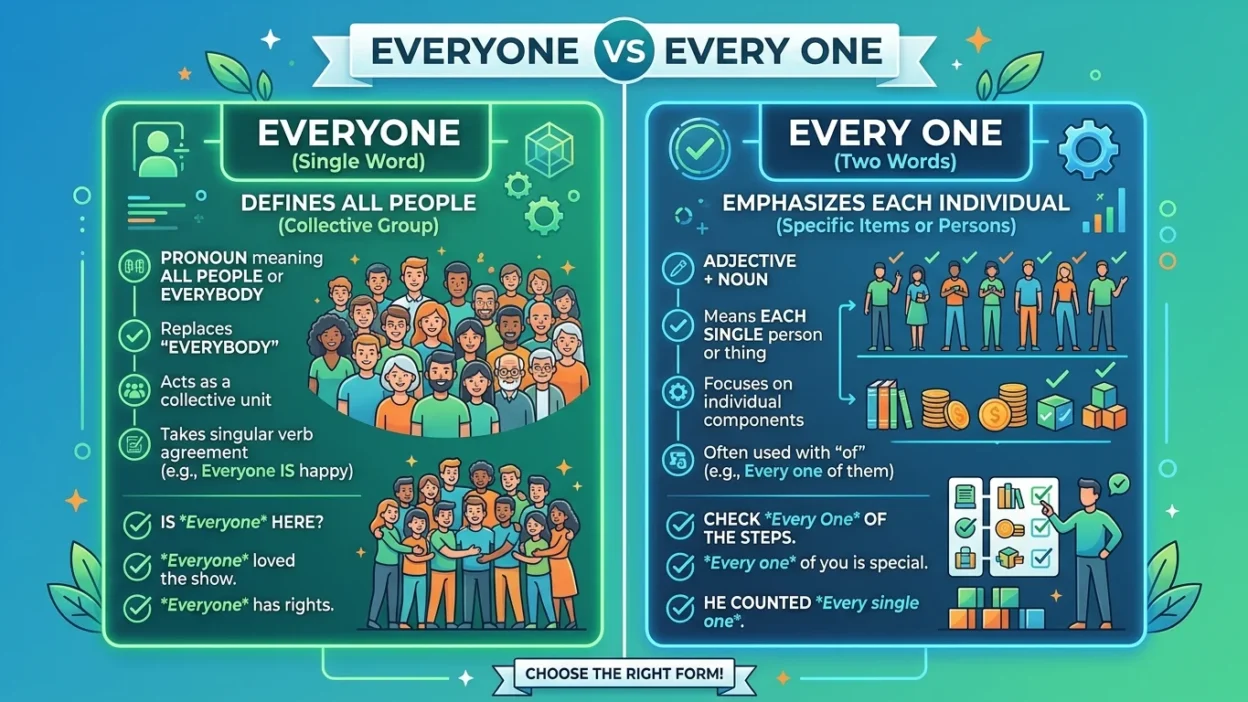
- Everyone = every person
- Every one = each single thing or person in a group
Easy examples
- Everyone enjoyed the movie.
→ means all people enjoyed it - Every one of the cookies is gone.
→ means each cookie is gone
Quick tip
If you can replace the word with everybody, use everyone.
If you are talking about items in a group, use every one.
Simple Background and Origin
The word everyone became common in English as a pronoun that means “all people.”
It works like words such as:
- everybody
- someone
- nobody
Over time, English speakers also kept the separate form every one. This form helps show that we are talking about each member of a group one by one.
That is why both forms still exist today.
Even though they look very similar, English uses them in different ways.
What Does “Everyone” Mean?
Everyone = All People
The word everyone talks about all people in a group.
It is an indefinite pronoun. In simple English, this means it stands for people without naming them directly.
Examples
- Everyone is ready for class.
- Everyone likes free food.
- Everyone laughed at the joke.
- Everyone needs sleep.
- Everyone in the office got the email.
In all these examples, everyone means all the people.
Important Grammar Rule
Even though everyone talks about many people, it is treated as singular in grammar.
Correct
- Everyone is happy.
- Everyone has a ticket.
Incorrect
- Everyone are happy.
- Everyone have a ticket.
This is one of the most common mistakes learners make.
What Does “Every One” Mean?
Every One = Each Single Member of a Group
The phrase every one is different.
Here, the word one is important because it points to individual things or people separately.
Usually, every one is followed by:
- of the
- of these
- of those
- of my
- of our
Examples
- Every one of the books was useful.
- Every one of the students passed.
- Every one of these phones works well.
- I checked every one of the answers.
- Every one of the lights was turned off.
In these examples, the speaker is thinking about each item separately.
Everyone vs Every One: Main Difference
The easiest way to remember the difference is this:
- Everyone = all people together
- Every one = each individual person or thing
Simple Comparison Table
| Feature | Everyone | Every One |
| Meaning | All people | Each single person or thing |
| Word type | Pronoun | Phrase |
| Talks about | People only | People or things |
| Usually followed by “of”? | No | Yes |
| Example | Everyone smiled. | Every one of the cakes was eaten. |
| Can mean “everybody”? | Yes | No |
Which One Should You Use?
Use “Everyone” When Talking About People in General
Choose everyone when you mean all people together.
Examples
- Everyone loves holidays.
- Everyone wants to succeed.
- Everyone in my family can cook.
- Everyone watched the game.
You can often replace it with everybody.
Example
- Everyone is excited.
- Everybody is excited.
Both are correct.
Use “Every One” When Thinking About Individuals Separately
Choose every one when you want to show each item or person one by one.
Examples
- Every one of the apples was fresh.
- Every one of my friends called me.
- Every one of these questions is difficult.
- She thanked every one of the guests.
Here, the focus is on each separate member of the group.
Easy Trick to Remember
Test 1: Can You Replace It with “Everybody”?
If yes, use everyone.
Example
- Everyone enjoyed dinner.
- Everybody enjoyed dinner.
This works, so everyone is correct.
Test 2: Is There an “Of” Phrase After It?
If yes, it is usually every one.
Example
- Every one of the players practiced hard.
The phrase “of the players” tells you to use every one.
Common Mistakes People Make
Mistake 1: Using “Everyone” for Objects
Incorrect
- Everyone of the books is new.
Correct
- Every one of the books is new.
Why? Because books are things, not people.
Mistake 2: Using Plural Verbs
Incorrect
- Everyone are waiting.
Correct
- Everyone is waiting.
Remember: everyone is grammatically singular.
Mistake 3: Writing “Every One” When Meaning “Everybody”
Incorrect
- Every one enjoyed the concert.
Correct
- Everyone enjoyed the concert.
If you mean all people together, use the single-word form.
Mistake 4: Forgetting the Space
Sometimes writers accidentally join or separate the words incorrectly.
Incorrect
- Everyone of us agreed.
Correct
- Every one of us agreed.
The phrase “of us” needs every one.
Everyday Real-Life Examples
In Emails
Everyone
- Everyone received the meeting link.
- Everyone should reply before Friday.
Every One
- Every one of the attached files is important.
- I checked every one of your comments.
In Social Media Posts
Everyone
- Everyone is talking about the new movie.
- Thanks everyone for your support!
Every One
- Every one of these pictures makes me smile.
- I loved every one of your messages.
In School or Classroom English
Everyone
- Everyone finished the test early.
- Everyone must bring a notebook tomorrow.
Every One
- Every one of the questions has two answers.
- The teacher reviewed every one of the essays.
In News or Daily Conversation
Everyone
- Everyone felt shocked by the news.
- Everyone wants lower prices.
Every One
- Every one of the damaged houses will be repaired.
- Police checked every one of the bags.
Learning Section for Students and Beginners
Step-by-Step Learning
Here is the easiest way to learn this topic:
Step 1: Ask Yourself
Are you talking about:
- all people together?
- or each item/person separately?
Step 2: Choose the Correct Form
Use:
- everyone → for all people together
- every one → for each separate member
Step 3: Look for “of”
If the sentence has:
- of the
- of these
- of us
- of them
then every one is often correct.
Mini Practice
Choose the correct answer.
- ___ enjoyed the party.
- ___ of the chairs is broken.
- ___ wants to win.
- I read ___ of the articles.
Answers
- Everyone
- Every one
- Everyone
- Every one
FAQ Section
1. Is “everyone” one word or two?
Usually, everyone is one word when it means all people.
Example:
- Everyone is here.
2. What does “every one” mean?
It means each single member of a group.
Example:
- Every one of the cookies was eaten.
3. Can “everyone” talk about objects?
No. Everyone is used for people only.
Incorrect:
- Everyone of the books
Correct:
- Every one of the books
4. Is “everyone” singular or plural?
It is grammatically singular.
Correct:
- Everyone is happy.
5. Can I replace “everyone” with “everybody”?
Yes, in most cases.
Example:
- Everyone laughed.
- Everybody laughed.
Both are correct.
6. Why do people confuse these words?
Because they sound the same in speech and look almost identical in writing.
7. Does “every one” always use “of”?
Very often, yes.
Examples:
- every one of us
- every one of them
- every one of the books
8. Which form is more common?
“Everyone” is more common in daily conversation because people often talk about groups of people.
Conclusion
The difference between everyone and every one is small but important.
Remember this simple rule:
- Everyone = all people together
- Every one = each individual person or thing
If you mean “everybody,” use everyone.
If you are talking about separate members of a group, especially with “of,” use every one.
With a little practice, choosing the correct form becomes very easy. Soon, you will be able to use both naturally in school writing, emails, conversations, and everyday English.