Many English learners get confused between sung and sang because both words come from the verb sing. They look similar, sound related, and both talk about music or singing. Because of this, people often use the wrong word in speaking and writing.
The good news is that the difference is actually very simple once you understand the verb forms. In this guide, you will learn when to use sang, when to use sung, and how to avoid common mistakes in everyday English.
Quick Answer: Sung vs Sang
Here is the simple answer:
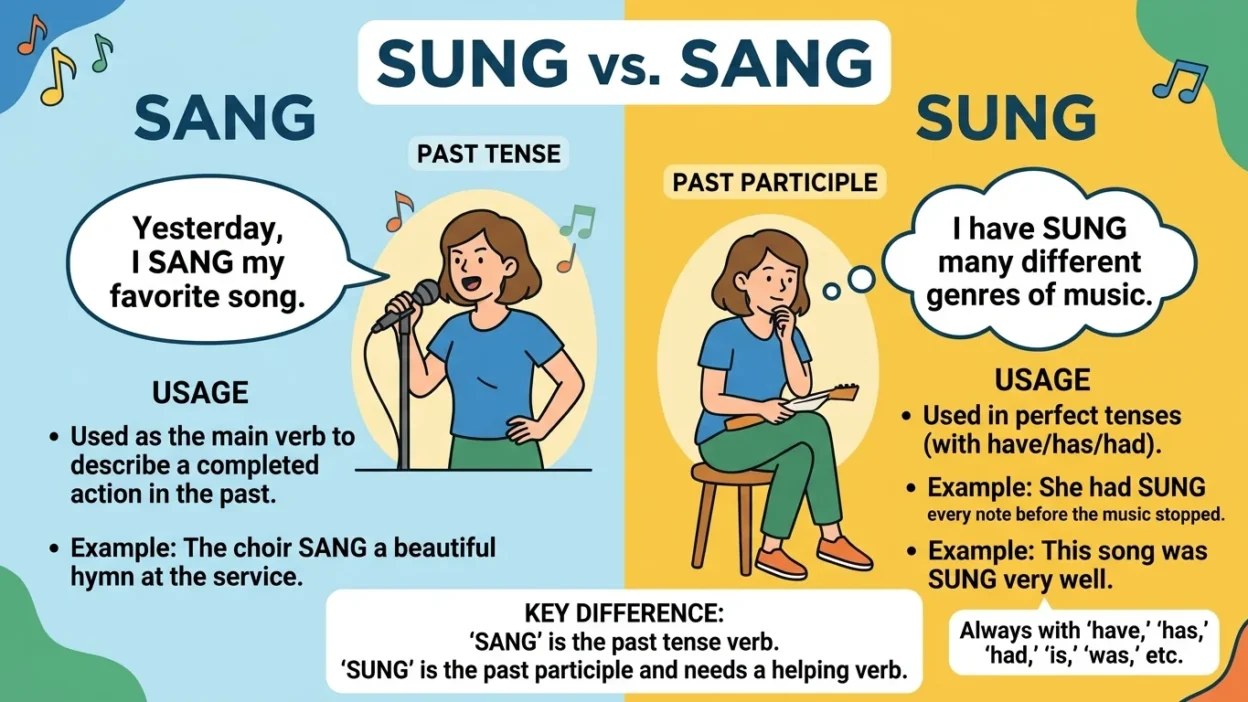
- Sang is the simple past tense of sing
- Sung is the past participle of sing
- Sung usually needs a helping verb like:
- has
- have
- had
- was
- were
Examples
- She sang beautifully last night. ✅
- She has sung beautifully for many years. ✅
Easy Memory Tip
- Sang = action happened in the past
- Sung = used with helping verbs
The Simple Background of These Words
English has many irregular verbs. That means they do not follow the normal “-ed” pattern.
For example:
| Base Verb | Past Tense | Past Participle |
| sing | sang | sung |
This pattern is old and has been part of English for a very long time.
Many similar verbs change their vowels too:
- ring → rang → rung
- drink → drank → drunk
- swim → swam → swum
So sang and sung follow a common English pattern.
What Does “Sang” Mean?
Sang is the simple past form of sing.
You use it when talking about something that happened in the past.
Structure
Subject + sang
Examples
- I sang at the school event.
- They sang loudly in the car.
- My mother sang my favorite song yesterday.
- The crowd sang together after the game.
In all these examples, the action already happened and is finished.
What Does “Sung” Mean?
Sung is the past participle form of sing.
It is usually used with helping verbs.
Common Helping Verbs
- has
- have
- had
- was
- were
- being
Structure
Subject + helping verb + sung
Examples
- She has sung in many concerts.
- The song was sung by a famous singer.
- We had sung before dinner.
- They have sung together for years.
Without a helping verb, sung is usually incorrect.
Main Difference Between Sung and Sang
The biggest difference is grammar.
Sang
Use sang for a completed action in the past.
Example
- He sang at the wedding.
This sentence is complete by itself.
Sung
Use sung with a helping verb.
Example
- He has sung at many weddings.
This sentence needs “has.”
Easy Comparison Table
| Feature | Sang | Sung |
| Verb type | Past tense | Past participle |
| Needs helping verb? | No | Yes |
| Used alone? | Yes | Usually no |
| Talks about past action? | Yes | Yes |
| Example | She sang yesterday. | She has sung before. |
Which One Should You Use?
Use “Sang” When:
- You talk about a finished action
- The sentence does not have a helping verb
- You mention a specific past time
Examples
- We sang at school today.
- He sang during the show.
- They sang all night.
Use “Sung” When:
- You use has, have, or had
- You make passive voice sentences
- You talk about experience or completed actions connected to the present
Examples
- I have sung that song before.
- The national anthem was sung beautifully.
- She had sung in many competitions.
Common Mistakes People Make
Many learners mix these words because both refer to singing in the past.
Here are the most common mistakes.
Mistake 1: Using “Sung” Alone
❌ I sung yesterday.
✅ I sang yesterday.
Why?
Because “sung” needs a helping verb.
Mistake 2: Using “Sang” With “Has”
❌ She has sang before.
✅ She has sung before.
Why?
After “has,” use the past participle form.
Mistake 3: Confusing Past Tense and Past Participle
Some learners think both words mean exactly the same thing.
They are connected, but they work differently in grammar.
Correct Pattern
- sing → present
- sang → past
- sung → past participle
Everyday Real-Life Examples
Seeing real examples makes learning easier.
In Daily Conversation
- My brother sang at the party.
- Have you ever sung in public?
In School
- The students sang the school song.
- The anthem was sung before the match.
In Emails
- She sang beautifully at yesterday’s event.
- The song has been sung by many artists.
On Social Media
- We sang our hearts out tonight!
- This classic song has been sung for generations.
In News Reports
- The singer sang three new songs last night.
- The opening song was sung by local students.
Easy Learning Section for Students and Beginners
Here is a very simple way to remember everything.
Step 1: Learn the Three Forms
| Verb Form | Word |
| Present | sing |
| Past | sang |
| Past participle | sung |
Say them aloud:
sing – sang – sung
Step 2: Check for Helping Verbs
Ask yourself:
Does the sentence have:
- has
- have
- had
- was
- were
If yes, use sung.
Example
- They have sung already.
Step 3: No Helping Verb?
Use sang.
Example
- They sang already.
Step 4: Practice Small Sentences
Practice these every day:
- I sang.
- She sang.
- We have sung.
- They had sung.
Short practice helps your brain remember faster.
Simple Practice Quiz
Choose the correct word.
1. She _____ at the concert yesterday.
- sung
- sang
✅ Answer: sang
2. They have _____ this song many times.
- sang
- sung
✅ Answer: sung
3. The anthem was _____ before the game.
- sang
- sung
✅ Answer: sung
4. We _____ together last night.
- sang
- sung
✅ Answer: sang
Frequently Asked Questions (FAQ)
1. Is “I sung” correct?
Usually no.
Correct:
- I sang yesterday.
- I have sung before.
2. Why does “sung” need a helping verb?
Because it is a past participle, not a simple past verb.
Past participles usually work with helping verbs.
3. Can “sang” and “sung” mean the same thing?
They both relate to singing in the past, but their grammar use is different.
4. Which word is more common in speaking?
Both are common.
People use:
- sang for simple past actions
- sung with helping verbs
5. What is the full verb form?
- sing
- sang
- sung
6. Is “has sang” correct?
No.
Correct sentence:
- She has sung before.
7. Can “sung” be used in passive voice?
Yes.
Example:
- The song was sung beautifully.
8. How can I remember the difference easily?
Remember this rule:
- No helping verb → sang
- Helping verb present → sung
Final Thoughts
The difference between sung and sang becomes much easier once you understand basic verb forms.
Use sang for a simple past action:
- She sang yesterday.
Use sung with helping verbs:
- She has sung before.
A quick way to remember is this:
- Sang stands alone
- Sung usually works with another verb
With a little practice, these two words will soon feel natural in your speaking and writing.