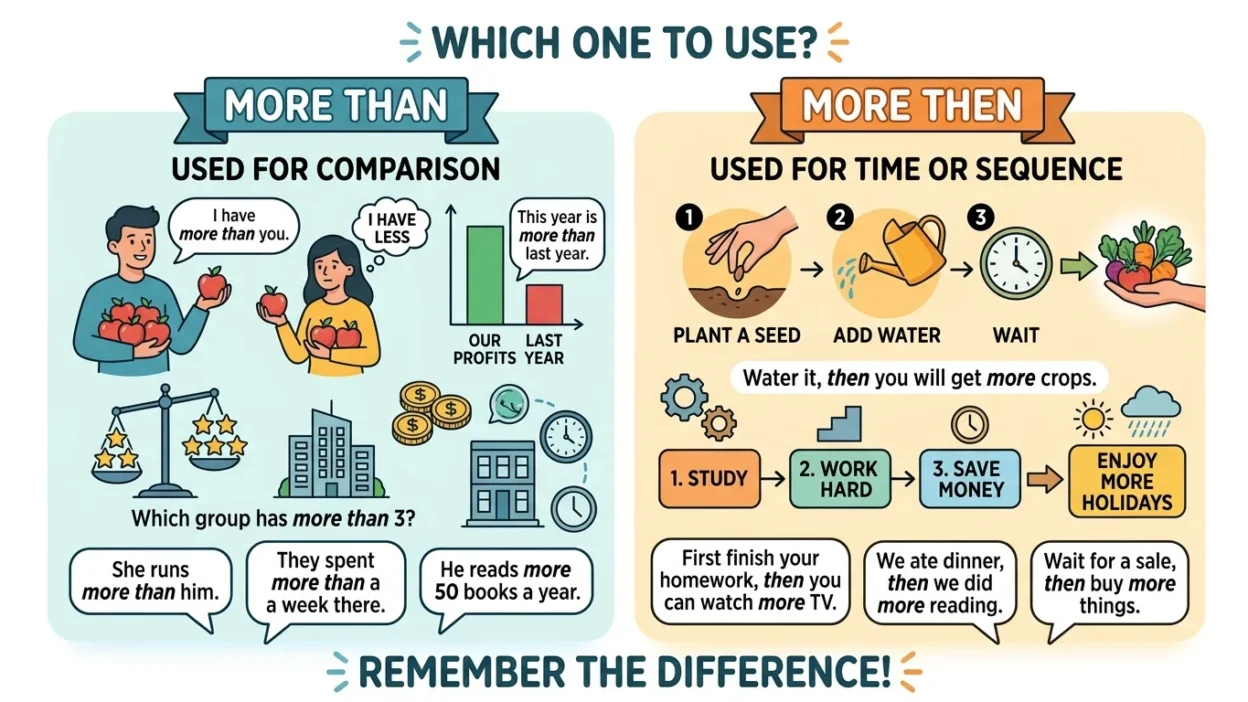
Many English learners get confused by “more than” and “more then.” The two phrases look almost the same, and the words than and then sound similar when spoken quickly.
Because of this, people often type the wrong one in messages, school work, emails, and social media posts.
The good news is that the difference is actually very simple. Once you understand what each word means, you will probably never mix them up again.
This guide explains everything in very easy English so students, beginners, and ESL learners can understand it clearly.
Quick Answer
- More than = correct when comparing things
- Example: She is more than ready.
- More then = usually incorrect
- Example: ❌ I have more then you.
- Use than for comparisons.
- Use then for time or order.
Easy memory trick
- Than → comparison
- Then → time
A Simple Background Explanation
The confusion happens because than and then are very close in spelling and sound.
But they have different jobs in English.
The word “than”
“Than” is mainly used when comparing two things.
Examples:
- taller than
- faster than
- more than
- less than
The word “then”
“Then” is connected to time, order, or what happens next.
Examples:
- eat dinner, then sleep
- first study, then relax
- back then
So when people write “more then,” they usually use the wrong word by mistake.
The Real Difference Between More Than and More Then
What Does “More Than” Mean?
“More than” means:
- a larger amount
- greater number
- extra degree
- beyond something
It is the correct phrase in almost all situations.
Examples
- I have more than ten books.
- She earns more than her brother.
- This movie is more than funny.
- We waited more than two hours.
In all these examples, something is being compared or measured.
What Does “More Then” Mean?
“More then” is usually wrong in normal English sentences.
Most of the time, the writer really means “more than.”
Incorrect Examples
❌ I need more then five minutes.
❌ He has more then me.
❌ There were more then 100 people.
Correct Versions
✔ I need more than five minutes.
✔ He has more than me.
✔ There were more than 100 people.
Comparison Table
| Feature | More Than | More Then |
| Correct in standard English? | Yes | Usually no |
| Main use | Comparison | Time word used wrongly |
| Related word | Than | Then |
| Meaning | Greater amount or degree | Usually a mistake |
| Example | More than 20 students | ❌ More then 20 students |
| Common in writing? | Very common | Common typo |
Which One Should You Use and When?
Use “More Than” When Comparing
Use it when talking about:
- numbers
- amounts
- size
- age
- time
- money
- feelings
- abilities
Examples
- The bag costs more than $50.
- Ali is more than six feet tall.
- I slept for more than eight hours.
- This game is more than exciting.
Use “Then” Only for Time or Order
“Then” is not part of the phrase “more than.”
Use “then” when talking about what happens next.
Examples
- We ate dinner and then watched TV.
- Finish your homework, then go outside.
- Back then, phones were very simple.
Common Mistakes People Make
1. Typing Fast and Choosing the Wrong Word
Many people accidentally write:
❌ more then
instead of:
✔ more than
This happens often on phones and social media.
2. Confusing Sound With Meaning
“Than” and “then” sound alike in many accents.
But remember:
- than = comparison
- then = time
3. Auto-Correct Errors
Sometimes phones or computers change the word automatically.
Always check your sentence before sending it.
4. Mixing Grammar Rules
Some learners know “then” is a real English word, so they think it works everywhere.
But “then” cannot replace “than” in comparisons.
Everyday Real-Life Examples
In Emails
Wrong
❌ We received more then expected.
Correct
✔ We received more than expected.
In School Writing
Wrong
❌ The blue whale is bigger then the elephant.
Correct
✔ The blue whale is bigger than the elephant.
On Social Media
Wrong
❌ I spent more then 3 hours online today.
Correct
✔ I spent more than 3 hours online today.
In News Sentences
Correct Examples
- More than 5,000 people attended the event.
- The company earned more than last year.
- Temperatures rose more than expected.
In Daily Conversation
People say things like:
- I need more than coffee today.
- She knows more than I do.
- That was more than enough food.
These are all correct uses.
Easy Learning Tips for Students and Beginners
Tip 1: Look for a Comparison
Ask yourself:
“Am I comparing something?”
If yes, use than.
Example
- My phone is newer than yours.
Tip 2: Think About Time
Ask:
“Am I talking about what happens next?”
If yes, use then.
Example
- We studied and then went home.
Tip 3: Remember This Tiny Rule
THAN = compare
THEN = time
This small trick helps many learners remember the difference quickly.
Tip 4: Read the Sentence Out Loud
Sometimes the mistake becomes clearer when you read slowly.
Example:
❌ I have more then you.
You can hear that something sounds strange.
Correct version:
✔ I have more than you.
Tip 5: Practice With Small Sentences
Fill in the blank
- She has more ___ five cats.
- Finish lunch, ___ clean the table.
- He is taller ___ me.
Answers
- than
- then
- than
Simple Grammar Explanation
“Than” as a Comparison Word
“Than” connects two different things in a comparison.
Examples
- colder than winter
- smarter than before
- more than enough
Without “than,” the comparison feels incomplete.
“Then” as a Time Word
“Then” shows sequence or timing.
Examples
- first this, then that
- back then
- until then
It helps explain when something happens.
Why “More Than” Is So Common
The phrase “more than” is used everywhere in English.
People use it for:
- money
- numbers
- emotions
- time
- opinions
- descriptions
Examples
- more than happy
- more than 100 miles
- more than a friend
- more than enough
Because it is so common, learning it correctly is very important.
Mini Practice Section
Choose the correct word.
1.
I waited more ___ an hour.
- then
- than
✔ Correct answer: than
2.
We ate pizza and ___ watched a movie.
- then
- than
✔ Correct answer: then
3.
She has more books ___ her sister.
- then
- than
✔ Correct answer: than
4.
Finish your work, ___ call me.
- then
- than
✔ Correct answer: then
FAQ Section
1. Is “more then” ever correct?
Usually no. In almost all cases, the correct phrase is “more than.”
2. Why do people confuse than and then?
They look similar and often sound similar in speech.
3. What does “more than” mean?
It means a greater amount, number, or degree.
4. What is “then” used for?
“Then” is used for time, order, or what happens next.
5. Can I say “more then enough”?
No. The correct phrase is:
✔ more than enough
6. Which is correct: “better then” or “better than”?
✔ better than
Because it is a comparison.
7. Is this mistake common among native speakers?
Yes. Many native speakers also type “then” instead of “than” by accident.
8. How can I remember the difference easily?
Use this memory trick:
- Than = compare
- Then = time
Conclusion
The difference between more than and more then is simple once you understand the jobs of than and then.
Use more than when comparing amounts, numbers, size, time, or ideas.
Use then only when talking about time or what happens next.
Final reminder
- ✔ more than 10 people
- ✔ better than before
- ✔ taller than me
But:
- ❌ more then 10 people
- ❌ better then before
With a little practice, you will start noticing the correct form naturally in everyday English.