Many people get confused about the words resume and CV because both are used when applying for jobs, college programs, internships, or scholarships. Some people think they are exactly the same thing. Others believe they are completely different documents.
The confusion becomes even bigger because different countries use these words in different ways. In some places, people say “CV” for almost every job application. In other places, employers ask for a “resume.”
The good news is that the difference is actually very easy to understand once someone explains it in simple English. This guide will help you clearly learn what a resume is, what a CV is, and when to use each one.
Quick Answer
Here is the simple answer:
- A resume is short and focused.
- A CV is longer and more detailed.
- A resume is usually used for normal jobs.
- A CV is often used for education, research, teaching, or academic work.
- In some countries, people use the word “CV” instead of “resume” for regular jobs too.
Easy Memory Trick
- Resume = short summary
- CV = full history
Simple Background and Origin
The word resume comes from a French word meaning “summary.” That makes sense because a resume gives a short summary of your skills, education, and work experience.
The letters CV stand for Curriculum Vitae. This is a Latin phrase that means “course of life.” A CV shows a fuller picture of your education, achievements, and professional history.
Over time, different countries started using these documents in different ways.
Common Usage Around the World
- In the United States and Canada, resumes and CVs are usually different.
- In many parts of Europe, Asia, Africa, and the Middle East, people often use the word “CV” for normal job applications too.
- Some employers may ask for a “CV” even when they really want a short resume.
Because of this, it is always smart to carefully read the job application instructions.
What Is a Resume?
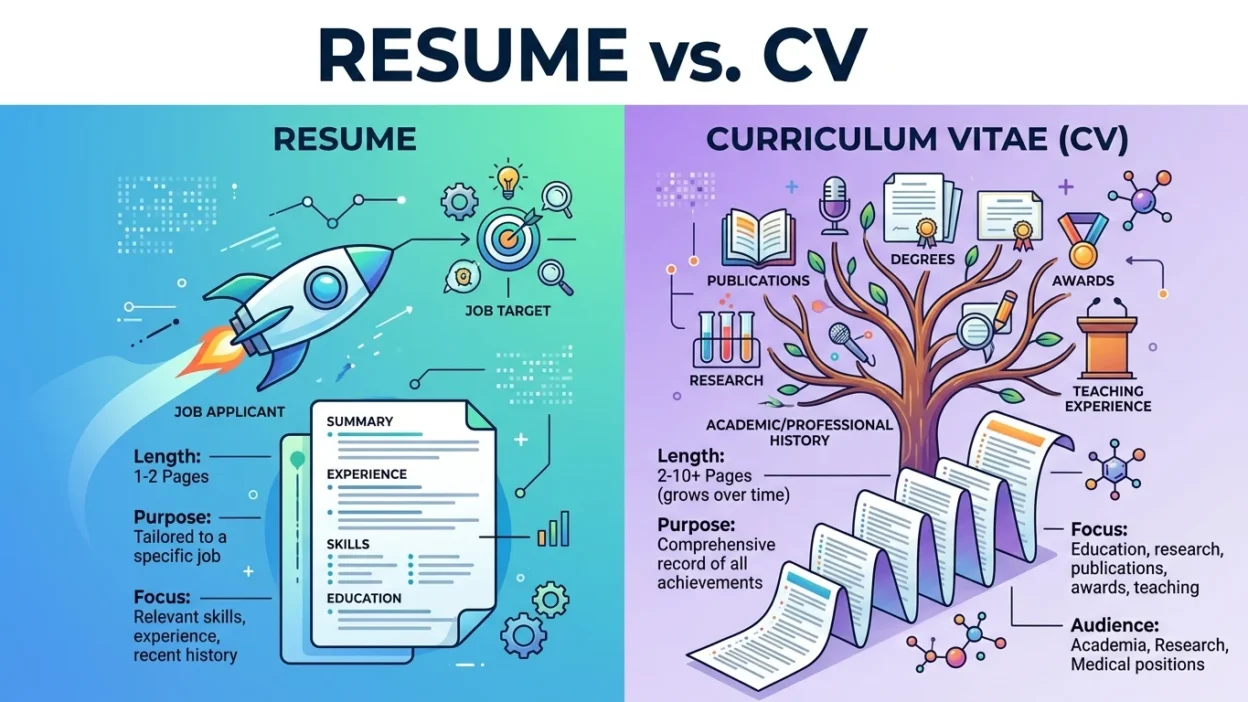
A resume is a short document that highlights your most important information for a job.
It is usually:
- 1 page long
- Sometimes 2 pages for experienced workers
- Quick and easy to read
- Focused on one job position
A Resume Usually Includes
- Name and contact details
- Short career goal or profile
- Education
- Work experience
- Skills
- Certifications
- Important achievements
A resume does not include every detail about your life. It only shows the information that matches the job you want.
Example
If you apply for a graphic design job, your resume should mainly show:
- Design skills
- Design software knowledge
- Creative projects
- Related work experience
What Is a CV?
A CV is a more detailed document. It gives a full picture of your academic and professional background.
A CV can be:
- 2 pages
- 5 pages
- Even longer for experienced professionals
A CV May Include
- Full education history
- Research work
- Teaching experience
- Publications
- Conferences
- Awards
- Projects
- Volunteer work
- Certifications
- Skills
- Professional memberships
CVs are often used in:
- Universities
- Research jobs
- Academic positions
- Scholarships
- Medical fields
- Scientific work
Main Difference Between Resume and CV
The biggest difference is simple:
A Resume Is Short
It gives a quick summary for a specific job.
A CV Is Detailed
It gives a complete history of education and professional work.
A resume is usually customized for each job application. A CV often stays more detailed and complete.
Resume vs CV Comparison Table
| Feature | Resume | CV |
| Length | Usually 1 page | Usually 2 or more pages |
| Purpose | Job application | Academic or detailed professional use |
| Details | Short summary | Full history |
| Focus | Skills and job experience | Education and achievements |
| Changes for each job | Often changed | Less often changed |
| Common Use | Business and company jobs | Research, teaching, medicine |
| Reading Time | Quick scan | More detailed reading |
| Best For | Most regular jobs | Academic positions |
Which One Should You Use?
The answer depends on the situation.
Use a Resume When:
- Applying for company jobs
- Looking for internships
- Applying for business positions
- Sending applications to private companies
- Applying for customer service, sales, design, or office jobs
Use a CV When:
- Applying to universities
- Applying for scholarships
- Applying for research jobs
- Applying for teaching positions
- Applying for medical or scientific work
Important Tip
Always read the job post carefully.
If the employer says:
- “Send your resume” → send a resume
- “Send your CV” → send a CV
If you are unsure, you can politely ask the employer.
Common Mistakes People Make
Many beginners make small mistakes because the two terms sound similar. Here are the most common ones.
1. Making a Resume Too Long
A resume should stay short and clear.
Bad idea:
- Adding every school activity from childhood
Better idea:
- Adding only relevant and recent information
2. Using the Same Resume for Every Job
Different jobs need different skills.
For example:
- A teaching job resume should look different from a marketing job resume.
3. Forgetting Contact Information
Some people forget to add:
- Phone number
- Email address
Without contact details, employers cannot reply.
4. Adding Unnecessary Information
You do not need to include:
- Favorite color
- Height
- Weight
- Family details
Keep the document professional.
5. Mixing Resume and CV Styles
Some people create a document that is too long for a resume but too incomplete for a CV.
It is better to decide clearly:
- “I am making a resume”
or - “I am making a CV”
Everyday Real-Life Examples
Learning becomes easier when we look at daily situations.
Example 1: Job Email
A company writes:
“Please send your resume for the sales assistant position.”
This means they want:
- A short job-focused document
Example 2: University Application
A university says:
“Applicants must submit a CV.”
This usually means:
- They want detailed education and academic information
Example 3: Social Media Advice
You may see online posts like:
“Keep your resume simple and clean.”
This advice is usually about:
- Short professional job documents
Example 4: Friend Conversation
A friend says:
“I updated my CV yesterday.”
Depending on the country, they may actually mean:
- A normal resume
That is why context matters.
Simple Learning Section for Students and Beginners
If you are a student or beginner, do not worry if you have little experience.
Your first resume or CV can still look professional.
Start With These Sections
For a Resume
- Name and contact information
- Education
- Skills
- Volunteer work
- Small projects
- Internship experience
For a CV
- Education history
- Courses
- Research projects
- Certificates
- Academic activities
- Presentations
Easy Tips for Writing Better Documents
Keep the Language Simple
Use clear sentences.
Instead of:
- “Utilized advanced communication methodologies”
Write:
- “Worked well with customers and team members”
Check Spelling Carefully
Small mistakes can create a bad impression.
Always read your document again before sending it.
Use Clean Formatting
- Use headings
- Leave spaces between sections
- Use bullet points
- Keep the layout easy to read
Tell the Truth
Never add fake experience or skills.
Honesty is always better.
Frequently Asked Questions (FAQ)
1. Is a resume the same as a CV?
Not always. A resume is usually shorter, while a CV is more detailed.
2. Which one is better for students?
Most students use resumes for normal jobs and CVs for academic applications.
3. Can a resume be 2 pages?
Yes, especially if you have more experience. But shorter is usually better.
4. Do I need work experience to make a resume?
No. Students can include:
- Skills
- School projects
- Volunteer work
- Internships
5. Why do some countries only use the word CV?
Different countries have different job application traditions. In many places, “CV” simply means a job document.
6. Should I include hobbies?
Only if the hobbies are useful or related to the position.
Example:
- Coding club for a tech job
7. Can I use the same CV for every application?
You can, but updating it for each opportunity is usually better.
8. What is the easiest way to remember the difference?
Remember this:
- Resume = short summary
- CV = full history
Conclusion
The difference between a resume and a CV is much easier than many people think. A resume is a short document made for job applications, while a CV is a longer and more detailed record of education and professional history.
The most important thing is understanding what the employer or school is asking for. Once you know the purpose, choosing the correct document becomes simple.
For beginners, students, and ESL learners, the best approach is to keep everything clear, honest, organized, and easy to read. A good resume or CV does not need difficult words or fancy designs. Simple and professional writing is usually the strongest choice.