Many people get confused by moulds and molds because both words look different but mean the same thing in many situations. You may see one spelling in books, school lessons, news articles, recipes, or online posts and wonder which one is correct.
The good news is simple: both spellings are correct. The difference mainly comes from the type of English being used.
This guide explains everything in very easy English so students, ESL learners, and beginners can understand the difference quickly and clearly.
Quick Answer
Here is the short and simple answer:
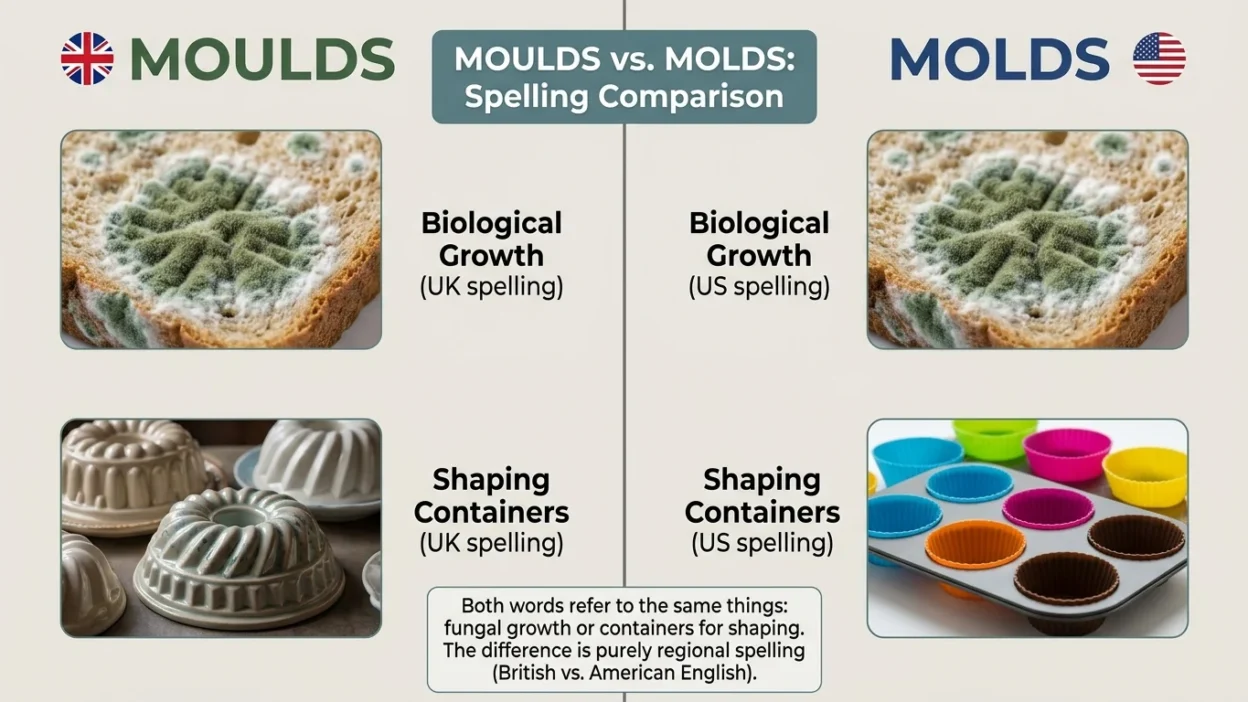
- Moulds = British English spelling
- Molds = American English spelling
- Both words have the same meaning
- Both can talk about:
- fungus growing in wet places
- shapes used to make objects
- Use the spelling that matches your audience or country
Simple Examples
- British English:
“The bread has moulds on it.” - American English:
“The bread has molds on it.”
Both sentences are correct.
Simple Background of the Word
The word came from old forms of English used many hundreds of years ago. Over time, English changed differently in different countries.
In the United Kingdom and many countries connected to British English, the spelling stayed as mould.
In the United States, many words became shorter or simpler in spelling. Because of that, mold became the normal American spelling.
The same thing happened with other words:
| British English | American English |
| colour | color |
| favourite | favorite |
| travelled | traveled |
| mould | mold |
So the difference is mostly about location and spelling style, not meaning.
What Do Moulds and Molds Mean?
Both words can have two main meanings.
1. Fungus Growing in Wet Places
This is the green, black, or white growth you may see on food or walls.
Examples
- moulds on bread
- molds in the bathroom
- mould growing on cheese
- mold on old fruit
Example Sentences
- “The old bread was covered in moulds.”
- “The basement had dangerous molds.”
Both sentences mean the same thing.
2. A Shape Used to Make Something
A mold or mould can also be a hollow shape used to create objects.
People use molds for:
- chocolate
- candles
- soap
- toys
- metal parts
Example Sentences
- “She poured chocolate into the moulds.”
- “The factory uses plastic molds.”
Again, both are correct spellings.
The Main Difference Between Moulds and Molds
The biggest difference is the kind of English being used.
Moulds
Use this spelling in:
- British English
- Australian English
- New Zealand English
- Some Canadian writing
Molds
Use this spelling in:
- American English
That is the main difference.
The meaning does not change.
Easy Comparison Table
| Feature | Moulds | Molds |
| Type of English | British English | American English |
| Meaning | Same meaning | Same meaning |
| Used for fungus | Yes | Yes |
| Used for shaping objects | Yes | Yes |
| Common in UK | Yes | Rare |
| Common in USA | Rare | Yes |
| Correct spelling | Correct | Correct |
Which One Should You Use?
The answer depends on where you are writing and who will read your writing.
Use “Moulds” When:
- writing for British readers
- studying British English
- using UK spelling rules
- writing in schools that follow British English
Example
“The bathroom walls had moulds because of the moisture.”
Use “Molds” When:
- writing for Americans
- studying American English
- using US spelling rules
- working with American companies or schools
Example
“The bread developed molds after a few days.”
Important Tip
Do not mix both spellings in the same piece of writing.
For example:
❌ “The walls had moulds, and the food had molds.”
It is better to stay consistent.
✔ British style:
“The walls had moulds, and the food had moulds.”
✔ American style:
“The walls had molds, and the food had molds.”
Common Mistakes People Make
Many learners make small mistakes with these words. Here are the most common ones.
1. Thinking One Spelling Is Wrong
Some people think only one spelling is correct.
That is not true.
Both spellings are correct in the right type of English.
2. Mixing British and American English
Writers sometimes use both spellings together.
This can look messy or confusing.
Choose one style and keep it through the whole article, email, or assignment.
3. Confusing “Mold” With “Moulding”
“Moulding” or “molding” can also mean decorative strips on walls or furniture.
Example:
- crown moulding
- decorative molding
The spelling rule is the same:
- British English → moulding
- American English → molding
4. Forgetting the Meaning Depends on Context
The word can mean fungus or a shaping form.
Read the sentence carefully.
Example
“The baker cleaned the molds.”
This could mean:
- fungus in the kitchen
- baking shapes
The context tells you the meaning.
Everyday Real-Life Examples
Here are simple examples from daily life.
In Emails
British English
“We found moulds in the storage room.”
American English
“We found molds in the storage room.”
In News Writing
British Style
“Experts warned about moulds in damp homes.”
American Style
“Experts warned about molds in wet buildings.”
On Social Media
British User
“These cake moulds are so cute!”
American User
“I bought new silicone molds today!”
In School Writing
British English
“Scientists studied moulds growing on old bread.”
American English
“Students examined molds under the microscope.”
In Daily Conversation
- “Throw the bread away. It has molds on it.”
- “These ice moulds make star shapes.”
Both are natural depending on the country.
Simple Learning Section for Students and Beginners
Here is an easy way to remember the difference.
Memory Trick
“OU” Often Appears in British English
British English keeps extra letters in many words.
Examples:
- colour
- favourite
- mould
American English usually removes extra letters.
Examples:
- color
- favorite
- mold
So if you see “ou”, it is often British English.
Easy Practice
Choose the correct spelling.
1.
“My sandwich had green _____ on it.”
- moulds
- molds
Answer:
- British English → moulds
- American English → molds
2.
“The artist poured clay into the _____.”
- moulds
- molds
Both are correct depending on English style.
3.
“We cleaned the bathroom because of the black _____.”
- moulds
- molds
Again, both are correct.
FAQ About Moulds vs Molds
1. Are moulds and molds the same word?
Yes. They have the same meaning. The spelling changes based on British or American English.
2. Which spelling is more common?
“Molds” is more common in the United States.
“Moulds” is more common in the UK and some other countries.
3. Is “moulds” old-fashioned?
No. It is still the normal British spelling today.
4. Can I use both spellings in one article?
It is better not to mix them. Choose one style and stay consistent.
5. Which spelling should ESL learners study?
It depends on the English style you are learning:
- British English → moulds
- American English → molds
6. Do both words have the same pronunciation?
Yes. Most people pronounce them the same way.
7. Can both words mean fungus and shaping tools?
Yes. Both spellings can describe:
- fungus
- shaping forms
8. Is “mold” wrong in British English?
Not exactly wrong, but “mould” is preferred in British English.
Final Thoughts
The difference between moulds and molds is very simple once you know the spelling rule.
- Moulds is the British English spelling.
- Molds is the American English spelling.
They mean the same thing and are used in the same ways. The only real difference is the type of English being used.
If you are writing for school, work, or online, choose the spelling that matches your audience and stay consistent throughout your writing.
After a little practice, the difference becomes easy to remember.