Many English learners get confused by “havnt” and “havent.” At first glance, both words may look correct because they are very close in spelling. People often type them quickly in messages, emails, or social media posts without noticing the mistake.
The confusion usually happens because English contractions can be tricky. The correct form actually includes an apostrophe, and many people forget to use it.
This guide will explain everything in very simple English so you can clearly understand the difference between havnt, havent, and the correct form haven’t.
Quick Answer
Here is the simple answer:
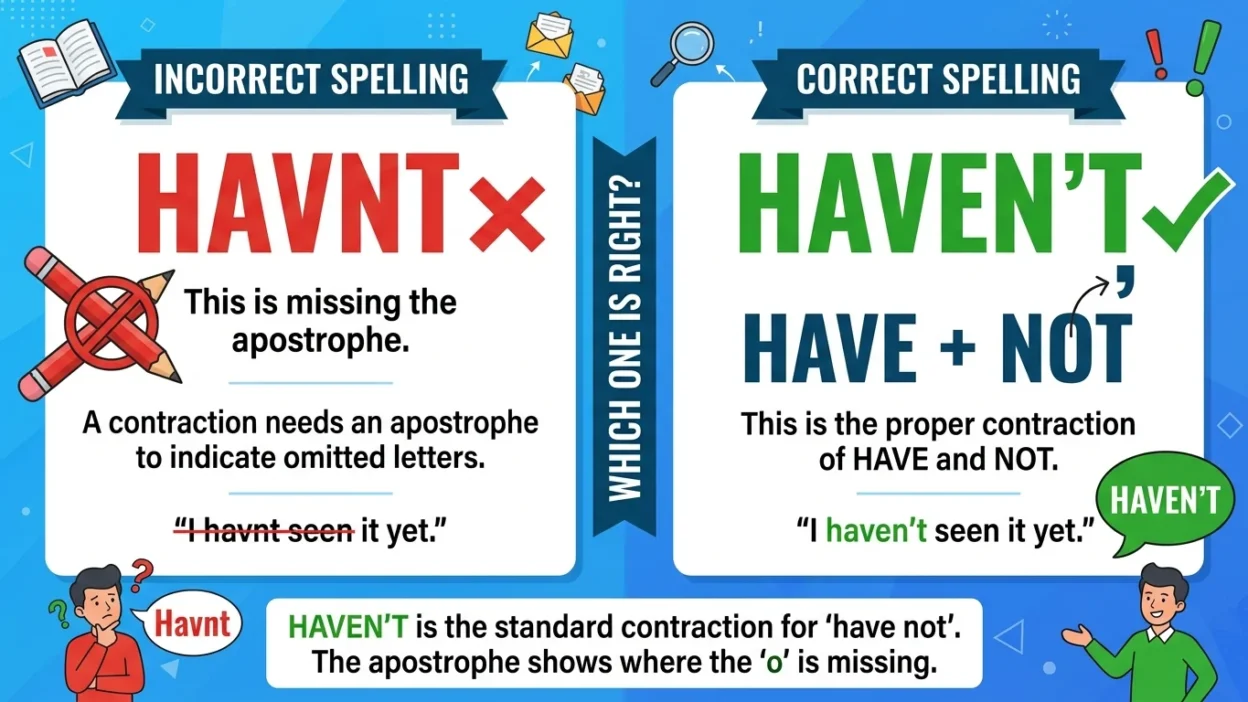
- Havnt → Incorrect spelling
- Havent → Incorrect spelling
- Haven’t → Correct spelling
Why?
“Haven’t” is the short form of:
- have not
The apostrophe ( ’ ) replaces the missing letter o in not.
Correct Example
- I haven’t finished my homework yet.
Incorrect Examples
- I havnt finished my homework yet. ❌
- I havent finished my homework yet. ❌
Simple Background of the Word
English often combines two words to make speaking and writing faster. These short forms are called contractions.
For example:
| Full Form | Short Form |
| do not | don’t |
| cannot | can’t |
| is not | isn’t |
| have not | haven’t |
In the word haven’t, the apostrophe replaces the missing o from not.
Without the apostrophe, the spelling becomes incorrect in standard English writing.
Understanding the Difference Clearly
The biggest thing to remember is this:
“Haven’t” is the only correct word.
The other two forms are simply spelling mistakes.
Let’s look at each one separately.
What Does “Haven’t” Mean?
“Haven’t” means:
- have not
It is used with:
- I
- You
- We
- They
Examples
- I haven’t seen that movie.
- They haven’t arrived yet.
- We haven’t eaten dinner.
This form is correct in normal writing, speaking, emails, and conversations.
What Is “Havent”?
“Havent” without the apostrophe is not considered correct English spelling.
People usually type it by mistake because:
- they are typing too fast
- they forget the apostrophe
- mobile keyboards skip punctuation
- they do not know contractions well yet
Example
- I havent called her yet. ❌
Correct form:
- I haven’t called her yet. ✅
What Is “Havnt”?
“Havnt” is also incorrect.
This spelling leaves out both:
- the apostrophe
- the letter “e”
Incorrect Example
- We havnt finished the project. ❌
Correct version:
- We haven’t finished the project. ✅
Easy Comparison Table
| Word | Correct or Incorrect? | Meaning | Should You Use It? |
| haven’t | Correct | have not | Yes |
| havent | Incorrect | none | No |
| havnt | Incorrect | none | No |
Which One Should You Use?
You should always use:
Haven’t
This is the correct spelling in:
- school writing
- homework
- essays
- emails
- text messages
- social media
- business communication
- everyday English
Examples
- I haven’t met him before.
- You haven’t answered my question.
- They haven’t started yet.
When Do People Accidentally Write “Havent” or “Havnt”?
These mistakes are very common online.
People often write incorrect spellings because:
Fast Typing
Many users type quickly and skip punctuation marks.
Example:
- havent instead of haven’t
Mobile Keyboard Errors
Phones sometimes remove apostrophes automatically.
Beginner English Learning
ESL learners may not fully understand contractions yet.
Informal Internet Writing
Some people ignore grammar in casual chats.
Even if you see these spellings online, they are still incorrect in proper English.
Common Mistakes People Make
Here are some mistakes learners often make.
Mistake 1: Forgetting the Apostrophe
Incorrect:
- We havent finished.
Correct:
- We haven’t finished.
Mistake 2: Removing Letters
Incorrect:
- I havnt seen it.
Correct:
- I haven’t seen it.
Mistake 3: Using the Wrong Subject
“Haven’t” works with:
- I
- you
- we
- they
But not with:
- he
- she
- it
Incorrect
- She haven’t arrived. ❌
Correct
- She hasn’t arrived. ✅
Everyday Real-Life Examples
Seeing real examples helps many learners remember grammar better.
In Emails
Correct:
- I haven’t received your message yet.
Incorrect:
- I havent received your message yet.
In Social Media Posts
Correct:
- We haven’t posted the photos yet.
Incorrect:
- We havnt posted the photos yet.
In Daily Conversation
Correct:
- I haven’t eaten today.
Correct:
- They haven’t called me back.
In School Writing
Correct:
- We haven’t completed the assignment.
Incorrect:
- We havent completed the assignment.
In News or Professional Writing
Professional writing almost always uses the correct form:
- The team hasn’t announced the results.
- Officials haven’t released new details.
Easy Grammar Tip to Remember
A very simple trick is this:
If you can say “have not,” then write “haven’t.”
Example:
- I have not finished.
- I haven’t finished.
Both mean the same thing.
This helps you remember the apostrophe.
Short Learning Section for Students and Beginners
Here is a simple learning guide.
Step 1: Learn the Full Form
- haven’t = have not
Step 2: Remember the Apostrophe
The apostrophe replaces the missing letter.
- have not → haven’t
Step 3: Practice Correct Sentences
Try reading these aloud:
- I haven’t seen him.
- We haven’t started yet.
- They haven’t finished dinner.
Step 4: Avoid Shortcuts
Even if friends type:
- havent
- havnt
you should still write:
- haven’t
especially in school or formal writing.
Simple Practice Sentences
Choose the correct word.
- I ___ finished my homework.
- They ___ arrived yet.
- We ___ seen this movie before.
Answers
- haven’t
- haven’t
- haven’t
FAQ About Havnt vs Havent
1. Is “havent” a real English word?
No. “Havent” without an apostrophe is incorrect in standard English.
2. Is “havnt” correct?
No. “Havnt” is also incorrect.
3. What is the correct spelling?
The correct spelling is:
- haven’t
4. Why does “haven’t” use an apostrophe?
The apostrophe replaces the missing “o” in “not.”
- have not → haven’t
5. Can I use “havent” in text messages?
People may understand it, but it is still grammatically incorrect.
6. Which subjects use “haven’t”?
Use “haven’t” with:
- I
- you
- we
- they
Example:
- They haven’t arrived.
7. What is the difference between “haven’t” and “hasn’t”?
- haven’t = have not
- hasn’t = has not
Examples:
- I haven’t eaten.
- She hasn’t eaten.
8. Why do many people type “havnt”?
Usually because of:
- fast typing
- spelling mistakes
- missing apostrophes
- casual internet writing
Final Thoughts
The difference between havnt, havent, and haven’t is actually very simple once you understand contractions.
Only “haven’t” is correct English.
The other forms:
- havnt
- havent
are spelling mistakes and should be avoided in proper writing.
A good way to remember this is:
- haven’t = have not
If you can replace the word with “have not,” then “haven’t” is the correct choice.
With a little practice, using the right spelling will become easy and natural.