Many English learners and even native speakers confuse specs and specks because the words look and sound very similar. A single missing letter changes the meaning completely. That is why people often make spelling mistakes when writing emails, text messages, school work, or online posts.
The good news is that the difference is actually very simple once you understand it clearly. In this guide, you will learn what each word means, when to use it, and how to remember the correct spelling easily.
Quick Answer
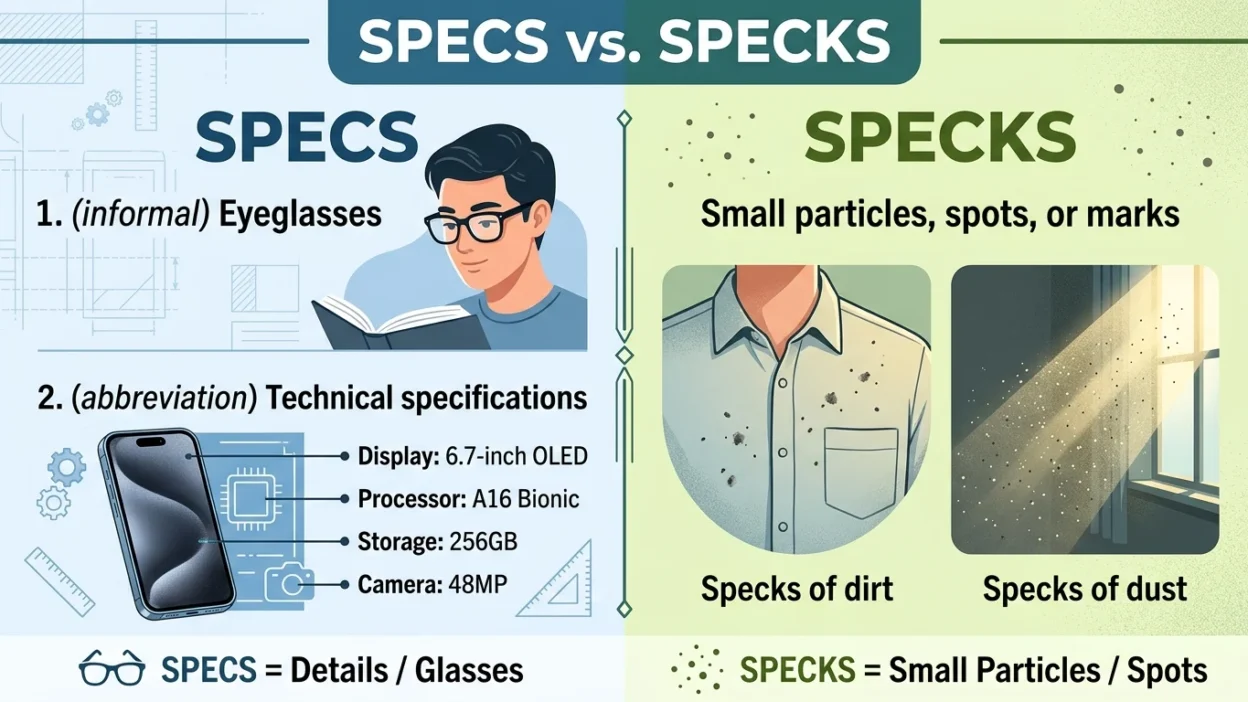
Here is the simple difference between specs and specks:
- Specs usually means:
- specifications or details about something
- glasses in informal English
- Specks means:
- very small spots, marks, or tiny pieces
Easy Example
- “Check the phone specs before buying it.”
- (details about the phone)
- “There are dust specks on the screen.”
- (tiny particles)
Simple Background of the Words
Understanding where the words come from can help you remember them better.
Specs
The word specs is a short form of specifications. Specifications are details or information about something.
For example:
- computer specifications
- car specifications
- product specifications
Over time, people shortened “specifications” to “specs.”
The word specs is also used informally for eyeglasses.
Example:
- “I cannot read without my specs.”
Specks
The word speck has been used in English for a very long time. It means a tiny mark, spot, or particle.
Examples include:
- a speck of dust
- a speck of paint
- tiny specks in the air
The plural form is specks.
The Main Difference Between Specs and Specks
The biggest difference is simple:
- Specs = details or glasses
- Specks = tiny spots or particles
Even though the words sound close, their meanings are completely different.
Think About This
If you are talking about:
- technology
- products
- details
- information
- glasses
→ use specs
If you are talking about:
- dust
- dirt
- tiny marks
- little particles
→ use specks
Comparison Table
| Word | Meaning | Common Use | Example Sentence |
| Specs | Details or specifications | Technology, products, information | “The laptop specs are impressive.” |
| Specs | Glasses | Informal speaking | “He forgot his specs at home.” |
| Specks | Tiny spots or particles | Dust, dirt, marks | “Tiny specks covered the table.” |
What Does “Specs” Mean?
The word specs has two common meanings.
1. Specs = Specifications
This is the most common meaning today.
People use it when talking about product details.
Examples
- phone specs
- gaming PC specs
- camera specs
- car specs
Sentences
- “The phone specs include a large battery.”
- “I compared the laptop specs online.”
- “These specs are perfect for gaming.”
In these examples, specs means information or technical details.
2. Specs = Glasses
In casual English, people sometimes call eyeglasses “specs.”
Examples
- reading specs
- new specs
- broken specs
Sentences
- “My grandfather wears specs.”
- “She lost her specs yesterday.”
- “I need new specs for school.”
This meaning is more common in British English, but many English learners still hear it in movies and conversations.
What Does “Specks” Mean?
The word specks means very tiny spots, marks, or particles.
These are usually so small that they are hard to see clearly.
Common Examples
- dust specks
- paint specks
- dirt specks
- tiny black specks
Sentences
- “There were specks of dust on the shelf.”
- “I noticed white specks on my jacket.”
- “Tiny specks floated in the sunlight.”
The word often appears when talking about cleaning, dirt, or very small marks.
Which One Should You Use?
Here is an easy way to choose the correct word.
Use “Specs” When Talking About:
Details or Information
Examples:
- computer specs
- phone specs
- machine specs
Glasses
Examples:
- reading specs
- fashion specs
Use “Specks” When Talking About:
Tiny Particles or Spots
Examples:
- dust specks
- paint specks
- tiny specks of dirt
Easy Memory Trick
A simple trick can help you remember the difference forever.
Specs → Specifications
Both words start with:
- Spec
Think:
- specifications
- product details
- information
Specks → Small Spots
The word has an extra k.
Think of the k as a tiny mark or spot.
So:
- specks = tiny spots
Common Mistakes People Make
Because the words sound alike, many learners mix them up in writing.
Here are some common mistakes.
Mistake 1: Using “Specks” for Product Details
❌ Wrong:
- “What are the laptop specks?”
✅ Correct:
- “What are the laptop specs?”
Why?
Because you are talking about technical details, not tiny particles.
Mistake 2: Using “Specs” for Dust
❌ Wrong:
- “There are dust specs on the desk.”
✅ Correct:
- “There are dust specks on the desk.”
Why?
Dust is made of tiny particles, so “specks” is correct.
Mistake 3: Forgetting the Meaning Changes
Some people think the words are just different spellings of the same thing. They are not.
- Specs and specks have different meanings.
- One extra letter changes the entire word.
Real-Life Examples
Seeing the words in everyday situations makes learning easier.
In Emails
Specs
- “Please send the product specs before the meeting.”
- “The customer asked about the phone specs.”
Specks
- “I noticed small specks on the screen.”
- “Please clean the dust specks from the keyboard.”
In News or Reviews
Specs
- “The new smartphone specs were announced today.”
- “Experts praised the car’s engine specs.”
Specks
- “Scientists discovered tiny specks in the sample.”
- “Dark specks appeared in the water.”
On Social Media
Specs
- “Just bought a laptop with amazing specs!”
- “Can someone explain these camera specs?”
Specks
- “Why are there white specks on my shirt?”
- “Tiny specks keep appearing on my monitor.”
Short Learning Section for Students and Beginners
If you are learning English, here are simple steps to remember the difference.
Step 1: Ask Yourself a Question
Are you talking about:
- details and information?
- or tiny particles?
Step 2: Choose the Correct Word
Use “Specs”
for:
- specifications
- product details
- glasses
Use “Specks”
for:
- dust
- dirt
- tiny marks
Step 3: Practice Simple Sentences
Practice With “Specs”
- “The phone specs are good.”
- “His specs are on the table.”
Practice With “Specks”
- “I saw dust specks.”
- “Black specks covered the floor.”
Reading and writing these examples several times can help you remember the difference naturally.
FAQ Section
1. Are specs and specks the same word?
No. They are different words with different meanings.
- Specs = details or glasses
- Specks = tiny spots or particles
2. What does “specs” mean in technology?
In technology, “specs” means specifications or technical details.
Example:
- storage
- memory
- screen size
- battery life
3. What are specks of dust?
Specks of dust are very tiny dust particles.
Example:
- “I cleaned the specks of dust from the shelf.”
4. Is “specs” short for specifications?
Yes. “Specs” is a shorter and more casual form of “specifications.”
5. Can “specs” mean glasses?
Yes. In informal English, “specs” can mean eyeglasses.
Example:
- “My specs are broken.”
6. Why do people confuse specs and specks?
People confuse them because:
- they look similar
- they sound similar
- only one letter is different
7. Which word is used for computer details?
Use specs.
Correct example:
- “The gaming PC specs are powerful.”
8. Which word is used for tiny marks?
Use specks.
Correct example:
- “Tiny specks appeared on the window.”
Final Thoughts
The difference between specs and specks becomes easy once you connect each word to its meaning.
Remember:
- Specs = specifications or glasses
- Specks = tiny spots or particles
If you are talking about technology, products, information, or eyeglasses, use specs.
If you are talking about dust, dirt, marks, or tiny pieces, use specks.
A single extra letter may seem small, but it changes the meaning completely. With a little practice, you will quickly learn to use both words correctly in everyday English.