Many English learners get confused by foregoing and forgoing because the two words look almost the same. They differ by only one letter, but their meanings are completely different.
This confusion is very common in emails, school writing, news articles, and online posts. Some people even use the wrong word without noticing it.
The good news is that the difference is actually easy once you learn a simple trick. This guide will explain both words in very clear English so you can understand them quickly and use them correctly every time.
Quick Answer
Here is the simple difference:
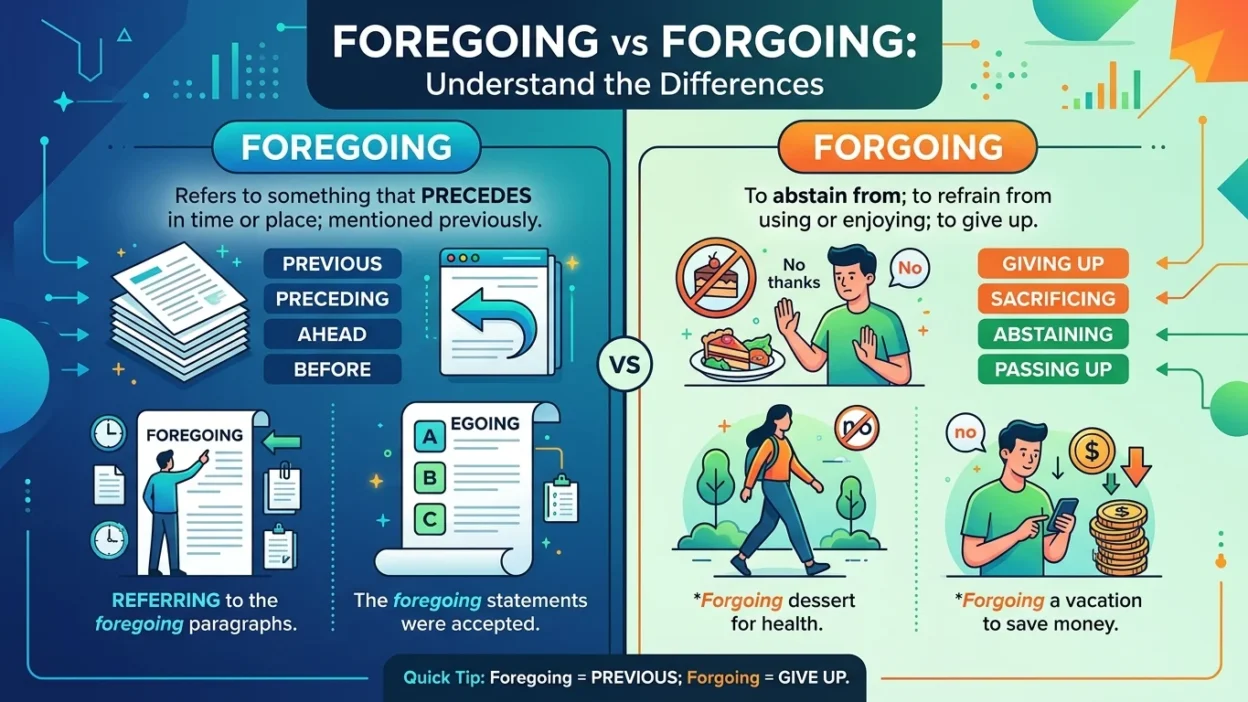
- Foregoing = something mentioned earlier
- Forgoing = choosing to give up something
Easy Memory Tip
- Foregoing has “fore” like “before”
- Meaning: something that came before
- Forgoing has “go”
- Meaning: letting something go or giving it up
Example Sentences
- “Please read the foregoing paragraph.”
- (the paragraph above)
- “She is forgoing dessert tonight.”
- (she is giving up dessert)
Where These Words Come From
Understanding the background of the words can make them easier to remember.
Foregoing
The word foregoing comes from:
- fore = before
- going = coming earlier
So the word means:
- going before
- mentioned earlier
- already stated
Forgoing
The word forgoing comes from the verb forgo.
Forgo means:
- to give up
- to do without
- to choose not to have something
Example:
- “He decided to forgo coffee.”
The spelling changes slightly when adding -ing:
- forgo → forgoing
The Main Difference Between Foregoing and Forgoing
Although the words look alike, they are used in very different situations.
Foregoing Meaning
Foregoing refers to something that was said, written, or shown earlier.
It usually appears in:
- formal writing
- business emails
- reports
- legal writing
- school essays
Examples
- “The foregoing points explain the problem.”
- “Based on the foregoing information, we agree.”
- “Please review the foregoing instructions.”
In all these examples, foregoing means:
- the information above
- the earlier points
- what came before
Forgoing Meaning
Forgoing means giving something up or choosing not to enjoy something.
It is connected to sacrifice or self-control.
Examples
- “She is forgoing sugar this month.”
- “They are forgoing vacations to save money.”
- “He is forgoing sleep to finish the project.”
In these examples, people are choosing not to have something.
Simple Comparison Table
| Word | Meaning | Used For | Easy Clue |
| Foregoing | Mentioned earlier | Writing, reports, emails | “Before” |
| Forgoing | Giving something up | Choices, sacrifice | “Letting go” |
Which One Should You Use?
This is the easiest way to decide.
Use “Foregoing” When Talking About Earlier Information
Ask yourself:
- Am I talking about something already mentioned?
If yes, use foregoing.
Examples
- “The foregoing chapter explains grammar.”
- “We accept the foregoing terms.”
- “The foregoing discussion was helpful.”
Use “Forgoing” When Talking About Giving Something Up
Ask yourself:
- Is someone choosing not to have something?
If yes, use forgoing.
Examples
- “I am forgoing fast food this week.”
- “She is forgoing a new phone.”
- “They are forgoing luxury items.”
Common Mistakes People Make
Because the spellings are so similar, many people mix them up.
Here are the most common mistakes.
Mistake 1: Using “Foregoing” Instead of “Forgoing”
❌ “He is foregoing lunch today.”
This is wrong because lunch is being given up.
✅ “He is forgoing lunch today.”
Mistake 2: Using “Forgoing” for Earlier Information
❌ “The forgoing statement explains everything.”
This is wrong because the sentence talks about something written earlier.
✅ “The foregoing statement explains everything.”
Mistake 3: Thinking They Are Different Spellings of the Same Word
Some learners believe both spellings mean the same thing. They do not.
They are two separate words with different meanings.
Mistake 4: Forgetting the Context
Always look at the sentence meaning.
Ask:
- Earlier information? → foregoing
- Giving up something? → forgoing
This simple check usually solves the problem immediately.
Real-Life Examples
Here are examples from everyday situations.
In Emails
Foregoing
- “Please review the foregoing details before signing.”
- “The foregoing message explains our policy.”
Forgoing
- “I am forgoing the meeting due to illness.”
- “She is forgoing overtime this week.”
In News Writing
Foregoing
- “The foregoing report highlighted safety concerns.”
Forgoing
- “Many families are forgoing travel because of rising costs.”
On Social Media
Foregoing
- “As mentioned in the foregoing post…”
Forgoing
- “I’m forgoing junk food for 30 days!”
In Daily Conversation
Foregoing
This word is less common in normal conversation.
People usually say:
- “the earlier point”
- “what I said before”
Forgoing
This word appears more often in speech.
Examples:
- “I’m forgoing coffee today.”
- “We’re forgoing expensive gifts this year.”
Easy Tricks to Remember the Difference
Trick 1: “Fore” Means Before
Think about:
- forecast
- forehead
- before
The part fore often relates to something ahead or earlier.
So:
- foregoing = earlier information
Trick 2: “Forgo” Means Give Up
Think:
- “go without”
So:
- forgoing = giving something up
Trick 3: Use Simple Replacement Tests
Replace with “earlier”
If the sentence still makes sense:
- use foregoing
Example:
- “The foregoing paragraph”
- “The earlier paragraph”
Works perfectly.
Replace with “giving up”
If the sentence still makes sense:
- use forgoing
Example:
- “She is forgoing dessert.”
- “She is giving up dessert.”
Works perfectly.
Learning Section for Students and Beginners
Here is a simple study guide.
Step 1: Learn One Meaning at a Time
Do not memorize both together immediately.
Start with:
- foregoing = earlier
Then learn:
- forgoing = giving up
Step 2: Practice With Short Sentences
Write your own examples.
Foregoing Practice
- “The foregoing lesson was easy.”
- “Read the foregoing note.”
Forgoing Practice
- “I am forgoing soda.”
- “They are forgoing luxury.”
Step 3: Read Carefully
When you see these words online or in books:
- stop for a moment
- check the meaning
- notice the context
This builds strong memory over time.
Step 4: Use Memory Clues
- Foregoing → before
- Forgoing → giving up
Simple memory tricks help a lot.
Frequently Asked Questions (FAQ)
1. Are foregoing and forgoing the same word?
No. They are different words with different meanings.
- foregoing = mentioned earlier
- forgoing = giving up something
2. Which word is more common?
Forgoing is more common in daily speech.
Foregoing is more common in formal writing.
3. Is “forgo” a real verb?
Yes.
Examples:
- “I will forgo dessert.”
- “She chose to forgo the offer.”
4. Can I use “foregoing” in conversation?
You can, but it sounds formal.
Most people simply say:
- “earlier”
- “what I said before”
5. Why do people confuse these words?
Because the spellings are almost identical.
Only one letter changes:
- foregoing
- forgoing
But the meanings are unrelated.
6. What is an easy way to remember “foregoing”?
Remember:
- fore = before
So:
- foregoing = earlier information
7. What is an easy way to remember “forgoing”?
Think:
- “go without”
So:
- forgoing = giving something up
8. Are both words correct in English?
Yes. Both are correct words.
The important thing is using the right one in the right situation.
Final Thoughts
The difference between foregoing and forgoing becomes simple once you focus on meaning instead of spelling.
Remember this:
- Foregoing = something mentioned earlier
- Forgoing = giving something up
A quick context check can help you choose the correct word every time.
If the sentence talks about earlier information, use foregoing.
If the sentence talks about sacrifice, skipping, or doing without something, use forgoing.
With a little practice, these two confusing words will become easy to recognize and use correctly in writing, speaking, emails, and everyday English.