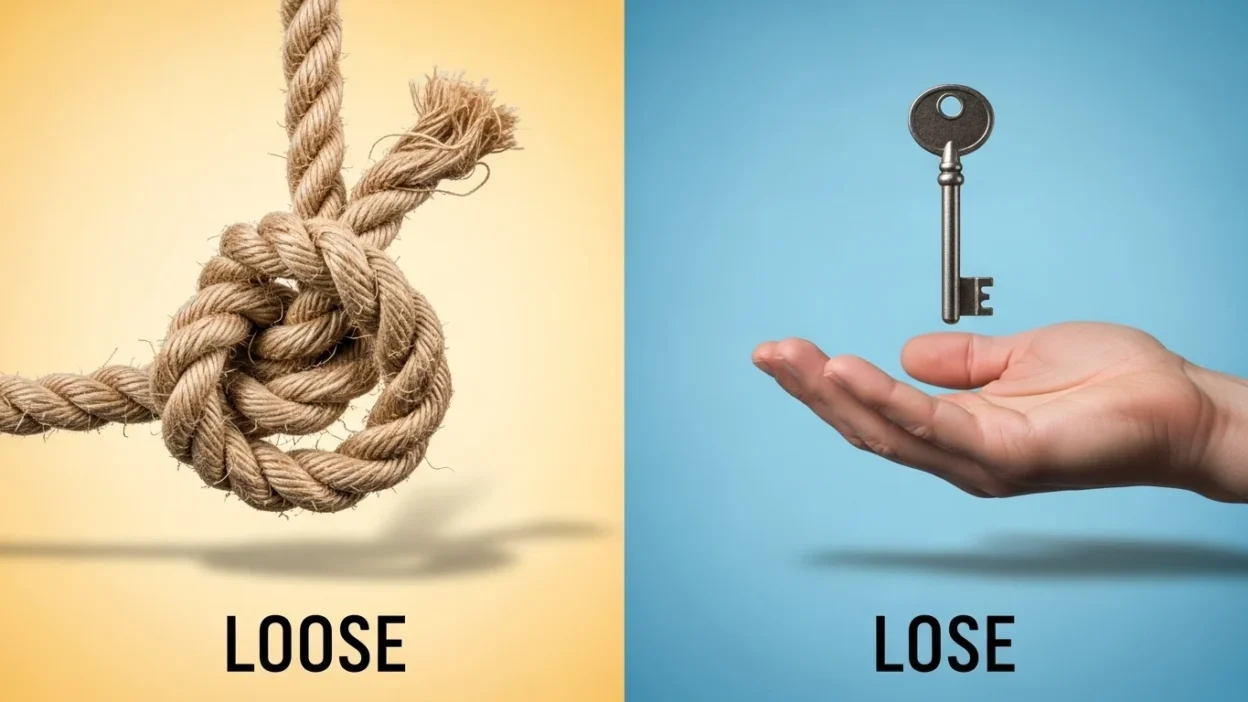
Many English learners and even native speakers often mix up “loose” and “lose.”
They look similar, and they even sound a bit close, but their meanings are completely different.
This confusion happens because:
- The spelling is almost the same
- One extra letter changes everything
- Both words are very common in daily English
But don’t worry. By the end of this article, you will clearly understand the difference and never confuse them again.
Quick Answer: Easy Difference
Here is the simplest way to understand them:
- Loose = not tight, free, or not fixed
- Lose = to misplace something or not win
Simple memory trick:
- Loose has extra “o” → something is “extra free”
- Lose has no extra “o” → you “lose” something
Origin and Background (Simple History)
Both words come from old forms of English, but they developed different meanings over time.
- Loose originally meant something that was not tied or held tightly. People used it for clothes, ropes, and objects.
- Lose came from an old word meaning “to fail to keep something.”
Even though they look similar today, they are completely separate words with different jobs in sentences.
Clear Explanation of the Difference
1. Meaning of “Loose”
Loose is an adjective. It describes something.
It means:
- Not tight
- Not fixed
- Free or relaxed
Examples:
- My shirt is too loose.
- The dog is running loose in the street.
- The screw is loose and needs tightening.
👉 Think: something is “free” or “not secure.”
2. Meaning of “Lose”
Lose is a verb. It is an action word.
It means:
- To not find something
- To fail to keep something
- To not win a game or competition
Examples:
- I don’t want to lose my phone.
- Our team might lose the match.
- Try not to lose your keys.
👉 Think: something is gone or not won.
Comparison Table: Loose vs Lose
| Feature | Loose | Lose |
| Type of word | Adjective | Verb |
| Meaning | Not tight, free | Not keep, not win |
| Action? | No | Yes |
| Used for | Things, clothes, objects | Actions, games, objects lost |
| Example | My belt is loose | I lose my keys often |
| Simple idea | Something is free or not tight | Something is gone or failed |
Which One to Use and When
Use “loose” when you are talking about:
- Clothes or shoes
- Objects not tightly fixed
- Something relaxed or not strict
Examples:
- The lid is loose.
- These jeans are loose on me.
- The wire is loose behind the TV.
Use “lose” when you are talking about:
- Losing objects
- Not winning games
- Forgetting or misplacing things
- Failure or defeat
Examples:
- I don’t want to lose my wallet.
- They lose every match.
- Don’t lose hope.
Common Mistakes People Make
Here are the most common errors:
1. Mixing spelling
People write:
- ❌ I will loose my phone
Correct: - ✅ I will lose my phone
2. Confusing meaning
People think:
- “Loose” means losing something
But actually: - Loose = not tight
- Lose = misplace or fail
3. Pronunciation confusion
- “Loose” = sounds like “looss”
- “Lose” = sounds like “looz”
4. Using loose as a verb
Wrong:
- ❌ Don’t loose your keys
Correct: - ✅ Don’t lose your keys
Everyday Real-Life Examples
1. At school
- Your bag is loose because the zip is open.
- You don’t want to lose your homework.
2. At home
- The chair is loose, fix it.
- I always lose my remote control.
3. On social media
- “My phone cover is too loose 😂”
- “I always lose my charger at night 😭”
4. In sports
- A team may lose a match.
- A player’s shoes can feel loose during a game.
5. In daily life
- Loose button on your shirt
- Losing your keys before leaving home
Short Learning Section for Students
Easy memory tips:
- Loose = Extra O = Open / free / not tight
- Lose = No extra O = Gone / not there
Practice trick:
Try filling the blanks:
- My pants are too _____.
- Don’t _____ your phone.
- The screw is _____.
- I don’t want to _____ the game.
Answers:
- loose
- lose
- loose
- lose
FAQ: Common Questions
1. Are “loose” and “lose” pronounced the same?
No. “Loose” sounds like looss and “lose” sounds like looz.
2. Is “loose” a verb?
No, “loose” is not a verb. It is an adjective.
3. Can “lose” describe objects?
Yes. You can lose things like keys, money, or phones.
4. What is the opposite of “loose”?
The opposite of “loose” is tight.
5. What is the opposite of “lose”?
The opposite of “lose” is find or win (depending on the situation).
6. Why do people confuse these words?
Because they look similar and differ by only one letter.
7. Can I use “loose” in exams?
Yes, but only when you mean not tight or free.
8. What is the fastest way to remember them?
Remember:
- Loose = extra “o” = extra space
- Lose = missing “o” = something is gone
Conclusion
The difference between loose and lose is very simple once you understand it:
- Loose means not tight or free
- Lose means to misplace or not win
Even though they look similar, they are completely different in meaning and use.
If you remember the small trick about the extra “o,” you will never confuse them again. Just take your time, practice a few examples, and soon it will feel natural in your everyday English.