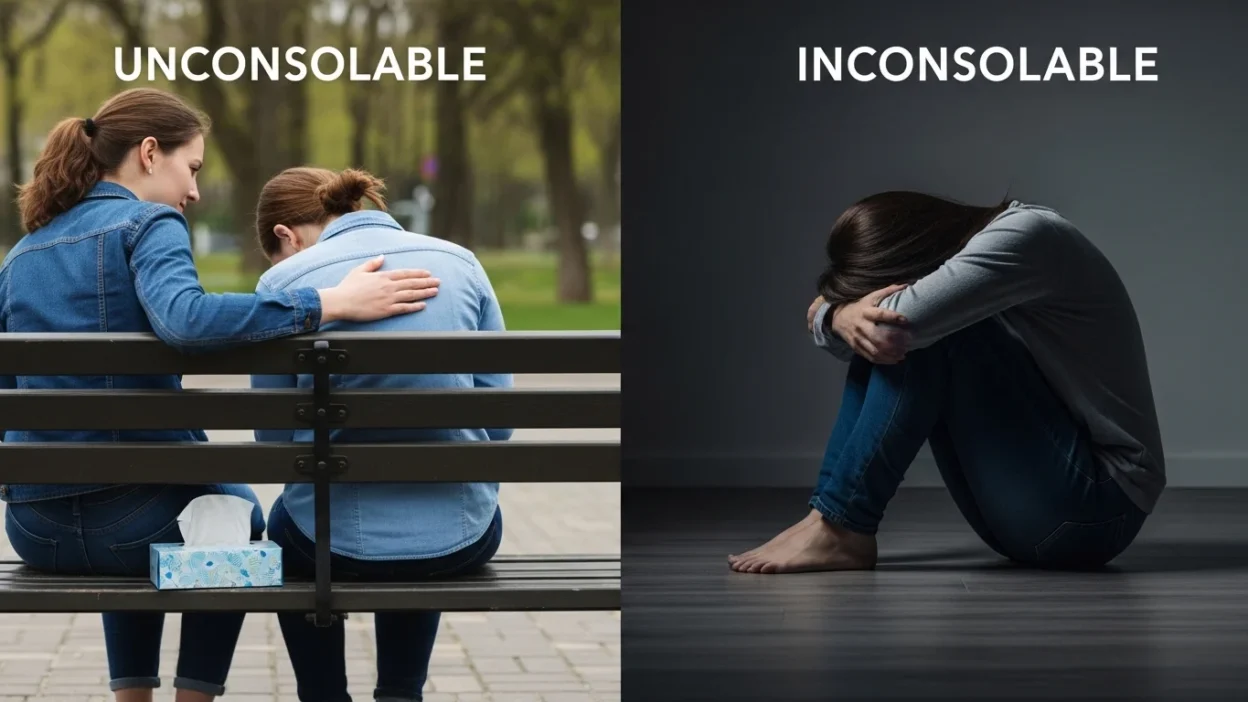
Many learners feel confused when they see the words unconsolable and inconsolable. At first look, they seem almost the same. Both describe strong sadness, and both end with “-consolable.” Because of this, people often think they can use them in the same way.
But there is a small difference in how they are used in real English. This guide will explain everything in very simple words so you can understand it clearly on your first read.
Quick Answer
- Unconsolable = someone cannot be comforted right now (focus on the moment)
- Inconsolable = someone is deeply sad and cannot be comforted at all (stronger and more emotional)
- Both words are very similar and often mean the same in daily use
- Inconsolable is more common and more natural in modern English
Simple Background
Both words come from the word “console,” which means to comfort someone who is sad.
- Console → to make someone feel better
- Consolable → able to feel better
- Add “un-” or “in-” → means “not”
So:
- Unconsolable = not able to be comforted
- Inconsolable = not able to be comforted
You can already see why people get confused—they look and sound almost the same.
Clear Explanation of the Difference
Even though both words mean almost the same, there is a small difference in feeling and usage.
1. Unconsolable
This word is used when someone cannot be comforted at a specific moment.
- It focuses on the current situation
- It can be temporary
- It sounds a bit less strong
Example idea:
A child crying loudly after losing a toy — unconsolable for a short time
2. Inconsolable
This word is stronger and more emotional.
- It shows deep, serious sadness
- It often feels more lasting or intense
- It is more common in books, news, and daily English
Example idea:
A person who lost a loved one — inconsolable with grief
Simple Way to Remember
- Unconsolable = can’t be comforted now
- Inconsolable = deeply sad, cannot be comforted at all
Comparison Table
| Feature | Unconsolable | Inconsolable |
| Meaning | Cannot be comforted (now) | Cannot be comforted (deeply) |
| Strength | Medium | Strong |
| Emotion level | Sad | Very sad / deep grief |
| Common use | Less common | More common |
| Time feeling | Temporary | Longer or stronger feeling |
| Tone | Neutral | Emotional |
Which One Should You Use?
If you are not sure which word to use, follow this simple advice:
Use “inconsolable” when:
- The sadness is very deep
- You are talking about serious loss
- You want to sound natural and common
Example:
“She was inconsolable after hearing the bad news.”
Use “unconsolable” when:
- You are talking about a short situation
- The sadness may pass soon
- You want to describe a moment
Example:
“The baby was unconsolable during the night.”
Easy Tip
If you are unsure, use “inconsolable” — it is more widely used and understood.
Common Mistakes People Make
1. Thinking both words are completely different
They are not very different. They mostly mean the same thing.
2. Using “unconsolable” for very serious situations
This can sound a bit weak.
❌ “He was unconsolable after losing his family.”
✔ “He was inconsolable after losing his family.”
3. Overthinking the difference
In daily English, many people use them interchangeably.
4. Spelling mistakes
Because both words look similar, people often mix them up.
- unconsolable ❌ inconsolable spelling confusion
- inconsolable ❌ unconsolable spelling confusion
Always double-check.
Everyday Real-Life Examples
1. In Emails
- “She has been inconsolable since the accident.”
- “The child was unconsolable during the meeting.”
2. In News
- “The family was inconsolable after the tragedy.”
- “Witnesses described the child as unconsolable.”
3. On Social Media
- “I felt inconsolable after hearing the news.”
- “My cat was unconsolable when I left home.”
4. Daily Conversations
- “He was inconsolable after the breakup.”
- “The baby became unconsolable at night.”
Short Learning Section for Students
Here is a simple way to learn and remember:
Step 1: Understand the base word
- Console = to comfort
Step 2: Learn the negative forms
- Un- = not
- In- = not
Step 3: Practice with sentences
Try these:
- “She felt ______ after losing her job.”
- “The child was ______ and kept crying.”
Answers:
- inconsolable
- unconsolable
Step 4: Speak it out loud
Repeat both words to get comfortable:
- inconsolable
- unconsolable
FAQ Section
1. Are unconsolable and inconsolable the same?
They are very similar, but inconsolable is stronger and more common.
2. Which word is used more in English?
Inconsolable is used more often in speaking and writing.
3. Can I use them in the same sentence?
Yes, but it is not necessary. One word is enough.
4. Is unconsolable wrong to use?
No, it is correct, just less common.
5. Which word shows stronger emotion?
Inconsolable shows deeper and stronger sadness.
6. Can both words describe children?
Yes.
- A crying baby → unconsolable
- A deeply upset child → inconsolable
7. Is this difference very important?
Not very. Most people understand both words easily.
8. What is the easiest way to choose?
Use inconsolable when unsure.
Conclusion
Unconsolable and inconsolable look almost the same and share the same basic meaning: someone cannot be comforted. This is why many learners feel confused.
The key difference is simple:
- Unconsolable → cannot be comforted right now
- Inconsolable → deeply sad and cannot be comforted at all
In everyday English, people use inconsolable more often because it sounds stronger and more natural.
If you remember one thing, remember this:
👉 When in doubt, choose inconsolable.