Many people feel confused about discrete and discreet because they look almost the same. They have similar spelling, and the difference is just one letter. Because of this, learners often mix them up in writing.
But the meanings are very different.
The good news is that once you understand a small trick and see clear examples, you will never confuse them again.
Quick Answer
Here is the easiest way to understand:
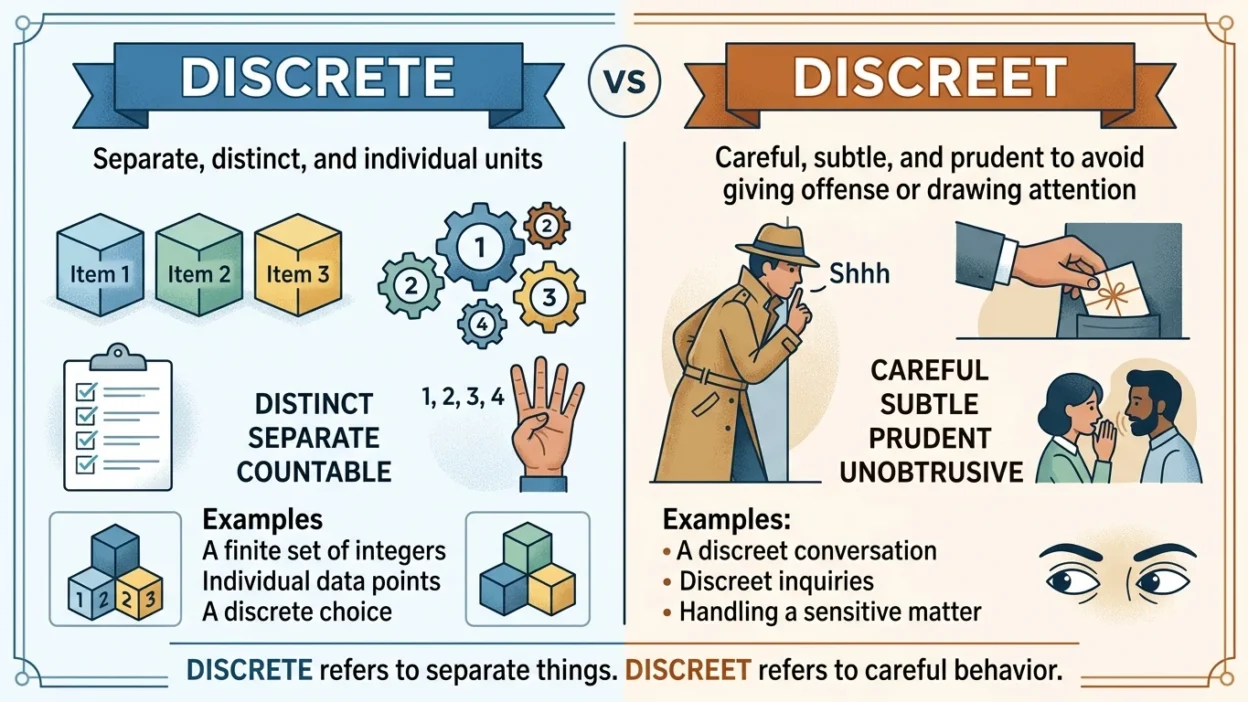
- Discrete = separate, individual, not connected
- Discreet = careful, quiet, keeping secrets
👉 Simple memory tip:
- Discreet has “ee” → think of “eyes” watching carefully
- Discrete has “t” → think of “things” (separate items)
Simple Background
Both words come from the same old root word in Latin, which means “to separate.” Over time, their meanings changed in English.
- Discrete kept the idea of “separate things”
- Discreet changed to mean “careful behavior”
Even though they started from the same place, today they are used in very different ways.
Clear Explanation of the Difference
What Does “Discrete” Mean?
Discrete means something is separate, individual, or not connected.
It is often used when talking about:
- Numbers
- Items
- Parts that are not joined together
👉 Example:
- The test has discrete sections.
(Each section is separate.)
👉 Another example:
- These are discrete points on the graph.
(Each point stands alone.)
What Does “Discreet” Mean?
Discreet means being careful, quiet, or not drawing attention.
It is often used for:
- Behavior
- Actions
- People who keep secrets
👉 Example:
- She was discreet about the surprise party.
(She did not tell anyone.)
👉 Another example:
- Please be discreet when discussing this issue.
(Be careful and quiet.)
Comparison Table
| Feature | Discrete | Discreet |
| Meaning | Separate, not connected | Careful, quiet, secretive |
| Use | Things, numbers, parts | People, behavior, actions |
| Focus | Separation | Carefulness |
| Example | Discrete steps | Discreet behavior |
| Easy Hint | “Things” (separate items) | “Eyes” (watch carefully) |
Which One to Use and When
Use discrete when you talk about things that are separate.
✔ Correct:
- The project has discrete stages.
- These are discrete values.
Use discreet when you talk about being careful or private.
✔ Correct:
- He gave a discreet smile.
- She handled the situation in a discreet way.
👉 Quick check:
- Talking about things? → Discrete
- Talking about behavior? → Discreet
Common Mistakes People Make
Here are some mistakes learners often make:
1. Using “discrete” for behavior
❌ He was very discrete about the news.
✔ He was very discreet about the news.
2. Using “discreet” for separate items
❌ The report has discreet sections.
✔ The report has discrete sections.
3. Guessing based on spelling
Many people just guess because the words look similar. This leads to wrong usage.
👉 Always think about meaning, not just spelling.
4. Forgetting the context
The meaning becomes clear when you look at the full sentence.
Ask yourself:
- Is this about separation? → discrete
- Is this about careful behavior? → discreet
Everyday Real-Life Examples
In Emails
- Please keep this information discreet.
- The report is divided into discrete parts.
In News
- The country has discrete regions with different cultures.
- The official gave a discreet response to the question.
In Social Media
- Be discreet when sharing personal details online.
- The app stores data in discrete units.
In Daily Conversation
- We need to keep this plan discreet.
- The machine works in discrete steps.
Short Learning Section for Students and Beginners
Here is a simple way to remember forever:
Step 1: Learn the key meaning
- Discrete = separate
- Discreet = careful
Step 2: Use a memory trick
- Discreet → “ee” → eyes → careful watching
- Discrete → “t” → things → separate items
Step 3: Practice with simple sentences
Fill in the blanks:
- She was very ______ about the secret.
- The data is in ______ groups.
✔ Answers:
- discreet
- discrete
Step 4: Make your own examples
Try writing:
- One sentence with discrete
- One sentence with discreet
This helps you remember faster.
FAQ Section
1. Are “discrete” and “discreet” the same?
No. They have different meanings. One is about separation, and the other is about careful behavior.
2. Which one means “keeping a secret”?
Discreet means keeping things private or secret.
3. Which one is used in math?
Discrete is often used in math to talk about separate numbers or values.
4. Is it a big mistake to mix them up?
It is a common mistake, but it can change the meaning of your sentence. So it is good to learn the difference.
5. How can I remember the difference easily?
Use this trick:
- Discreet = eyes = careful
- Discrete = things = separate
6. Can both words be used in the same sentence?
Yes, but they will have different meanings.
Example:
- The data is discrete, but you must be discreet when sharing it.
7. Is one word more common than the other?
Both are common, but they are used in different situations.
8. Can “discreet” describe objects?
Not usually. It is mostly used for people and behavior.
Conclusion
The words discrete and discreet may look almost the same, but their meanings are very different.
- Discrete = separate, individual things
- Discreet = careful, quiet, and private behavior
If you remember one simple idea, it becomes easy:
- Think of things → discrete
- Think of behavior → discreet
With a little practice and attention, you will start using both words correctly in your writing and speaking.