Many people feel confused when they see “deep-seeded” and “deep-seated.” The two phrases look very similar, and they even sound almost the same when spoken. Because of this, it is easy to mix them up.
But here is the important part: only one of them is correct in most situations. The other one is usually a mistake.
In this guide, you will learn the difference in a very simple way, so you can use the right phrase with confidence.
Quick Answer (Easy to Remember)
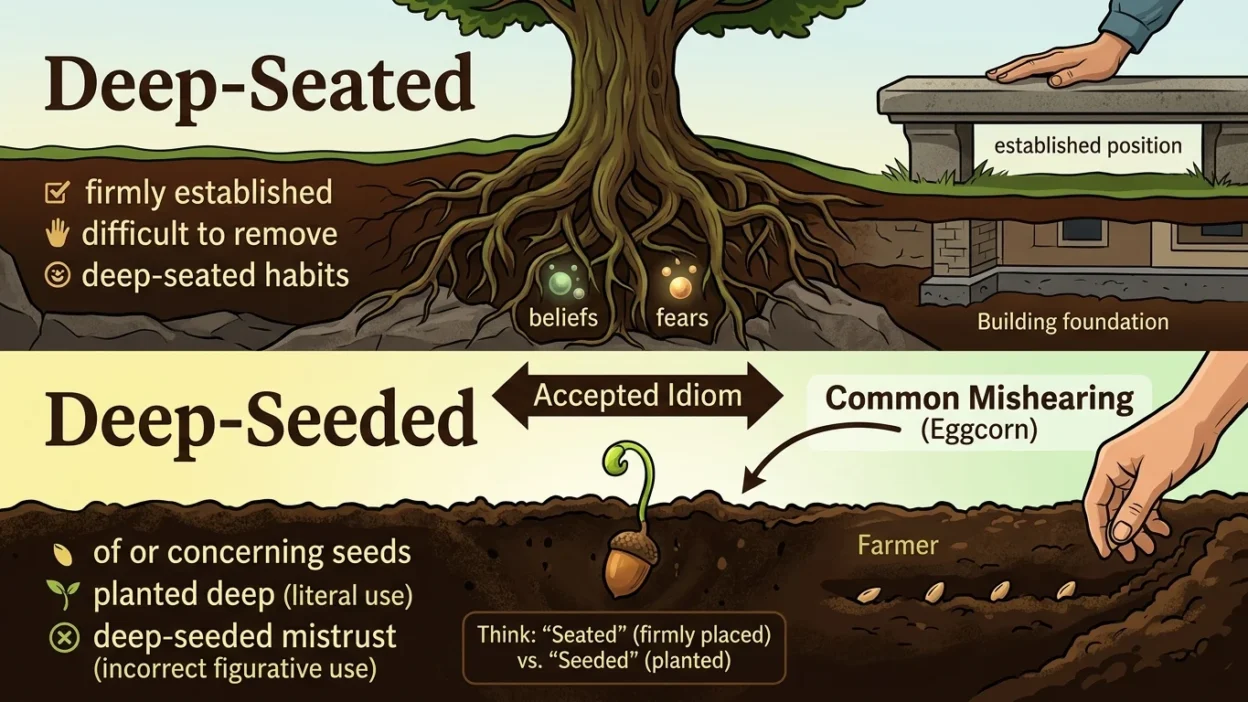
- ✅ Deep-seated = correct phrase
→ means something is strong, fixed, and hard to change - ❌ Deep-seeded = usually incorrect
→ people use it by mistake because of the word “seed”
👉 Quick tip:
If you mean strong feelings, beliefs, or problems, use deep-seated.
Simple Background: Where Do These Words Come From?
To understand the difference, let’s look at the words inside each phrase.
Deep-Seated
- “Seated” comes from the word seat
- A “seat” is a place where something sits
- So, “deep-seated” means something is sitting deep inside
👉 Example idea:
A feeling that is “seated” deep inside your mind or heart
Deep-Seeded (Why People Say It)
- “Seeded” comes from the word seed
- A seed grows into a plant
- People think of something growing deeply, like roots
👉 This sounds logical, but in standard English, this phrase is not correct for most uses
Clear Explanation of the Difference
Now let’s make it very clear.
Deep-Seated (Correct)
Use this when talking about:
- Feelings
- Beliefs
- Problems
- Habits
These things are:
- Strong
- Long-lasting
- Hard to change
👉 Example:
- She has a deep-seated fear of heights.
This means her fear is very strong and has been there for a long time.
Deep-Seeded (Incorrect in Most Cases)
People often use “deep-seeded” by mistake because:
- They imagine something growing like a plant
- It feels natural to say
But in correct English:
- It is not the standard phrase
- It is seen as an error in writing and speaking
Comparison Table (Quick View)
| Feature | Deep-Seated ✅ | Deep-Seeded ❌ |
| Correct usage | Yes | No (in most cases) |
| Meaning | Fixed deeply inside | Mistaken form |
| Used for | Feelings, beliefs, fears | Often used by error |
| Example | Deep-seated anger | Deep-seeded anger ❌ |
| Easy idea | “Sitting deep inside” | “Growing like a seed” (wrong use) |
Which One Should You Use and When?
Always Use “Deep-Seated” When:
You are talking about:
- Emotions
- Opinions
- Habits
- Social problems
👉 Examples:
- Deep-seated anger
- Deep-seated belief
- Deep-seated fear
- Deep-seated issue
Avoid “Deep-Seeded”
Even if it sounds correct:
- Do not use it in writing
- Do not use it in exams
- Do not use it in formal speaking
👉 It may confuse readers or make your English look incorrect
Common Mistakes People Make
Here are some mistakes many learners (and even native speakers) make:
1. Mixing Up the Words
❌ He has a deep-seeded fear of failure
✅ He has a deep-seated fear of failure
2. Thinking “Seeded” Is More Logical
People think:
- “Seed = growth”
- “So it must be correct”
But English does not always follow logic. The correct phrase is deep-seated, not “deep-seeded.”
3. Using It in Formal Writing
Using “deep-seeded” in:
- Essays
- Emails
- Exams
can make your writing look incorrect.
Everyday Real-Life Examples
Let’s see how people use deep-seated in daily life.
1. In Emails
- “There seems to be a deep-seated problem in the system.”
- “He has a deep-seated dislike for unfair rules.”
2. In News or Articles
- “The country is facing deep-seated economic issues.”
- “There are deep-seated social challenges in the region.”
3. On Social Media
- “I think this comes from a deep-seated insecurity.”
- “Her reaction shows a deep-seated fear.”
4. In Daily Conversations
- “He has a deep-seated habit of worrying.”
- “This is a deep-seated belief in our culture.”
Simple Learning Section for Students and Beginners
Here is an easy way to remember:
Memory Trick
👉 Seated = Sitting
So:
- Deep-seated = something sitting deep inside you
Practice Sentences
Fill in the blank:
- She has a ______ fear of dogs.
- This is a ______ problem in society.
- His anger is ______ and hard to control.
✅ Answers:
- deep-seated
- deep-seated
- deep-seated
Quick Check
Ask yourself:
- Am I talking about a strong feeling or belief?
👉 If yes → use deep-seated
Frequently Asked Questions (FAQ)
1. Is “deep-seeded” ever correct?
In most cases, no. It is considered a mistake when used instead of “deep-seated.”
2. Why do people still say “deep-seeded”?
Because it sounds natural and people think of “seeds growing.” But standard English uses “deep-seated.”
3. What does “deep-seated fear” mean?
It means a fear that is very strong and has existed for a long time.
4. Can I use “deep-seated” in formal writing?
Yes. It is correct and commonly used in essays, reports, and professional writing.
5. Is this mistake common?
Yes. Many people, even native speakers, confuse these two phrases.
6. How can I avoid this mistake?
Remember:
- Seated = correct
- Seeded = usually wrong
7. Is the meaning of both phrases the same?
People use them to mean the same thing, but only deep-seated is correct.
8. Can “deep-seeded” ever be used literally?
Very rarely, if you are actually talking about seeds planted deep in soil. But this is not common in normal language use.
Conclusion
The confusion between deep-seated and deep-seeded is very common, but the solution is simple.
- Deep-seated is the correct phrase
- It means something strong, lasting, and deeply fixed inside
On the other hand:
- Deep-seeded is usually a mistake
- It should be avoided in correct English
👉 Final tip:
If you are unsure, always choose deep-seated. It is the safe and correct option.