Many people get confused between “labelling” and “labeling.”
Both words look almost the same, and both are connected to the word “label.” The only visible difference is the extra “l” in labelling.
So which spelling is correct?
The simple answer is that both are correct, but they are used in different types of English. This small spelling change often confuses students, ESL learners, and even native speakers.
This guide explains everything in very easy English so you can understand the difference clearly and use the correct spelling with confidence.
Quick Answer
Here is the short and simple answer:
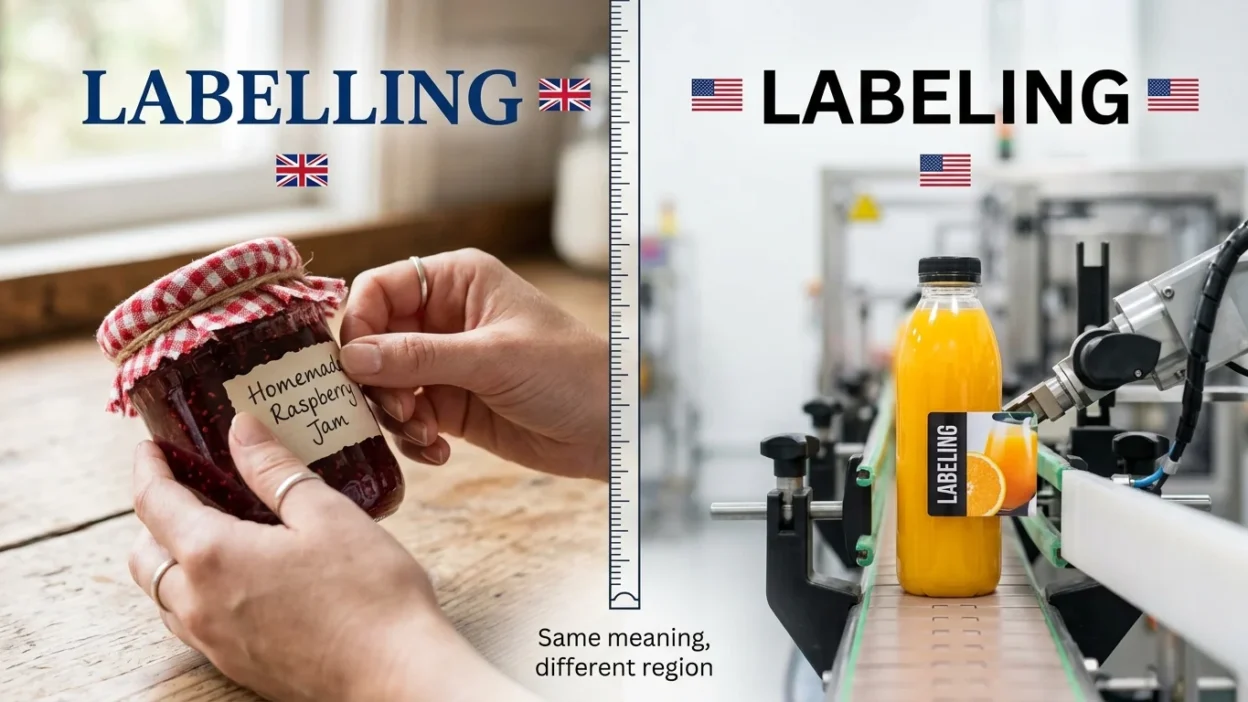
- Labelling = British English spelling
- Labeling = American English spelling
- Both words mean the same thing
- Both come from the verb “label”
- The difference is only in spelling, not meaning
Simple Example
- British English: The company is labelling the boxes.
- American English: The company is labeling the boxes.
Both sentences are correct.
The Simple Background of the Word
The word “label” came into English many years ago from older European languages. A label is a small piece of paper, sticker, tag, or title that gives information about something.
For example:
- A food package has a label
- A school file has a label
- A shirt may have a size label
- A person can also be “labeled” with an opinion or description
Over time, English developed in different countries. British English and American English began using slightly different spelling rules.
That is why some words have two accepted spellings today.
Examples:
| British English | American English |
| travelling | traveling |
| cancelled | canceled |
| labelling | labeling |
The meaning stays the same, but the spelling changes depending on the style of English.
What Does “Labelling” or “Labeling” Mean?
Both words mean:
- putting a label on something
- giving information through a label
- describing or naming something
The word can be used in physical situations or in ideas and opinions.
Physical Use
- labeling boxes
- labelling folders
- labeling products
Opinion or Description Use
- labeling someone as shy
- labelling a group unfairly
In all these cases, the meaning does not change.
The Main Difference Between Labelling and Labeling
The only real difference is the type of English being used.
Labelling
- Used mainly in British English
- Common in the UK and many countries that follow British spelling
- Uses a double “l”
Example
- The workers are labelling the packages.
Labeling
- Used mainly in American English
- Common in the United States
- Uses one “l”
Example
- The workers are labeling the packages.
Easy Comparison Table
| Feature | Labelling | Labeling |
| Type of English | British English | American English |
| Spelling Style | Double “l” | Single “l” |
| Meaning | Same | Same |
| Correct? | Yes | Yes |
| Used in UK? | Very common | Less common |
| Used in USA? | Rare | Very common |
| Pronunciation | Same | Same |
Why Does British English Use Double “L”?
This happens because of a spelling pattern in British English.
When a word ends with a vowel + “l,” British English often doubles the “l” before adding endings like:
- -ing
- -ed
Examples:
| Base Word | British English | American English |
| travel | travelling | traveling |
| cancel | cancelled | canceled |
| label | labelling | labeling |
British English keeps the extra “l,” while American English often removes it.
Which One Should You Use?
The best choice depends on your audience, school style, or country.
Use “Labelling” If:
- You follow British English
- You study in the UK
- Your school uses British spelling
- You write for British readers
Example
- The teacher is labelling the science equipment.
Use “Labeling” If:
- You follow American English
- You study in the United States
- Your company uses American spelling
- You write for American readers
Example
- The teacher is labeling the science equipment.
Can You Use Both in One Piece of Writing?
It is better not to mix them.
Choose one style and stay consistent throughout your writing.
For example:
Correct British Style
- labelling
- travelling
- cancelled
Correct American Style
- labeling
- traveling
- canceled
Mixing styles can make writing look careless or confusing.
Common Mistakes People Make
Here are some mistakes learners often make.
1. Thinking One Spelling Is Wrong
Many people believe only one version is correct.
That is not true.
Both spellings are accepted in English.
2. Mixing British and American Spelling
Example of mixed style:
- The company is labelling products and organizing canceled orders.
This mixes British and American spelling together.
It is better to keep one style.
3. Forgetting the Double “L” Rule
Some learners write:
- labling
This is incorrect.
Correct forms:
- labelling
- labeling
4. Confusing “Label” With “Lable”
Some people accidentally spell the base word incorrectly.
Correct:
- label
Incorrect:
- lable
Everyday Examples of Labelling and Labeling
Here are simple real-life examples to help you understand how the words are used.
In Emails
British English
- Please finish labelling the office files today.
American English
- Please finish labeling the office files today.
In Schools
- Students are labeling their notebooks.
- The teacher spent time labelling classroom materials.
In Shops
- Workers are labeling food products.
- The store is labelling new clothing items.
On Social Media
- Stop labeling people without knowing the truth.
- Many users are labelling the video as fake.
In News Reports
- The company changed its food labeling rules.
- The government updated labelling laws.
Is the Pronunciation Different?
No.
Both words are pronounced the same way.
Pronunciation
LABEL-ing
The extra “l” in labelling does not change the sound.
Is One More Formal Than the Other?
No.
Neither spelling is more formal.
The difference is only regional:
- British English → labelling
- American English → labeling
Both are standard and professional in the correct context.
Short Learning Section for Students and Beginners
Here is a quick learning trick.
Easy Memory Tip
Think about the country:
- UK English likes double “l”
- US English often uses single “l”
Remember These Pairs
| British | American |
| labelling | labeling |
| travelling | traveling |
| cancelling | canceling |
This pattern can help you remember many English spelling differences.
Practice Sentences
Choose the style you want and complete the sentence.
- The company is ______ the new boxes.
- She spent the afternoon ______ folders.
- Food ______ rules are changing.
Possible answers:
- labeling
- labelling
Both are correct depending on the English style.
FAQ About Labelling vs Labeling
1. Is “labelling” correct in English?
Yes. It is the British English spelling.
2. Is “labeling” correct in English?
Yes. It is the American English spelling.
3. Do the two words have different meanings?
No. They mean exactly the same thing.
4. Which spelling is more common in the USA?
“Labeling” is more common in the United States.
5. Which spelling is more common in the UK?
“Labelling” is more common in the United Kingdom.
6. Can I use both spellings together?
It is better to choose one style and stay consistent.
7. Is “labling” a correct spelling?
No. “Labling” is incorrect.
Correct spellings are:
- labelling
- labeling
8. How do I know which style to use?
Check your school, workplace, or audience.
Use British English or American English consistently.
Final Thoughts
The confusion between labelling and labeling is very common, especially for students and English learners. The good news is that both spellings are correct.
The main thing to remember is simple:
- Labelling = British English
- Labeling = American English
The meaning, pronunciation, and usage are the same. Only the spelling changes based on the style of English you choose.
If you stay consistent and follow one spelling style throughout your writing, your English will look clear, correct, and professional.