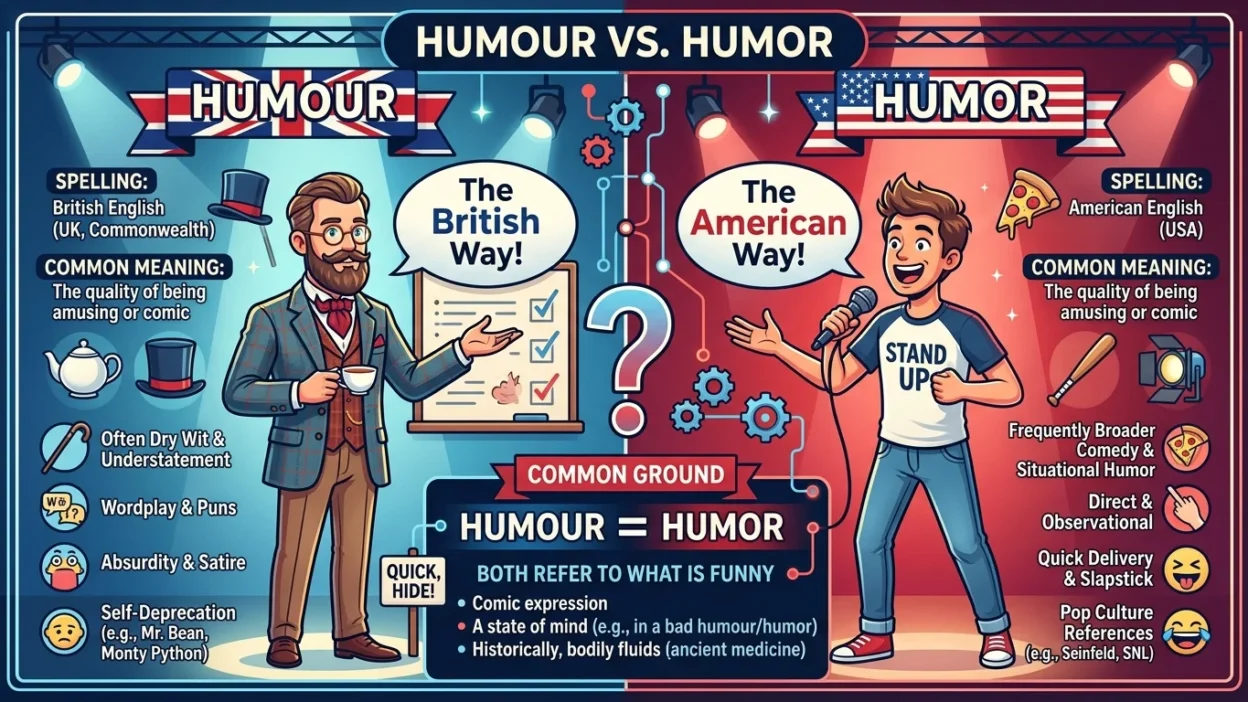
Many people feel confused about “humour” and “humor.” They look almost the same. They sound the same when spoken. So, why are there two spellings?
The simple reason is this: different English styles use different spellings. One is common in British English, and the other is common in American English. This small difference often confuses students, ESL learners, and even native speakers.
Quick Answer
Here is the short and easy answer:
- Humour = British English spelling
- Humor = American English spelling
- Both words have the same meaning
- Both are correct, depending on where you are or what style you follow
- You should not mix them in the same piece of writing
Simple Origin and Background
The word comes from an old Latin word “humor,” which meant “liquid” or “fluid.” Long ago, people believed that body fluids affected a person’s mood.
Later, the meaning changed. It started to mean:
- Mood
- Personality
- Ability to laugh or make others laugh
When English developed in different parts of the world, spelling changed:
- In British English, many words kept older spellings like colour, favour, humour
- In American English, spelling was simplified to color, favor, humor
So, the difference is mainly about history and location, not meaning.
Clear Explanation of the Difference
Let’s make it very simple:
Humour
- Used in British English
- Common in the UK, Australia, and some other countries
- Has an extra “u”
Humor
- Used in American English
- Common in the USA
- Shorter spelling (no “u”)
👉 Important point:
Both words mean the same thing. There is no difference in meaning or pronunciation.
Comparison Table
| Feature | Humour | Humor |
| English Style | British English | American English |
| Spelling | Has “u” | No “u” |
| Meaning | Same | Same |
| Pronunciation | Same | Same |
| Example Regions | UK, Australia | USA |
| Usage | Formal & informal | Formal & informal |
Which One Should You Use and When?
Choosing the right spelling is easy if you follow these simple rules:
Use “Humour” if:
- You are writing for a British audience
- You follow British English rules
- Your school or teacher uses British spelling
Use “Humor” if:
- You are writing for an American audience
- You follow American English rules
- You are writing for US-based exams or content
Important Tip:
👉 Always stay consistent
Do not mix “humour” and “humor” in the same writing.
For example:
❌ Wrong: His humour is great, and his humor is unique.
✅ Correct: His humour is great, and his humour is unique.
✅ Correct: His humor is great, and his humor is unique.
Common Mistakes People Make
Here are some mistakes learners often make:
1. Mixing both spellings
- ❌ Writing “humour” in one sentence and “humor” in another
- ✔️ Choose one style and stick to it
2. Thinking they have different meanings
- ❌ Believing “humour” and “humor” mean different things
- ✔️ They mean exactly the same
3. Using the wrong spelling for the audience
- ❌ Using “humour” in American writing
- ✔️ Match the spelling with your audience
4. Changing spelling in exams
- ❌ Switching styles in the same test
- ✔️ Follow one style only
Everyday Real-Life Examples
Let’s look at how people use these words in daily life.
Emails
British style:
- “I really enjoy your sense of humour.”
American style:
- “I really enjoy your sense of humor.”
Social Media
British style:
- “This video has great humour!”
American style:
- “This video has great humor!”
News or Articles
British style:
- “The show is full of clever humour.”
American style:
- “The show is full of clever humor.”
Daily Conversation (Writing)
- “She has a good sense of humour.” (UK)
- “She has a good sense of humor.” (US)
👉 When speaking, both sound the same.
Short Learning Section for Students and Beginners
Here is a quick learning guide you can remember:
Easy Trick to Remember
- Words with “u” → British English
- colour, favour, humour
- Words without “u” → American English
- color, favor, humor
Practice Sentences
Fill in the blanks:
- He has a great sense of ______.
- British English uses ______.
- American English uses ______.
Answers:
- humour / humor (both correct)
- humour
- humor
Mini Tip
If you are not sure which to use:
- Ask: “Am I writing in British or American English?”
FAQ (Frequently Asked Questions)
1. Are “humour” and “humor” the same?
Yes, they have the same meaning. Only the spelling is different.
2. Which one is correct?
Both are correct. It depends on the type of English you use.
3. Which one is more common?
- “Humor” is more common in the USA
- “Humour” is more common in the UK and similar regions
4. Do they sound different?
No, they sound exactly the same when spoken.
5. Can I use both in one sentence?
No, it is better to use only one style in your writing.
6. Is one more formal than the other?
No, both can be used in formal and informal writing.
7. Which spelling should students learn?
It depends on your school or exam system. Follow what your teacher or syllabus uses.
8. What about other similar words?
There are many like this:
- colour / color
- favour / favor
- honour / honor
Conclusion
The difference between “humour” and “humor” is simple once you understand it.
- Both words mean the same thing
- The only difference is spelling style
- “Humour” is British English
- “Humor” is American English
The most important rule is to stay consistent. Choose one style and use it throughout your writing.
Once you remember this, you will never feel confused again.