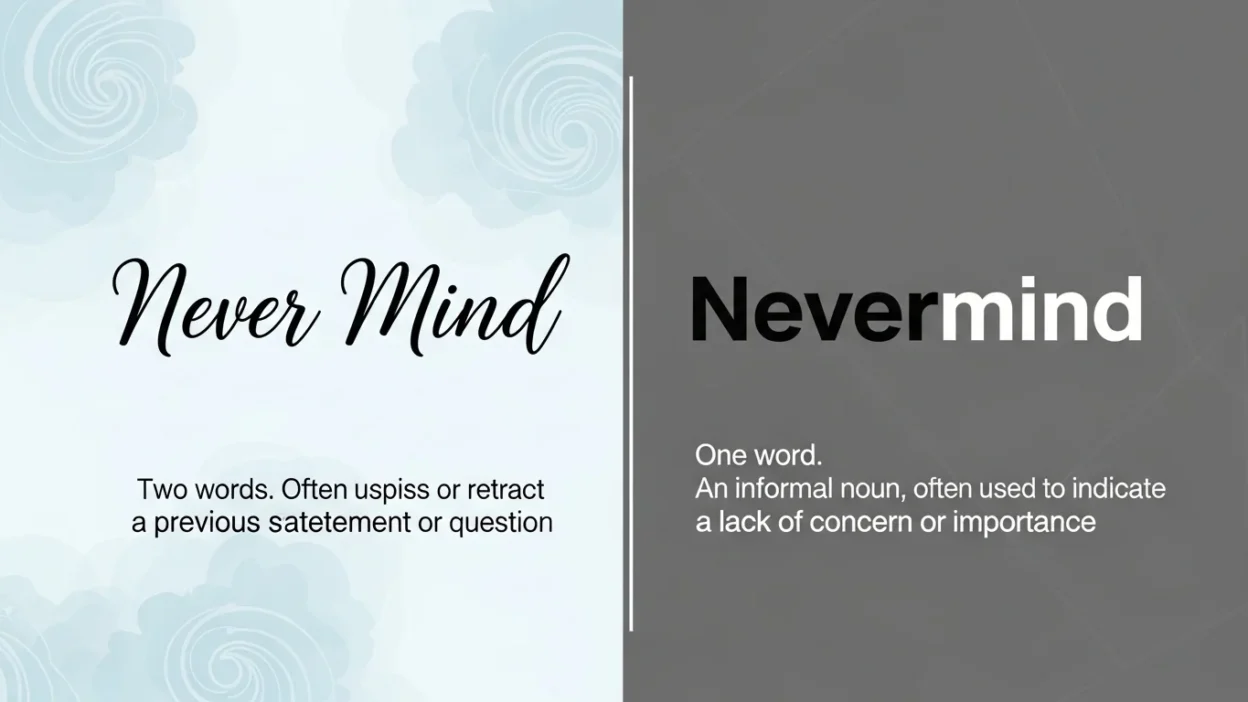
Many learners feel confused about “never mind” and “nevermind.” They look almost the same, and they sound exactly the same when we speak. Because of this, people often think they mean the same thing and can be used in the same way.
But here’s the truth: they are not used in the same way in modern English. One form is correct in most situations, and the other is usually avoided.
Don’t worry—this guide will make everything simple and clear so you can understand it easily on your first read.
Quick Answer
- ✅ “Never mind” (two words) = correct and widely used
- ❌ “Nevermind” (one word) = usually incorrect in standard English
- 🗣️ Use “never mind” when you want to say:
- “It’s okay”
- “Forget it”
- “Don’t worry about it”
👉 In short: Always use “never mind” in writing and speaking.
Simple Background
The phrase “never mind” has been used in English for a long time. It comes from the idea of “not paying attention” or “not worrying about something.”
Over time, people started writing it quickly in informal messages, like chats or texts, and that’s how “nevermind” (one word) appeared.
However, most teachers, books, and grammar guides still accept only the two-word form as correct.
Clear Explanation of the Difference
1. “Never mind” (Correct Form)
“Never mind” is a phrase (two separate words). It is used in everyday English and is accepted everywhere.
You use it when:
- Something is not important anymore
- You want someone to stop worrying
- You want to cancel a question or request
📌 Example:
- “Can you help me with this? Oh, never mind, I figured it out.”
2. “Nevermind” (Incorrect or Informal)
“Nevermind” (one word) is often seen in:
- Text messages
- Social media
- Informal writing
But in formal English, school writing, emails, and exams, it is considered incorrect or non-standard.
📌 Example (informal):
- “nevermind lol”
👉 It may appear in casual chat, but it is not recommended for proper English use.
Comparison Table
| Feature | Never mind ✅ | Nevermind ❌ |
| Number of words | Two words | One word |
| Correct usage | Yes | No (in standard English) |
| Used in writing | Yes | Not recommended |
| Used in speaking | Yes | Sounds the same |
| Formal situations | Yes | No |
| Informal chatting | Yes | Sometimes used |
Which One to Use and When
Use “never mind” when:
- Writing emails
- Doing homework
- Speaking politely
- Writing essays or exams
- Talking in daily life
📌 Examples:
- “Never mind, it’s not a big problem.”
- “Oh, never mind. I don’t need it anymore.”
Avoid “nevermind” when:
- Writing anything important
- Talking in professional settings
- Learning correct English
👉 Even if you see it online, it’s safer to stick with “never mind.”
Common Mistakes People Make
❌ Mistake 1: Writing it as one word
- Wrong: “nevermind”
- Correct: “never mind”
❌ Mistake 2: Thinking both are correct
Some learners think both forms are equal.
👉 They are not. Only “never mind” is correct in standard English.
❌ Mistake 3: Using it in formal writing
Using “nevermind” in emails, school work, or tests can look incorrect.
❌ Mistake 4: Not understanding the meaning
Some people use it without knowing what it means.
👉 Remember:
- It means “forget it” or “it’s okay.”
Everyday Real-Life Examples
📧 In Emails
- “Please send the file today. Oh, never mind—I already received it.”
📰 In News or Articles
- “The manager said the delay is small, so never mind the schedule change.”
💬 In Social Media
- “I was going to post something… never mind 😅”
🗣️ In Daily Conversation
- “Can you pass me the pen? Oh, never mind, I found one.”
🏫 In School
- “Never mind the mistake. Just try again.”
Short Learning Section (For Students & Beginners)
Here is an easy way to remember:
👉 Think of it like this:
- Never = not
- Mind = care or worry
So:
👉 “Never mind” = do not worry / do not care about it
Quick Practice
Choose the correct sentence:
- “Never mind / Nevermind, I’ll do it myself.”
- “nevermind / never mind, it’s okay.”
✅ Answers:
- Never mind
- never mind
FAQ (Frequently Asked Questions)
1. Is “nevermind” ever correct?
No, not in standard English. It is better to use “never mind.”
2. Why do people still write “nevermind”?
Because of fast typing in chats and social media.
3. Can I use “nevermind” in texting?
You can, but it’s better to use “never mind” to stay correct.
4. Is “never mind” formal or informal?
It can be both. It works in all situations.
5. Does “never mind” mean “sorry”?
Not exactly. It means:
- “It’s okay”
- “Forget it”
- “Don’t worry”
6. Can I use it in exams?
Yes, but only as “never mind.”
7. Is it the same as “no problem”?
Yes, sometimes. They can have similar meaning.
8. How do I remember the correct form?
Just remember:
👉 Two words = correct
Conclusion
The difference between “never mind” and “nevermind” is simple once you understand it.
- “Never mind” (two words) is the correct and standard form.
- “Nevermind” (one word) is informal and not recommended.
If you want to speak and write English correctly, always choose “never mind.” It is safe, clear, and accepted everywhere.