Many people feel confused when they see “sneaked” and “snuck.” Both words look different, but they come from the same verb: “sneak.” So which one is correct? Are both okay to use?
This confusion happens because English changes over time. Some words have more than one correct past form. The good news is: once you understand a few simple points, the confusion disappears completely.
Quick Answer
- Both “sneaked” and “snuck” are correct
- “Sneaked” is more traditional and formal
- “Snuck” is more informal and common in everyday speech
- Both mean the same thing: to move quietly or secretly
Simple Background (Where These Words Come From)
The verb “sneak” first appeared in English many years ago. At that time, the correct past tense was only:
- sneaked
Later, people started using “snuck” in casual speech, especially in the United States. Over time, it became widely accepted.
So today:
- “Sneaked” is the older, original form
- “Snuck” is newer but now also correct
English often works like this. Some verbs develop new forms as people use them more.
Clear Explanation of the Difference
The important thing to understand is this:
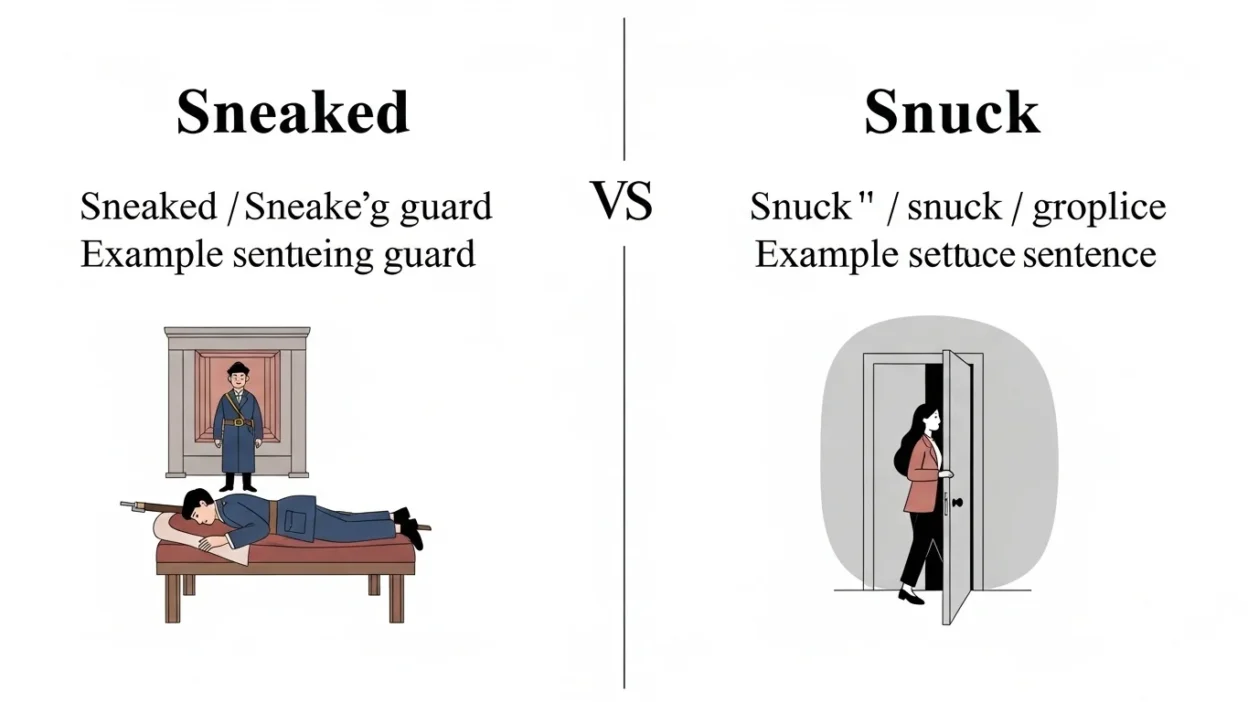
👉 There is NO difference in meaning between “sneaked” and “snuck.”
Both words describe:
- Moving quietly
- Doing something secretly
- Trying not to be noticed
The only difference is style and tone.
“Sneaked”
- Sounds more formal
- Used more in writing, school, or professional situations
“Snuck”
- Sounds more casual
- Used more in everyday conversations
Comparison Table
| Feature | Sneaked | Snuck |
| Meaning | Same | Same |
| Formality | More formal | More informal |
| Usage | Writing, school, news | Daily speech, casual talk |
| Age | Older form | Newer form |
| Correct? | Yes | Yes |
Which One Should You Use and When?
Here’s a simple guide to help you choose:
Use “Sneaked” when:
- Writing essays or school work
- Writing formal emails
- Speaking in professional settings
Example:
- She sneaked into the room quietly.
Use “Snuck” when:
- Talking with friends
- Writing casual messages
- Sharing stories in a relaxed tone
Example:
- He snuck out of the house last night.
👉 Easy rule:
- Formal = sneaked
- Casual = snuck
Common Mistakes People Make
1. Thinking one is wrong
Many learners think “snuck” is incorrect. That is not true anymore. Both forms are accepted.
2. Mixing tense forms
Incorrect:
- He has snuck into the room (This is actually okay, but some prefer consistency)
Better:
- He has sneaked into the room (more formal)
- He has snuck into the room (casual but acceptable)
3. Using the wrong tone
Using “snuck” in a formal essay can sound too casual.
4. Overthinking the difference
Some learners try to find a meaning difference—but there is none.
Everyday Real-Life Examples
In Emails
- Formal:
“Someone sneaked into the office after hours.” - Casual:
“Someone snuck into the office last night.”
In News Style
- “The suspect sneaked into the building unnoticed.”
On Social Media
- “I snuck some snacks into the movie theater 😄”
In Daily Conversations
- “He snuck out when his parents were sleeping.”
- “She sneaked up behind me and scared me!”
In Stories
- “The cat snuck into the kitchen and stole food.”
- “The child sneaked into the room to surprise his mom.”
Short Learning Section for Students and Beginners
Here’s a quick and easy way to remember:
Step 1: Learn the base verb
- Sneak = to move quietly
Step 2: Learn both past forms
- Sneaked
- Snuck
Step 3: Practice with simple sentences
- I sneaked into the room.
- I snuck into the room.
Both are correct!
Step 4: Choose based on situation
- School writing → sneaked
- Talking with friends → snuck
Quick Memory Tip
👉 “Sneaked is safe everywhere. Snuck is friendly and casual.”
FAQ (Frequently Asked Questions)
1. Is “snuck” a real word?
Yes, “snuck” is a real and correct word. It is widely used today.
2. Which is more correct: sneaked or snuck?
Both are correct. “Sneaked” is more formal, while “snuck” is more casual.
3. Can I use “snuck” in exams?
It is safer to use “sneaked” in exams because it sounds more formal.
4. Do Americans and British people use these differently?
- Americans often use “snuck”
- British speakers more often use “sneaked”
But both forms are understood everywhere.
5. Is there a difference in meaning?
No, there is no difference in meaning. Both mean the same thing.
6. What is the past participle form?
Both can be used:
- He has sneaked out
- He has snuck out
“Sneaked” is more formal.
7. Which one should beginners learn first?
Learn “sneaked” first because it is simple and always safe to use.
8. Why does English have two forms?
Because language changes over time. People started using “snuck,” and it became accepted.
Conclusion
The confusion between “sneaked” and “snuck” is very common, but the answer is simple:
- Both are correct
- Both mean the same thing
- The only difference is how formal they sound
If you want to stay safe, especially in writing, use “sneaked.”
If you are speaking casually, “snuck” is perfectly fine.
Once you understand this, you don’t need to worry anymore. You can choose the word that fits your situation—and use it with confidence.