Many people get confused between foreword and forward because the two words sound exactly the same. They are pronounced alike, but they have very different meanings and uses.
This confusion is very common for students, English learners, writers, and even native speakers. One word is mostly connected to books, while the other is used in movement, emails, plans, and daily conversation.
The good news is that the difference is actually very simple once you see clear examples.
In this guide, you will learn:
- What each word means
- When to use each one
- Easy memory tricks
- Common mistakes to avoid
- Real-life examples from daily English
By the end, you will never mix them up again.
Quick Answer: Foreword vs Forward
Foreword
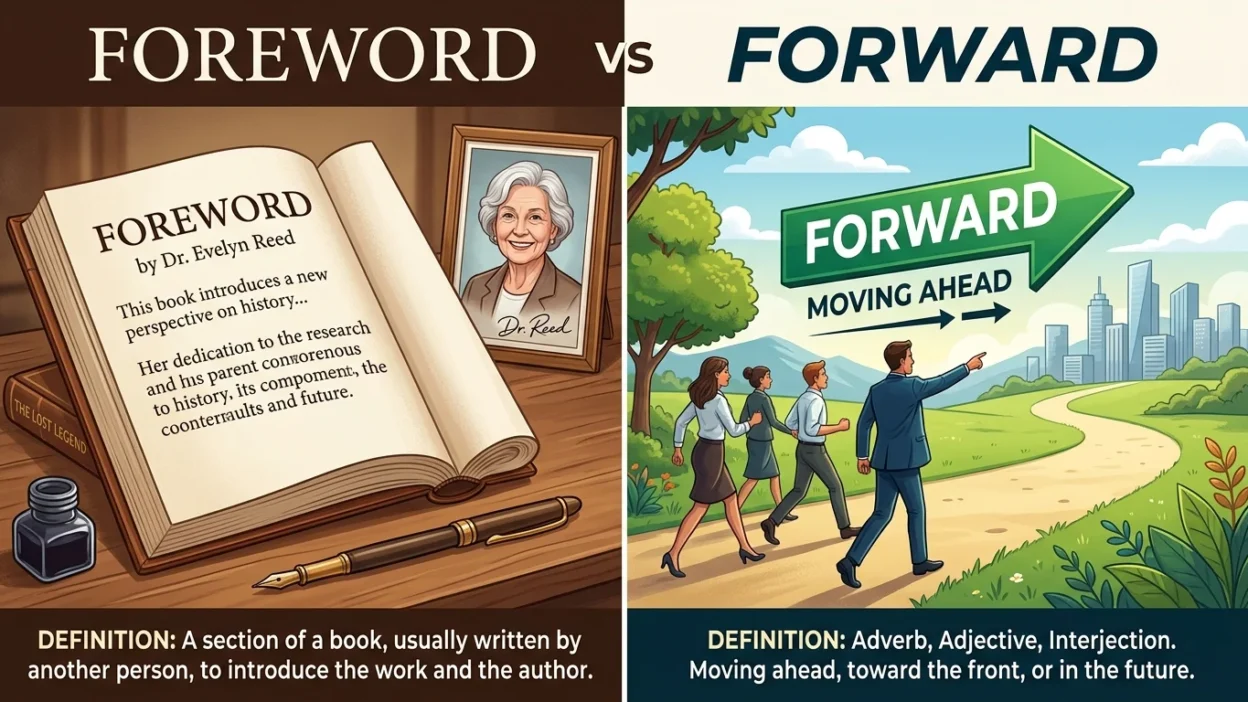
- A foreword is a short introduction at the beginning of a book.
- It is usually written by someone other than the main author.
- It talks about the book or the writer.
Example:
The teacher wrote the foreword for the new science book.
Forward
- Forward usually means moving ahead or sending something onward.
- It can be used as an adjective, adverb, verb, or noun.
Examples:
Please move forward in the line.
I will forward your email to the manager.
Simple Background and Origin
Understanding where the words come from can make them easier to remember.
Where “Foreword” Comes From
The word foreword has two parts:
- Fore = before or in front
- Word = written or spoken language
So, a foreword literally means:
“Words that come before the main text.”
That is why it appears at the beginning of a book.
Where “Forward” Comes From
The word forward comes from the idea of moving ahead or going in front.
It is connected to:
- progress
- direction
- movement
- sending things onward
That is why we use it in everyday speech.
The Main Difference Between Foreword and Forward
The easiest way to understand the difference is this:
- Foreword is a book-related noun
- Forward is mostly about movement or sending
Foreword
A foreword is:
- part of a book
- found before the first chapter
- usually written by another person
It often explains:
- why the book matters
- why the author is important
- what readers can expect
Example:
The famous professor wrote the foreword for the history book.
Forward
Forward has several meanings.
It can mean:
- ahead
- toward the front
- to send something
- progress into the future
Examples:
She stepped forward to ask a question.
Please forward this message to your team.
The company is moving forward with the plan.
Foreword vs Forward Comparison Table
| Feature | Foreword | Forward |
| Meaning | Introduction in a book | Ahead, onward, or send |
| Part of Speech | Noun | Verb, adjective, adverb, noun |
| Used in Books? | Yes | Usually no |
| Used in Emails? | No | Yes |
| Connected to Movement? | No | Yes |
| Common Example | “He wrote the foreword.” | “Move forward.” |
| Sounds Like | Forward | Foreword |
| Same Meaning? | No | No |
Which One Should You Use?
Use “Foreword” When Talking About Books
Choose foreword if you mean:
- an introduction
- opening comments
- text before Chapter 1
Examples:
- The writer asked her teacher to write the foreword.
- I read the foreword before starting the novel.
- The foreword explains how the book was created.
Use “Forward” for Everything Else
Use forward when talking about:
- movement
- progress
- direction
- sending messages
- future plans
Examples:
- Please walk forward slowly.
- She forwarded the email yesterday.
- We need to move forward together.
- The football player passed the ball forward.
Easy Memory Trick
Here is a simple trick that helps many learners.
Foreword = Before the Words
Think:
“Foreword comes before the words of the book.”
The word contains:
- fore = before
- word = writing
So it belongs at the beginning of a book.
Forward = Moving Ahead
Think:
“Forward means going ahead.”
If movement, action, progress, or sending is involved, use forward.
Common Mistakes People Make
Mistake 1: Writing “forward” in a book review
❌ Wrong:
The author’s forward was inspiring.
✅ Correct:
The author’s foreword was inspiring.
Why?
Because it is the introduction of a book.
Mistake 2: Writing “foreword” in emails
❌ Wrong:
Please foreword this message.
✅ Correct:
Please forward this message.
Why?
Because you are sending something onward.
Mistake 3: Confusing pronunciation with spelling
Both words sound the same:
“FOR-werd”
This makes spelling difficult.
That is why many people choose the wrong word in writing.
Mistake 4: Thinking they are interchangeable
They are not interchangeable.
Even though they sound alike, they have completely different meanings.
Real-Life Examples of Foreword and Forward
In Books
Foreword
The foreword was written by a famous scientist.
I skipped the foreword and started Chapter 1.
Her grandmother wrote the foreword to the cookbook.
In Emails
Forward
Can you forward this email to the class?
He forwarded the document this morning.
I accidentally forwarded the wrong file.
In Daily Conversation
Forward
Please move forward.
We must look forward to the future.
The team is moving forward with confidence.
On Social Media
Forward
Forward this post to your friends.
She shared and forwarded the video online.
In News and Business
Forward
The project will move forward next month.
Leaders discussed the best way forward.
Short Learning Section for Students and Beginners
Here is a quick study guide.
Remember This Simple Rule
Foreword
= beginning of a book
Forward
= ahead, onward, or send
Fill-in-the-Blank Practice
1.
The writer thanked his teacher in the ________.
✅ Answer: foreword
2.
Please ________ the email to the office.
✅ Answer: forward
3.
The team is moving ________ with the project.
✅ Answer: forward
4.
I enjoyed reading the book’s ________.
✅ Answer: foreword
Mini Quiz
Which word is correct?
| Sentence | Correct Word |
| Move ________ slowly. | forward |
| The book has a short ________. | foreword |
| Please ________ the message. | forward |
| Her friend wrote the ________. | foreword |
Frequently Asked Questions (FAQ)
1. Are foreword and forward pronounced the same?
Yes. They sound the same when spoken, which is why many people confuse them.
2. What is a foreword in a book?
A foreword is a short introduction at the beginning of a book. It is often written by someone other than the author.
3. Can “forward” be used as a verb?
Yes.
Example:
I will forward your email.
4. Is “foreword” only used for books?
Mostly yes. It is connected to written works like books and sometimes reports.
5. Which word means “moving ahead”?
The correct word is forward.
Example:
She stepped forward.
6. Which word should I use in an email?
Use forward.
Example:
Please forward this file.
7. Can a book author write the foreword?
Yes, but usually another person writes it to introduce the author or book.
8. Why do people mix up these words?
Because:
- they sound identical
- they look similar
- both contain “fore/for”
But their meanings are very different.
Simple Conclusion
The difference between foreword and forward becomes easy once you connect each word with its purpose.
Use foreword for:
- book introductions
- opening comments before the main text
Use forward for:
- movement
- progress
- sending emails or messages
- direction and future action
A simple memory trick is:
Foreword = words before a book
Forward = moving ahead
These two words may sound the same, but now you know exactly how to use each one correctly in real life, school writing, emails, and daily English.