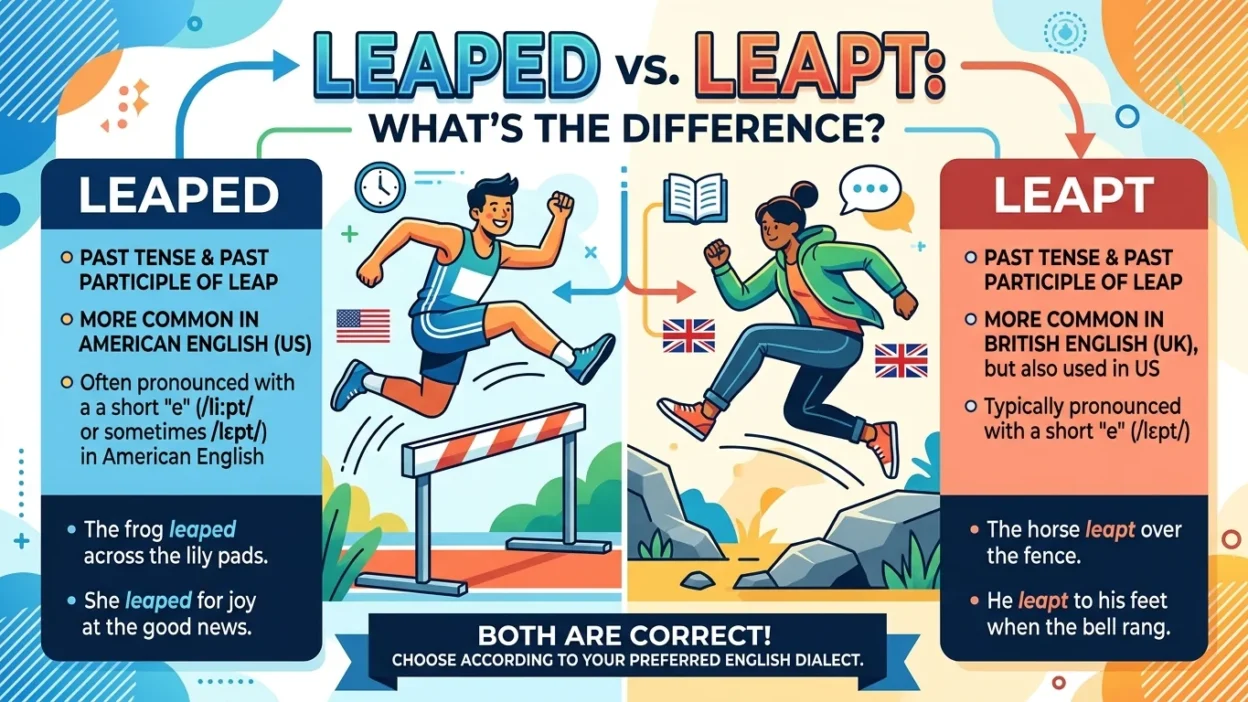
Many English learners get confused by “leaped” and “leapt” because both words come from the verb “leap.” The surprising part is that both are correct. That is why people often wonder which one they should use.
You may see one word in books, another in movies, and a different one in school writing. This can make English feel confusing, especially for beginners and ESL learners.
The good news is simple: “leaped” and “leapt” mean exactly the same thing. The difference is mostly about style, region, and personal choice. Once you understand that, the confusion becomes much easier to handle.
Quick Answer
Here is the simple answer first:
- Leaped and leapt are both past tense forms of leap
- Both words mean:
- jumped
- sprang into the air
- moved quickly
- Leaped is more common in American English
- Leapt is more common in British English
- Neither word is wrong
- You can usually use either one safely
Example
- The cat leaped onto the table.
- The cat leapt onto the table.
Both sentences are correct.
Simple Background of the Words
The verb “leap” is a very old English word. For hundreds of years, English speakers have used different past tense forms for some verbs.
English has two common patterns:
- Regular verbs
- add -ed
- Example:
- walk → walked
- jump → jumped
- Irregular verbs
- change spelling
- Example:
- keep → kept
- sleep → slept
The word “leap” became special because people used both patterns:
- leap → leaped
- leap → leapt
Over time, both stayed in the language.
That is why modern English accepts both forms today.
What Is the Difference Between Leaped and Leapt?
The meaning is the same. The real difference is mostly about:
- location
- writing style
- sound
- preference
“Leaped”
“Leaped” follows the normal -ed pattern.
It sounds more modern and more regular.
It is common in:
- American English
- school writing
- everyday conversation
- simple learning materials
“Leapt”
“Leapt” has the shorter irregular form.
It sounds a little more traditional or literary.
It is common in:
- British English
- novels
- storytelling
- dramatic writing
Still, many people in both countries use both words.
Easy Comparison Table
| Feature | Leaped | Leapt |
| Meaning | Jumped | Jumped |
| Correct? | Yes | Yes |
| Type | Regular form | Irregular form |
| More common in | American English | British English |
| Sounds | Modern and simple | Traditional or literary |
| Used in daily speech | Very often | Often |
| Safe for school writing | Yes | Yes |
Which One Should You Use?
The best choice depends on your situation.
Use “Leaped” When:
- You are learning English as a beginner
- You want simple grammar
- You write in American English
- You want a more natural modern tone
Example Sentences
- The child leaped over the puddle.
- She leaped from excitement.
- The dog leaped into the car.
Use “Leapt” When:
- You use British English
- You enjoy traditional writing
- You want a dramatic storytelling style
- You see it in books and want to match the tone
Example Sentences
- The knight leapt from the horse.
- The crowd leapt to their feet.
- He leapt across the stream.
Are Both Accepted in Grammar?
Yes. Modern dictionaries and grammar guides accept both words.
Teachers normally will not mark either one wrong if:
- the sentence is correct
- the spelling is correct
- the writing stays consistent
Consistency Matters
If you start using one form, try to keep using it throughout your writing.
For example:
✔ Correct:
- He leaped over the fence and leaped again later.
✔ Also correct:
- He leapt over the fence and leapt again later.
⚠ Less smooth:
- He leaped over the fence and leapt again later.
The mixed version is not truly wrong, but it may look inconsistent.
Common Mistakes People Make
Here are mistakes many learners make.
1. Thinking One Word Is Wrong
Some learners believe:
- “leaped” is correct
- “leapt” is old or incorrect
This is false.
Both are standard English words.
2. Using the Wrong Tense
Remember:
- leap = present tense
- leaped/leapt = past tense
Correct
- Yesterday, she leaped over the box.
Incorrect
- Yesterday, she leap over the box.
3. Confusing “Leap” With “Jump”
The words are close in meaning, but “leap” often suggests:
- a bigger jump
- a stronger movement
- excitement or speed
Example
- The frog jumped.
- The frog leaped across the pond.
The second sentence sounds more powerful.
4. Mixing American and British Style Too Much
If your writing follows American English, “leaped” may sound more natural.
If your writing follows British English, “leapt” may fit better.
Everyday Real-Life Examples
Seeing real examples helps learners remember better.
In Daily Conversation
- My little brother leaped onto the couch.
- The cat leapt through the window.
In Emails
- The sales numbers leaped last month.
- Her confidence leapt after the interview.
Notice that “leap” can also describe quick increases, not only physical jumping.
In News Writing
- Oil prices leaped overnight.
- Fans leapt with joy after the victory.
On Social Media
- I nearly leapt out of my chair watching that movie.
- My heart leaped when I saw the message.
In School Writing
- The deer leaped over the fence.
- The athlete leapt across the finish area.
Extra Meaning of “Leap”
“Leap” does not always mean a real jump.
It can also mean:
- a sudden increase
- fast progress
- strong emotion
Examples
- Technology has leaped forward.
- Her heart leapt with happiness.
- Prices leaped this year.
In these examples, nobody is physically jumping.
Learning Tips for Students and Beginners
Here are simple ways to remember the difference.
Easy Memory Trick
Think of this:
- Leaped = regular modern style
- Leapt = shorter traditional style
Beginner Advice
If you are unsure, choose “leaped.”
Why?
- easier spelling
- follows normal grammar rules
- very common in American English
You will sound natural and correct.
Reading Tip
When reading books from the UK, you may notice “leapt” more often.
Do not worry. It means exactly the same thing.
Practice Exercise
Fill in the blanks:
- The dog ______ over the gate.
- Her heart ______ with excitement.
- The athlete ______ into the pool.
Possible answers:
- leaped
- leapt
Both forms work.
FAQ About Leaped vs Leapt
1. Is “leapt” old-fashioned?
Not completely. It is still widely used today, especially in British English and storytelling.
2. Is “leaped” more common in America?
Yes. American English usually prefers “leaped.”
3. Can I use both in the same article?
You can, but it is better to stay consistent with one style.
4. Which word is easier for ESL learners?
“Leaped” is usually easier because it follows the regular “-ed” rule.
5. Do both words mean exactly the same thing?
Yes. There is no difference in meaning.
6. Which form sounds more formal?
Neither is truly more formal, but “leapt” may sound slightly more literary or dramatic.
7. Do teachers accept both spellings?
Yes. Most teachers accept both if used correctly.
8. What is the present tense form?
The present tense is:
- leap
Example:
- I leap over puddles after the rain.
Final Thoughts
The confusion between “leaped” and “leapt” happens because English allows both forms. Luckily, the meaning is exactly the same, so learners do not need to feel stressed about choosing the “perfect” word.
Here is the simplest way to remember it:
- Leaped → more common in American English and easier for beginners
- Leapt → more common in British English and often sounds more literary
Both are correct, natural, and widely accepted.
If you are learning English, the most important thing is to use the word clearly and consistently. Once you understand that both forms are valid, this grammar question becomes much easier.