Many people get confused by lay and lie because both words talk about resting or putting something down. The problem is that their past forms also look very similar. Even native English speakers mix them up sometimes.
If you have ever wondered:
- “Should I say lay down or lie down?”
- “Why does lay appear in both words?”
- “Which one needs an object?”
You are not alone.
The good news is that the difference is actually simple once you learn one important rule. This guide explains everything in very easy English so students, ESL learners, and beginners can understand it quickly.
Quick Answer
Here is the easiest way to remember the difference:
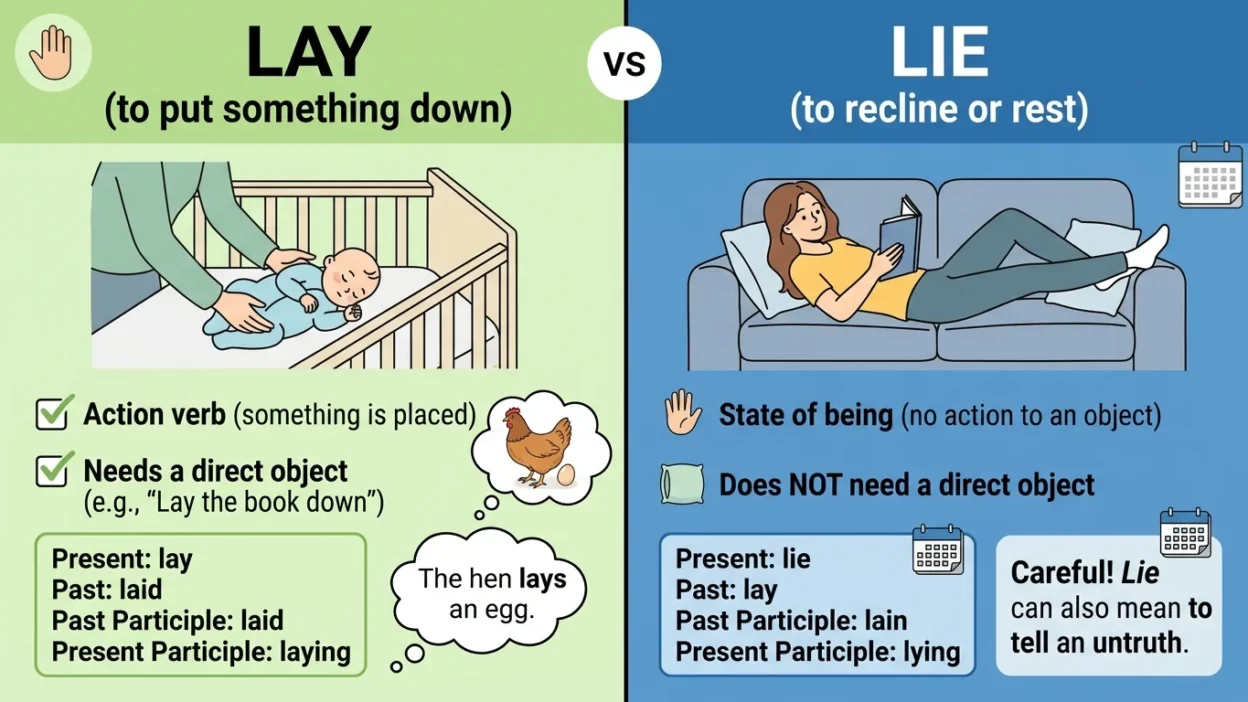
Use lay when you put something down.
It needs an object.
- I lay the book on the table.
- She laid the phone on the bed.
Ask yourself: Lay what?
Use lie when someone rests or reclines.
It does not need an object.
- I want to lie down.
- The cat is lying on the sofa.
Ask yourself: Who is resting?
Simple Memory Trick
- Lay = place something
- Lie = rest yourself
That is the main difference.
Simple Background of the Words
The confusion comes from old English verb forms.
Over time, the words changed like this:
| Present | Past | Past Participle |
| lay | laid | laid |
| lie | lay | lain |
Notice something strange?
The past tense of lie is lay.
That is why people become confused.
Example:
- Today: I lie down.
- Yesterday: I lay down.
Even though the word becomes lay, it still means “rested.”
The Real Difference Between Lay and Lie
1. “Lay” Means Put Something Down
You use lay when an object is involved.
Something is being placed somewhere.
Examples
- Please lay the keys on the desk.
- She lays the baby in the crib.
- He laid the papers on the table.
In all these examples, something is being moved.
Easy Question Test
Ask:
Lay what?
If you can answer that question, “lay” is probably correct.
Example:
- Lay what? → the keys
- Lay what? → the baby
- Lay what? → the papers
2. “Lie” Means Rest or Recline
You use lie when a person or animal rests.
No object is needed.
Examples
- I need to lie down.
- The dog is lying near the door.
- She lay on the couch yesterday.
Nobody is placing an object anywhere. Someone is simply resting.
Easy Question Test
Ask:
Who is resting?
If someone or something is resting, use “lie.”
Lay vs Lie Comparison Table
| Word | Meaning | Needs Object? | Example |
| lay | to put something down | Yes | Lay the bag here. |
| lie | to rest or recline | No | I want to lie down. |
| laid | past tense of lay | Yes | She laid the book there. |
| lay | past tense of lie | No | He lay on the bed yesterday. |
| lying | resting | No | The cat is lying outside. |
| laying | placing something | Yes | She is laying the plates out. |
Which One Should You Use?
Use “Lay” When Something Is Being Put Somewhere
Think about movement from one place to another.
Correct Examples
- Lay your jacket on the chair.
- The waiter laid the menu on the table.
- I am laying the clothes on the bed.
In each sentence, an object is being placed.
Use “Lie” When Someone Is Resting
Think about relaxing, sleeping, or staying in a position.
Correct Examples
- I want to lie down after work.
- The baby is lying peacefully.
- They lay on the beach all afternoon.
No object is involved.
Common Mistakes People Make
Mistake 1: “I’m going to lay down.”
Many people say this in casual English, but standard grammar says:
✅ Correct: I’m going to lie down.
Why?
Because you are resting yourself, not placing something.
Mistake 2: Confusing Past Tense Forms
Incorrect
- Yesterday I laid on the couch.
Correct
- Yesterday I lay on the couch.
Why?
Because “lay” is the past tense of “lie.”
Mistake 3: Forgetting the Object
Incorrect
- Please lay down.
Correct
- Please lie down.
“Lay” usually needs an object.
Correct use of “lay”:
- Please lay the blanket down.
Mistake 4: Using “Laying” Instead of “Lying”
Incorrect
- The dog is laying on the floor.
Correct
- The dog is lying on the floor.
The dog is resting, not placing something.
Everyday Real-Life Examples
In Daily Conversation
- I need to lie down for a few minutes.
- Please lay the groceries on the counter.
- The children lay in the grass yesterday.
In Text Messages
- “I’m just lying in bed watching videos.”
- “Can you lay my notebook on the desk?”
In Emails
- “Please lay the documents on my chair before lunch.”
- “I had to lie down because I felt tired.”
On Social Media
- “Just lying on the beach and relaxing.”
- “She laid all her makeup products out for the video.”
In News or Reports
- “The workers laid new pipes underground.”
- “The injured player lay on the field for several minutes.”
Easy Learning Tips for Students and Beginners
Tip 1: Remember This Short Rule
Lay = put
Lie = rest
This helps most learners immediately.
Tip 2: Check for an Object
Ask yourself:
- Is something being placed somewhere?
If yes → use lay.
Example:
- Lay the phone here.
If no → use lie.
Example:
- I want to lie down.
Tip 3: Practice the Verb Forms
Lay Forms
| Tense | Word |
| Present | lay |
| Past | laid |
| Past Participle | laid |
Example:
- Today I lay the book down.
- Yesterday I laid it there.
Lie Forms
| Tense | Word |
| Present | lie |
| Past | lay |
| Past Participle | lain |
Example:
- Today I lie down.
- Yesterday I lay down.
- I have lain here for hours.
Tip 4: Read Sentences Out Loud
Speaking the sentences helps your brain remember the correct pattern.
Practice:
- I lie down every afternoon.
- Yesterday I lay down early.
- Please lay the towel on the chair.
FAQ About Lay vs Lie
1. What is the main difference between lay and lie?
“Lay” means to put something down.
“Lie” means to rest or recline.
2. Does “lay” need an object?
Yes. Usually something must be placed somewhere.
Example:
- Lay the book on the table.
3. Does “lie” need an object?
No. It only describes resting.
Example:
- I want to lie down.
4. Why is this grammar rule confusing?
Because the past tense of “lie” is “lay,” which looks exactly like the present form of “lay.”
5. Is “I’m going to lay down” wrong?
In casual speech, many people say it.
In standard grammar, “I’m going to lie down” is correct.
6. What is the past tense of “lay”?
The past tense of “lay” is laid.
Example:
- She laid the keys on the table.
7. What is the past tense of “lie”?
The past tense of “lie” is lay.
Example:
- He lay on the couch yesterday.
8. What does “lying” mean?
“Lying” means resting or reclining.
Example:
- The cat is lying by the window.
Final Thoughts
The difference between lay and lie becomes much easier when you remember one simple idea:
- Lay = put something down
- Lie = rest yourself
If there is an object, use lay.
If someone is simply resting, use lie.
Do not worry if you still make mistakes at first. Even fluent English speakers sometimes confuse these words. With practice, the correct choice will start to feel natural.
A good final test is this:
- Can you ask “lay what?”
→ Use lay. - Is someone resting?
→ Use lie.
Once you use this trick a few times, the confusion usually disappears.