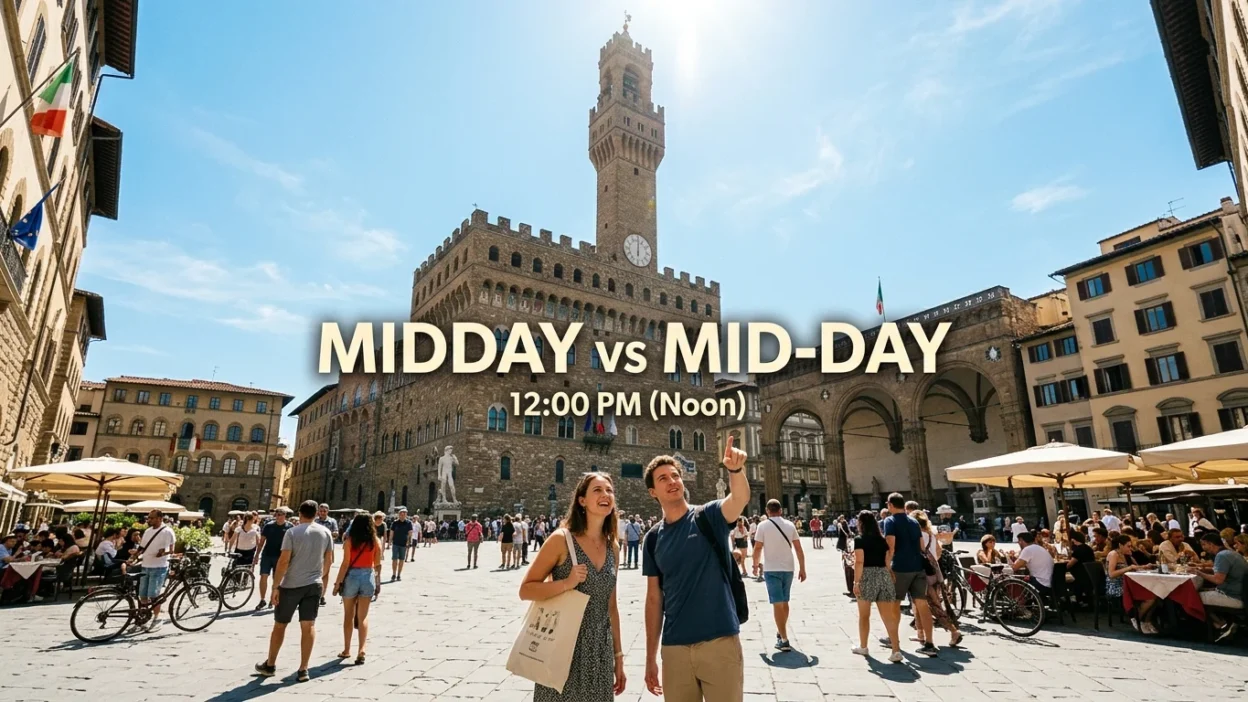
Many people get confused between midday and mid-day because both forms look very similar. You may see one spelling in a book and another spelling in a message, article, or social media post. This makes learners wonder which one is correct.
The good news is that both forms are connected to the same idea: the middle part of the day, around noon. However, one form is much more common in modern English today.
This guide explains everything in very simple English so students, ESL learners, and beginners can understand the difference easily.
Quick Answer
Here is the short and simple answer:
- Midday is the modern and most common spelling.
- Mid-day is an older hyphenated spelling.
- Both words mean around noon or the middle of the day.
- In most writing today, midday is the better choice.
- Use mid-day only if a style guide or publication prefers it.
Simple Example
- Correct modern form:
We will meet at midday. - Older form:
We will meet at mid-day.
Both sentences mean the same thing.
Where Did These Words Come From?
The word comes from two smaller words:
- mid = middle
- day = daytime
Long ago, English often used hyphens to join words together. Over time, many hyphenated words became one full word.
For example:
- today
- tonight
- midday
This is why mid-day slowly changed into midday in modern English.
English does this often. A word may start as:
- Two separate words
- A hyphenated word
- One complete word
So the change from mid-day to midday is normal in English history.
The Main Difference Between Midday and Mid-Day
The meaning is the same, but the spelling style is different.
Midday
- One word
- Modern spelling
- More common today
- Preferred in most dictionaries and writing
Mid-Day
- Hyphenated spelling
- Older style
- Less common now
- Sometimes used in older books or special writing styles
Important Point
There is no difference in meaning.
Both mean:
- noon
- lunchtime
- the middle part of the day
The only real difference is the writing style.
Comparison Table
| Feature | Midday | Mid-Day |
| Spelling Style | One word | Hyphenated |
| Meaning | Middle of the day | Middle of the day |
| Modern Usage | Very common | Less common |
| Preferred Today | Yes | Usually no |
| Found in Older Writing | Sometimes | Often |
| Easy for Students | Yes | Slightly less common |
| Best Choice for Most Writing | Yes | Only in special cases |
Which One Should You Use?
Use “Midday” Most of the Time
This is the safest and easiest choice for modern English.
Use it in:
- school writing
- emails
- articles
- social media
- messages
- daily conversation
Examples
- The meeting starts at midday.
- It became very hot by midday.
- We stopped for lunch at midday.
When Might “Mid-Day” Be Used?
You may still see mid-day in:
- older books
- newspapers with older style rules
- creative writing
- special brand names or titles
Even then, many writers still prefer midday.
Common Mistakes People Make
1. Thinking One Is Wrong
Many learners think one spelling must be incorrect.
That is not true.
Both are accepted, but midday is more modern.
2. Mixing Both Styles in One Piece of Writing
Choose one style and stay consistent.
Incorrect example:
- The event begins at midday.
- Lunch will be served at mid-day.
Better:
- The event begins at midday.
- Lunch will be served at midday.
3. Writing “Mid Day”
Some people separate the word completely.
Example:
- ❌ mid day
This form is usually avoided.
Better choices:
- ✅ midday
- ✅ mid-day
4. Using It as an Exact Time
Midday usually means around noon, not always exactly 12:00 PM.
Example:
- “Come by midday” may mean sometime around noon.
Everyday Real-Life Examples
Here are simple examples from daily life.
In Emails
- Please send the report by midday.
- The package should arrive before midday.
In News Writing
- Heavy traffic continued until midday.
- Rain is expected by midday tomorrow.
On Social Media
- Feeling sleepy already and it’s only midday.
- Midday coffee is saving me today.
In School
- Classes end at midday on Fridays.
- We have a short break at midday.
In Daily Conversation
- Let’s meet around midday.
- The sun is strongest near midday.
Midday as a Noun
Most of the time, midday works as a noun.
Examples
- Midday is the hottest part of the day.
- We arrived at midday.
It acts like words such as:
- morning
- evening
- night
Midday in Weather and Nature
You will often hear the word in weather reports.
Examples
- Temperatures will rise by midday.
- The sky cleared around midday.
- Midday heat can be very strong in summer.
This is because midday is usually when the sun is highest.
Easy Tips to Remember
Here are simple memory tricks.
Tip 1: Think of “Today”
Just like “today” became one word, “midday” also became one word.
Tip 2: Modern English Likes Shorter Forms
English often removes hyphens over time.
Examples:
- email instead of e-mail
- today instead of to-day
- midday instead of mid-day
Tip 3: If Unsure, Choose “Midday”
This is the safest modern choice.
Short Learning Section for Students and Beginners
Very Simple Rule
- Use midday in modern writing.
- Understand that mid-day is an older version.
Easy Sentence Practice
Fill in the blanks:
- We ate lunch at _______.
- The shop closes at _______.
- By _______, the streets were busy.
Answers:
- midday
- midday
- midday
Beginner Vocabulary
| Word | Meaning |
| Mid | Middle |
| Noon | 12:00 PM |
| Midday | Around noon |
| Hyphen | The “-” mark |
Frequently Asked Questions (FAQ)
1. Is midday one word or two?
It is usually written as one word today: midday.
2. Is mid-day wrong?
No. It is still acceptable, but it is older and less common.
3. Which spelling is more modern?
Midday is the modern spelling used most often today.
4. Do both words mean noon?
Yes. Both mean the middle part of the day, around noon.
5. Should students use midday or mid-day?
Students should usually use midday because it is simpler and more common.
6. Can I use midday in formal writing?
Yes. It is correct in both formal and informal writing.
7. Why do some old books use mid-day?
Older English writing often used more hyphens than modern English.
8. Is “mid day” correct with a space?
Usually no. The better forms are:
- midday
- mid-day
Final Conclusion
The difference between midday and mid-day is mainly about spelling style, not meaning. Both words refer to the middle part of the day around noon.
In modern English, midday is the preferred form because it is cleaner, simpler, and more common. The hyphenated form mid-day is older and appears less often today.
For students, ESL learners, and everyday writers, the easiest rule is simple:
- Use midday in most situations.
- Recognize mid-day as an older alternative spelling.
Once you remember that, the confusion becomes much easier to handle.