Many people mix up laying and lying because the words sound similar and both talk about resting or putting something down. Even native English speakers sometimes use the wrong one in daily conversation.
The confusion becomes bigger because the verb lie changes to lay in the past tense. That makes learners wonder:
- Is it “I am laying down”?
- Or “I am lying down”?
This guide explains everything in very simple English so you can finally understand the difference with confidence.
Quick Answer
Here is the easiest way to remember it:
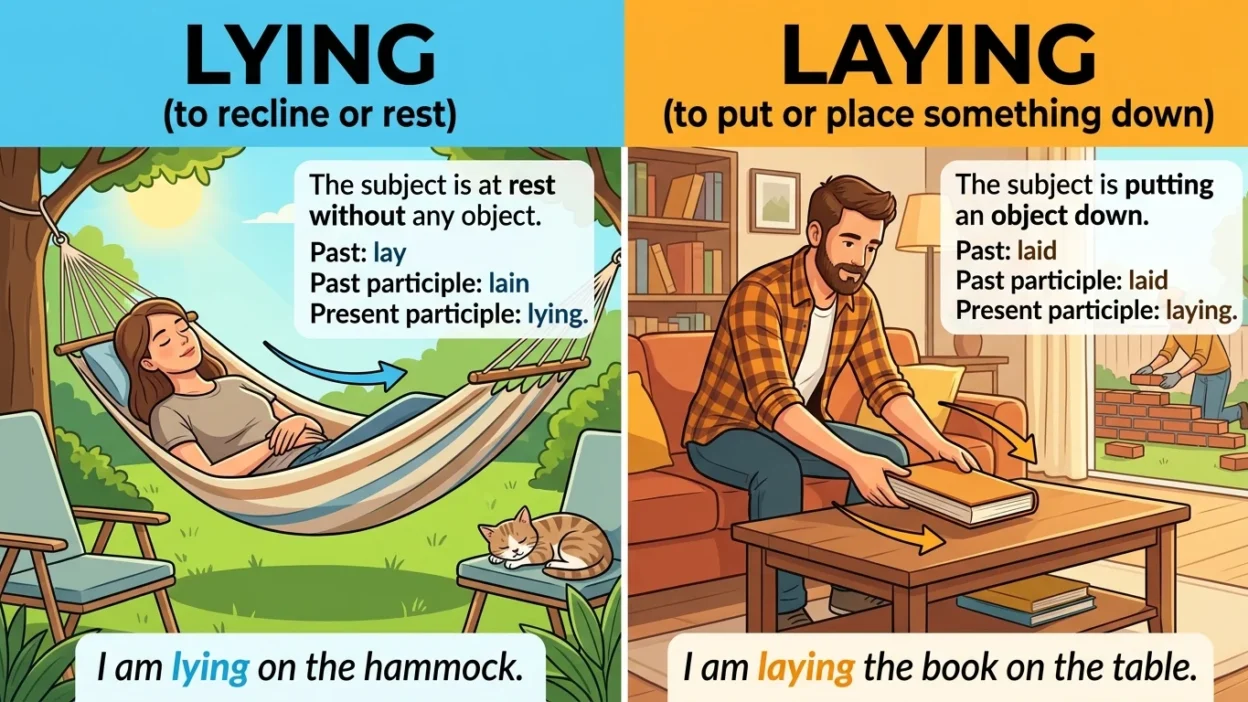
Use laying when:
- Someone puts something else down
- There is an object after the verb
Examples:
- She is laying the book on the table.
- The hen is laying eggs.
Use lying when:
- A person or thing is resting
- No object is needed
Examples:
- He is lying on the bed.
- The dog is lying on the floor.
Simple Memory Trick
- Lay = put
- Lie = rest
If you can replace the word with “put,” then “laying” is usually correct.
A Simple Background of the Words
The confusion comes from old English verb forms.
The verb lie means:
- to rest
- to recline
- to be in a flat position
But its past tense is lay.
Example:
- Today: I lie down.
- Yesterday: I lay down.
The verb lay means:
- to place something somewhere
Example:
- I lay the keys on the desk.
Because both words connect to “lay,” learners often mix them up.
What Does “Lying” Mean?
“Lying” comes from the verb lie.
It means:
- resting
- reclining
- staying in a flat position
No object is needed.
Examples
- The baby is lying in the crib.
- I am lying on the sofa.
- The phone is lying on the table.
- He was lying under the tree.
Notice that no one is placing another object anywhere.
The subject simply rests somewhere.
What Does “Laying” Mean?
“Laying” comes from the verb lay.
It means:
- putting something down
- placing something somewhere
An object is needed.
Examples
- She is laying the clothes on the bed.
- They are laying bricks for the wall.
- He is laying the phone on the desk.
- The waiter is laying plates on the table.
In every sentence, something is being placed somewhere.
Main Difference Between Laying and Lying
The biggest difference is this:
| Word | Meaning | Needs an Object? |
| Lying | Resting or reclining | No |
| Laying | Putting something down | Yes |
Easy Comparison Table
| Feature | Laying | Lying |
| Main meaning | Putting something down | Resting or reclining |
| Verb form | From “lay” | From “lie” |
| Needs object? | Yes | No |
| Example | She is laying the blanket down. | She is lying on the blanket. |
| Action type | Active placement | Resting position |
| Common use | Objects, eggs, materials | People, animals, objects resting |
Which One Should You Use?
Use “Lying” When Resting
Choose “lying” if:
- a person is resting
- an animal is relaxing
- something is already in a flat position
Examples
- My cat is lying near the window.
- He is lying on the couch after work.
- The shoes are lying under the bed.
Quick Test
Ask:
“Is someone resting?”
If yes, use lying.
Use “Laying” When Placing Something
Choose “laying” if:
- someone places an object somewhere
- something is being set down
Examples
- She is laying the baby in the crib.
- I am laying the papers on your desk.
- Workers are laying tiles in the kitchen.
Quick Test
Ask:
“What is being placed?”
If there is an object, use laying.
Common Mistakes People Make
Mistake 1: “I am laying on the bed.”
This is very common in speech, but grammar experts usually consider it incorrect.
Correct:
- I am lying on the bed.
Why?
Because no object is being placed anywhere.
Mistake 2: Forgetting the Object
Incorrect:
- She is laying down.
This sounds incomplete unless something is being laid down.
Better:
- She is lying down.
OR
- She is laying the bag down.
Mistake 3: Confusing Past Tense
This part confuses many learners.
| Present | Past |
| Lie | Lay |
| Lay | Laid |
Examples
- Today I lie down.
- Yesterday I lay down.
But:
- Today I lay the book down.
- Yesterday I laid the book down.
Everyday Real-Life Examples
At Home
- Dad is lying on the sofa.
- Mom is laying the dishes on the table.
At School
- The student is lying on the grass.
- The teacher is laying books on each desk.
On Social Media
- “I’m just lying in bed watching videos.”
- “She’s laying out her outfits for tomorrow.”
In News Reports
- “The dog was lying beside the road.”
- “Workers are laying new pipes downtown.”
In Text Messages
- “I’m lying down because I’m tired.”
- “I’m laying your package outside the door.”
Easy Sentence Practice
Choose the correct word:
- The baby is ___ in the crib.
- She is ___ the keys on the counter.
- The cat is ___ near the fireplace.
- They are ___ carpet in the office.
Answers
- lying
- laying
- lying
- laying
Short Learning Section for Students and Beginners
Here is a simple learning method that works well.
Step 1: Look for an Object
Ask:
“What is being placed?”
If you see an object:
- use laying
Example:
- laying the towel
- laying the phone
- laying the books
Step 2: Check for Resting
Ask:
“Is someone simply resting?”
If yes:
- use lying
Example:
- lying on the bed
- lying on the floor
- lying under a tree
Step 3: Use the “Put” Trick
Replace the word with “put.”
If the sentence still makes sense:
- use laying
Example:
- She is laying the bag down.
- She is putting the bag down.
Works perfectly.
But:
- He is putting on the couch.
That sounds wrong, so use:
- He is lying on the couch.
Mini Grammar Guide
Forms of “Lie”
| Tense | Form |
| Present | lie |
| Present participle | lying |
| Past | lay |
| Past participle | lain |
Example
- I lie down every afternoon.
- I am lying down now.
- Yesterday I lay down early.
- I have lain here for hours.
Forms of “Lay”
| Tense | Form |
| Present | lay |
| Present participle | laying |
| Past | laid |
| Past participle | laid |
Example
- I lay the book here.
- I am laying the book here.
- Yesterday I laid the book here.
- I have laid the book here before.
FAQ About Laying vs Lying
1. Is “laying in bed” wrong?
Usually, yes.
The correct form is:
- lying in bed
Because no object is being placed anywhere.
2. Why do people still say “laying in bed”?
Many native speakers use it casually in conversation. It is common in informal speech, but traditional grammar rules prefer “lying.”
3. What is the easiest way to remember the difference?
Remember:
- lay = put
- lie = rest
4. Is “the chicken is laying eggs” correct?
Yes.
Eggs are the object being produced or placed.
5. Can objects be “lying” too?
Yes.
Examples:
- The keys are lying on the table.
- The papers are lying on the floor.
6. What is the past tense of “lie”?
The past tense is:
- lay
Example:
- Yesterday I lay on the couch all day.
7. What is the past tense of “lay”?
The past tense is:
- laid
Example:
- She laid the phone on the desk.
8. Which word is more common in daily English?
Both are common, but “lying” is often used more because people frequently talk about resting, sleeping, or relaxing.
Final Thoughts
The difference between laying and lying becomes much easier once you focus on one important rule:
- Laying needs an object.
- Lying does not.
If someone places something somewhere, use laying.
If someone is resting or already in a flat position, use lying.
With a little practice, the confusion disappears quickly. The next time you hear these words in conversation, movies, school, or social media, you will understand exactly which one is correct and why.